

Imagine walking into a Catholic church, entering a confessional and finding Jesus waiting for you on the other side of the screen.
Not a priest. Not an actor. An artificial intelligence version of Jesus Christ, capable of listening to your questions and responding almost instantly.
It sounds like something from science fiction, but a Catholic church in Switzerland actually tried it.
The experimental installation, called “Deus in Machina,” placed an AI-generated Jesus avatar inside a confessional at St. Peter’s Chapel in Lucerne. Visitors could sit down, speak to the digital Jesus and receive responses generated with the help of artificial intelligence.
The project immediately raised a much bigger question.
If AI can imitate a spiritual conversation convincingly enough, could it eventually take the place of a priest?
For the Catholic Church, the answer is much more complicated than what technology can technically accomplish.
Meet AI Jesus
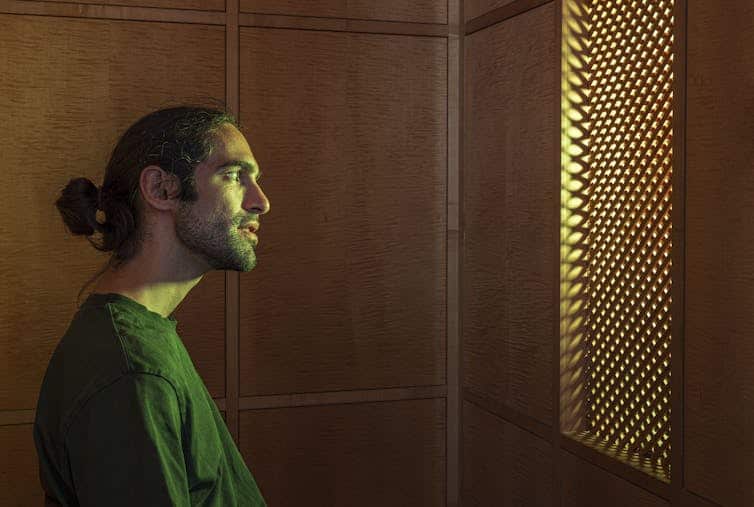
The two-month project was created in collaboration with researchers from the University of Lucerne and Lucerne University of Applied Sciences and Arts.
Visitors encountered a digital representation of Jesus on a screen behind the traditional latticework of a confessional. The AI system had access to theological material and could converse with visitors in multiple languages.
People were explicitly warned that they were talking to an avatar and were advised not to disclose personal information.
Despite the confessional setting, however, the installation wasn’t actually designed to hear sacramental confessions.
That distinction is important.
A person could tell AI Jesus what was troubling them. They could ask about faith, morality, suffering, relationships or the meaning of life.
What the AI couldn’t do was forgive their sins.
Why a chatbot can’t replace a priest
To someone outside Catholicism, the difference might sound technical.
If a person confesses wrongdoing, receives spiritual advice and walks away feeling comforted, does it really matter whether the listener was human?
Within Catholic theology, it matters enormously.
Confession isn’t simply a private conversation in which someone admits what they’ve done wrong. It is one of the church’s sacraments, formally known as the sacrament of penance and reconciliation.
A Catholic priest isn’t merely listening and offering advice. He is acting in a specific sacramental role when he grants absolution.
An AI system can’t be ordained. It therefore cannot administer the sacrament.
That puts a hard theological limit on something technology otherwise seems increasingly capable of imitating.
AI may be able to sound compassionate. It may quote Scripture. It may explain Catholic teaching. It may even provide an answer that feels deeply personal.
But sounding like a spiritual adviser isn’t the same thing as being one.
Confession has always depended on another human being
The human element isn’t an accidental feature of Catholic confession. It goes back to Christianity’s earliest traditions.
The New Testament repeatedly places confession and forgiveness within a human community.
In the Gospel of John, Jesus gives his apostles authority connected with the forgiveness of sins. The Epistle of James similarly tells believers to confess their sins to one another.
Early Christian confession could actually be much more public than it is today.
Christians accused of serious sins might perform public acts of penance before being formally reconciled with the church. Over centuries, the practice evolved toward the private, one-on-one confession Catholics recognize today.
By the Middle Ages, private confession to a priest had become increasingly formalized. In 1215, church rules required Catholics to confess at least once a year.
The familiar wooden confessional arrived later.
Save this article
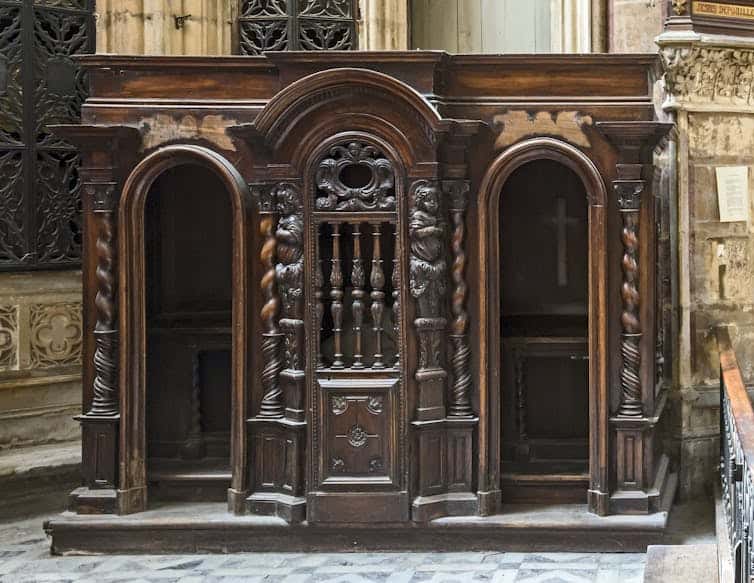
Following the Council of Trent in the 16th century, confessionals with physical barriers between priests and penitents became increasingly common, providing privacy and anonymity.
Ironically, that screen may be part of what makes an AI confessional seem strangely plausible today.
Catholics have spent centuries speaking about their most private failures to someone they may barely be able to see.
Replace the priest behind the screen with a computer, however, and the theological meaning changes completely.
AI could still find a place in religion
None of this necessarily means artificial intelligence has no role in religious life.
An AI trained on reliable theological sources could answer basic questions at any hour. It could explain Scripture, define unfamiliar religious terms or help someone understand what a church teaches about a particular issue.
It might even provide a low-pressure way for people who are embarrassed, curious or disconnected from organized religion to begin asking questions they would otherwise keep to themselves.
There is also something revealing about the appeal.
Talking to another person can be uncomfortable, particularly when the subject involves guilt, shame or doubt. A machine doesn’t look shocked. It doesn’t interrupt. It doesn’t gossip. It doesn’t visibly judge you.
For some people, that may make AI unusually easy to talk to.
But that advantage also exposes the central problem.
Is spiritual comfort the same without another person?
As artificial intelligence becomes more conversational, the question extends far beyond Catholic confession.
People are already turning to AI for advice about relationships, grief, anxiety, morality and some of the most personal decisions of their lives.
Religion may be one of the clearest tests yet of where society draws the line between simulated human understanding and actual human connection.
A chatbot can generate words of reassurance without feeling compassion. It can discuss grief without having experienced loss. It can talk about mortality without facing death.
And an AI Jesus can discuss forgiveness without possessing the religious authority Catholics believe is necessary to grant it.
That doesn’t necessarily make the conversation meaningless. Someone may still find insight, comfort or even inspiration in what an AI tells them.
But within Catholicism, a sacrament is not simply an exchange of information.
It requires another human being.
The technology may change. The theological line may not
AI will almost certainly become better at mimicking the kinds of conversations people once assumed required another person.
Future religious chatbots could know enormous amounts of Scripture and theology, remember previous conversations and respond in ways tailored to an individual’s spiritual concerns.
They may become extraordinarily convincing.
But Catholic teaching presents technology with an unusual boundary: There are some things a machine cannot accomplish simply by becoming more intelligent.
AI Jesus might answer your questions.
It might offer advice.
It might even say exactly what you desperately needed to hear.
But if you’re looking for absolution, you’ll still need a priest.





