

Disney and ABC are no longer looking for a middle ground. On Tuesday, the entertainment company, its news division, and eight ABC-owned local television stations filed a federal lawsuit against the Federal Communications Commission, asking a court to stop what they describe as an unprecedented and unconstitutional attack on free speech.
The suit names FCC Chair Brendan Carr as a defendant and seeks immediate relief, including a temporary restraining order blocking an accelerated license renewal process the agency launched in April. Disney has called that process an “existential threat” to its stations and says the broader regulatory push amounts to retaliation over ABC’s programming and political commentary.
What began as a compliance fight over diversity practices has now become a much bigger constitutional showdown.
And sitting awkwardly in the middle are Jimmy Kimmel, The View, President Trump’s public complaints about ABC, and a licensing process that normally would not have started for years.
A Licensing Order That Rarely Happens
The FCC’s April order was unusual enough that former agency officials from both parties called it alarming before a single lawsuit was filed.
The order required eight Disney-owned ABC stations to submit broadcast license renewal applications within 30 days. Ordinarily, none of those licenses would have been up for renewal until at least October 2028, and some would not have faced renewal until 2031.
Disney argues that the compressed timetable is part of the punishment. Preparing applications that normally take months suddenly became a one-month exercise, years before the stations expected to go through the process. The FCC has not launched an early license review like this in more than 50 years. The affected stations serve Los Angeles, New York, Chicago, San Francisco, Philadelphia, Houston, Fresno and Durham, North Carolina.
Disney complied, but hardly quietly. It filed the applications under protest on May 28, calling the order “unlawful, arbitrary, and unconstitutional.” In July, former FCC commissioners who served under both Republican and Democratic administrations urged the agency to withdraw the effort, warning that the process risked becoming leverage over ABC’s editorial choices.
The Timing That Turned a Compliance Fight Into a First Amendment Case
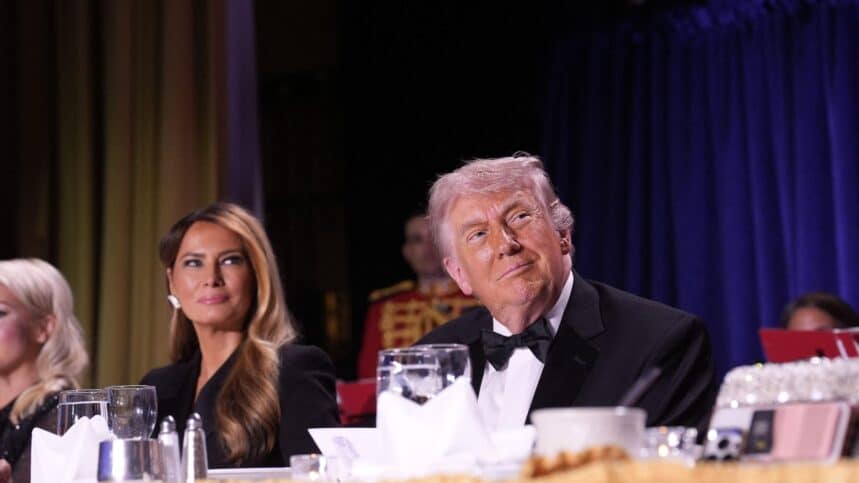
The early renewal order landed exactly one day after President Trump and Melania Trump publicly called for ABC to fire Jimmy Kimmel.
Kimmel had joked on his late-night show that the first lady glowed “like an expectant widow.” The remark drew swift backlash, and Trump responded on social media by demanding that ABC fire him. On April 28, one day later, the FCC issued the early-renewal order.
Disney’s lawsuit places that sequence near the heart of its retaliation argument. It also points to Trump’s broader complaints about late-night television, including his claim that hosts were negative toward him and his public question about whether broadcast licenses should “be terminated.” His own answer was blunt: “I say, Yes!”
The timing gives Disney a striking narrative. It does not, by itself, prove why the FCC acted. Carr also rejected any suggestion that Kimmel’s joke or political pressure drove the decision.
What Disney Is Actually Claiming
The lawsuit does not mince words: it accuses the Trump administration of running an ongoing “retaliatory campaign” against ABC.
Its opening line sets the tone immediately: “Government censorship is profoundly un-American.”
According to Reazon, Disney argues that the administration has used the FCC to punish ABC for content it dislikes, describing a campaign that “began in this Administration’s earliest days and has only intensified since.” The complaint goes further by identifying what Disney believes is the motive: “Acting through the Federal Communications Commission, the Administration has waged a retaliatory campaign against ABC for a single reason: it disapproves of what ABC broadcasts.”
The company also argues that the early renewal order has “no legitimate purpose,” saying the FCC already has other ways to obtain whatever information it needs.
Save this article
Now Disney wants the court to move quickly. Along with the broader lawsuit, it is seeking a temporary restraining order that would stop the FCC from advancing or threatening action tied to the early renewal applications while the case is being litigated.
The FCC’s Counter: Public Airwaves Come With Obligations
Carr’s position has remained consistent throughout: use public airwaves, accept public responsibilities.
The dispute did not begin with Kimmel. The FCC reportedly opened an investigation into Disney in March 2025 over whether the company’s diversity, equity, and inclusion policies could violate the Communications Act of 1934 and agency rules prohibiting unlawful discrimination. Disney denied that allegation.
Carr says the accelerated renewal process grew out of that investigation. According to his explanation, Disney’s document production was considered insufficient and nonresponsive, prompting the agency to escalate.
His response to the broader First Amendment argument has been equally direct. “If broadcasters don’t like that, that’s okay. They can become a cable channel, they can become a podcast, they can stream online. But if you want to uniquely be on the public’s airwaves, you have to comply with those obligations.”
According to the Guardian, after Disney submitted the applications, the FCC opened a public comment period in June. Members of the public could petition against the renewals, and Disney could respond.
The Question a Court Now Has to Answer
This case is formally about license paperwork. The underlying argument is whether a federal regulator can use licensing pressure to shape what a broadcaster puts on air.
Broadcast licenses are both valuable and difficult to replace. Actual revocations are uncommon, but an accelerated renewal process can still impose cost, uncertainty, and pressure on stations that depend on access to the public airwaves. Former FCC officials captured that concern sharply when they described the Disney review as “an assault on free speech disguised as regulatory process.”
That bipartisan criticism helps explain why this dispute has moved far beyond paperwork.
The immediate issue is whether the court will give Disney and ABC emergency relief before the FCC process moves further. Because the agency itself imposed an accelerated timetable, that decision could come relatively quickly.
The deeper fight will take longer: whether the government used regulatory power to punish a broadcaster over what appeared on its air.
What started with diversity policy documents has now pulled in a late-night joke, a daytime talk show, presidential social media posts and decades-old FCC rules. The result is a First Amendment battle with stakes that extend well beyond ABC.
If a broadcaster’s comedy or political commentary can trigger federal licensing scrutiny, how do you think that would change what networks are willing to put on air?
Related Articles:
- ABC Pushes Back Against FCC Investigation Into ‘The View,’ Calling It a First Amendment Fight
- Supreme Court Rejects Trump’s Final Bid to Overturn E. Jean Carroll Sexual Abuse Verdict
- ABC Takes On the FCC as “The View” Becomes the Center of America’s Free Speech Battle
- Judge Indira Talwani Blocks Trump’s USPS Ballot Plan as Election Officials Face a Race Against Time





