

A billionaire sat down on a podcast last week and explained his management philosophy. Put a camera on the work-from-home crowd, watch them, measure the keystrokes. The first week he tried it, he says, 23 people quit. To him, that settled something: they never wanted to work in the first place.
Then the clip got out, and a few million people saw something else.
The video the numbers came from
Billionaire John Morgan reveals 23 employees quit the first week he put cameras on work from home computers…
“We’re going to put a camera on your computer… We’re going to put a camera up your a**… The first week, 23 people quit. It’s not that they don’t want to work from… pic.twitter.com/tyc3j7l6R0
— The Iced Coffee Hour (@TheICHpodcast) August 28, 2026
The man in the chair is John Morgan, founder of Morgan & Morgan, the “For the People” personal injury firm whose ads run on roughly every bus bench in America. He started the firm in 1988 and built it into an operation with more than 1,000 attorneys and about 6,000 employees across all 50 states, generating more than two billion dollars in annual revenue. Forbes counts him among the world’s billionaires. Morgan credits luck with much of his success.
The policy he described on The Iced Coffee Hour was not hypothetical. Morgan said remote employees who qualified to work from home could expect a camera on their computer. A camera, as he put it, up your a*s.
He said nobody would actually be sitting there watching them, that each worker would amount to a pixel on a screen somewhere. The firm measures keystrokes, he said, and uses a productivity score he called incredible.
That was the deal: work from home, but under a level of monitoring Morgan considered necessary to make sure the work was actually getting done.
Where it stopped being his story
The clip has cleared six million views, and plenty of people rejected that conclusion.
Save this article
“If you can’t tell if people are getting their work done without a camera constantly being on them,” wrote a user posting as Miss Sandrist, “maybe you’re not qualified to be anyone’s boss.”
A manager replying under the clip said he oversees four employees who work at least half the time from home and rarely needs to check in on them. He knows they are working because, as he put it, “the work gets done.” Micromanaging, he added, is a disease of the ego.
Morgan had offered the resignations as evidence about the people who left. A lot of viewers were more interested in what the policy said about the people running the workplace.
The part he didn’t plan on
This was not the first time Morgan had told the story.
Back in July, on another podcast, he described the same cameras, the same keystroke tracking and the same resistance from remote workers. He also cast the people who quit as workers unwilling to be held accountable.
So this was not one stray line from a long interview. It was a management philosophy Morgan had already explained publicly before.
That also makes the resignations harder to treat as self-explanatory. Morgan sees them as proof that the workers were lazy. The people reacting to the clip saw employees walking away from a surveillance policy they did not want to accept.
The same 23 departures were doing very different work depending on who was telling the story.
So who wasn’t working
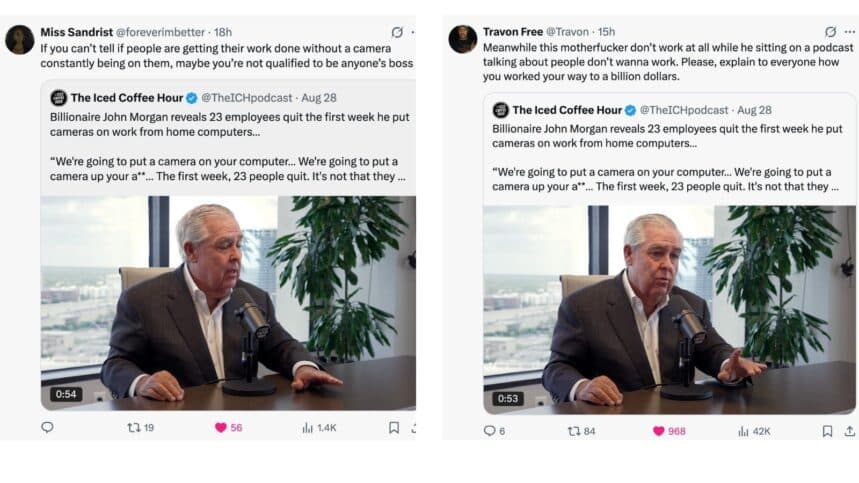
One of the responses that traveled furthest never touched the surveillance argument at all. It just noticed the setting. “Meanwhile this motherf***er don’t work at all while he sitting on a podcast talking about people don’t wanna work,” wrote the comedy writer Travon Free, before asking Morgan to explain exactly how he worked his way to a billion dollars.
That was the reply that stuck. Morgan put a camera on 23 people to find out who was really working. Six million views later, the only person still being asked that question was the one the camera was never pointed at.





