

GLP-1 medications can transform diabetes and weight management, but for people with irritable bowel syndrome (IBS), their effects on digestion raise a complicated question: Will they help, hurt, or simply change an already sensitive gut?
If you already live with IBS, starting a GLP-1 medication can raise an obvious concern: What happens when a drug known for digestive side effects meets a gut that’s already unpredictable?
Medications such as Ozempic, Wegovy and Zepbound can cause nausea, constipation, diarrhea, abdominal discomfort and changes in digestion—the same territory familiar to many people with IBS. But that doesn’t mean having IBS automatically makes GLP-1 therapy a bad idea. The relationship is considerably more complicated.
GLP-1 signaling affects how food moves through the digestive tract and interacts with the gut-brain system.Intriguingly, researchers have even studied a specific investigational GLP-1 analog for IBS pain. That research doesn’t mean Ozempic, Wegovy or Zepbound treats IBS, but it does help illustrate why the effects of these medications on an individual person’s symptoms aren’t always easy to predict.
Your IBS subtype may matter, too. Someone prone to constipation may face different challenges from someone with diarrhea-predominant or mixed IBS. And when symptoms change after starting treatment, it can be surprisingly difficult to determine whether the culprit is IBS, the medication, diet—or several factors at once.
So, can you take a GLP-1 if you have IBS? Here’s what the research says, what symptoms deserve particular attention, and how to protect your nutrition while giving treatment the best chance of working for you.
- What Are these Drugs Going to do to My Gut?
- First, What Are GLP-1 Drugs?
- IBS Is Already a Disorder of Gut-Brain Interaction
- The Big Issue: GLP-1 Side Effects Look A Lot Like IBS
- GLP-1 Medications Can Slow Digestion
- Here's Where The Story Gets Really Interesting: GLP-1 Has Actually Been Studied For IBS
- Ozempic, Wegovy and Zepbound Are NOT IBS Treatments
- Where Does The Low FODMAP Diet Fit In?
- Eating Enough Still Matters
- Don't Make Five Changes At Once
- When "My IBS Is Acting Up" May Not Be IBS
- Talk To The Person Prescribing Your GLP-1 About Your IBS
- So, Can You Take A GLP-1 If You Have IBS?
- The FODMAP Everyday® Takeaway
- Sources & References
What Are these Drugs Going to do to My Gut?

It is an important question because some of the most common gastrointestinal effects associated with GLP-1 medications — nausea, constipation, diarrhea, abdominal discomfort, bloating and changes in digestion — overlap considerably with symptoms people with IBS already manage.
At the same time, the relationship between GLP-1 and IBS is more complicated than simply saying these medications are “bad for IBS.” GLP-1 itself plays a role in gastrointestinal motility and gut-brain signaling, and researchers have even investigated a GLP-1 analog specifically for the treatment of IBS pain.
So, can someone with IBS take a GLP-1 medication? Could it make IBS worse? Could some symptoms actually improve? And where does the low FODMAP diet fit into the picture?
Here’s what we know.
GLP-1 can slow gastric emptying and influence gastrointestinal motility. Research in both healthy individuals and people with IBS has demonstrated effects on the motor activity of the stomach and small intestine. That can have noticeable consequences when your digestive system is already sensitive.
First, What Are GLP-1 Drugs?
GLP-1 stands for glucagon-like peptide-1, a hormone naturally produced in the gastrointestinal tract after eating.
Among its many functions, GLP-1 helps regulate blood glucose, promotes feelings of fullness and influences how quickly food moves through the digestive system.
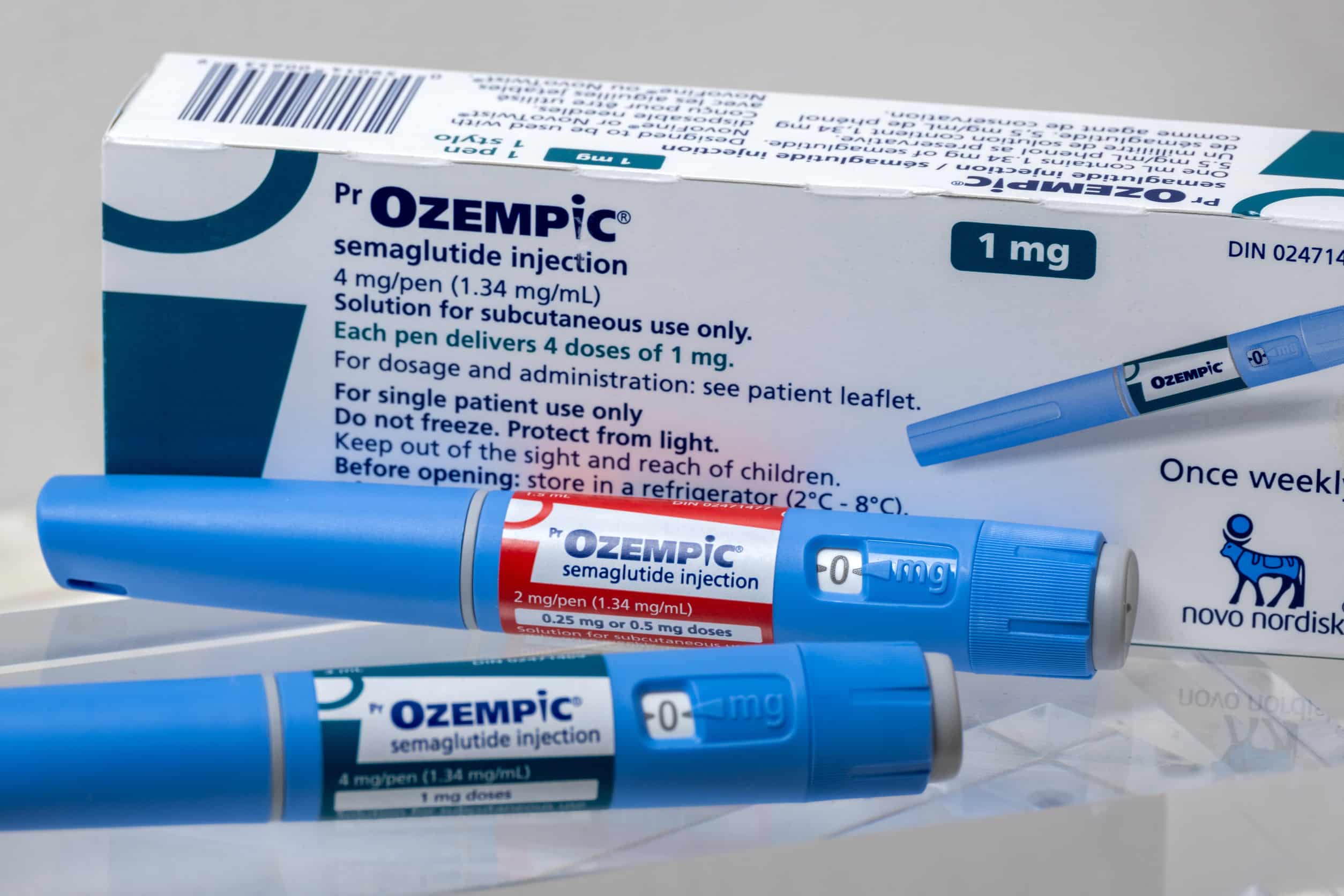
GLP-1 receptor agonist medications mimic some of the actions of naturally occurring GLP-1. Semaglutide is the active drug in Ozempic and Wegovy, for example. Tirzepatide, sold as Mounjaro and Zepbound, works on both GLP-1 and GIP (glucose-dependent insulinotropic polypeptide) receptors.
These medications were initially developed within diabetes care, while several are now also approved for chronic weight management and other indications.
One of the reasons they are so effective is also particularly relevant to people with digestive disorders:
GLP-1 signaling changes gastrointestinal function
GLP-1 can slow gastric emptying and influence gastrointestinal motility. Research in both healthy individuals and people with IBS has demonstrated effects on the motor activity of the stomach and small intestine. That can have noticeable consequences when your digestive system is already sensitive.
IBS Is Already a Disorder of Gut-Brain Interaction
IBS is classified as a Disorder of Gut-Brain Interaction (DGBI). People with IBS experience recurring abdominal pain associated with changes in bowel movements, which may include constipation, diarrhea or both.
Other common symptoms include bloating, urgency, incomplete evacuation and changes in stool frequency and consistency.
Depending on bowel patterns, IBS is generally categorized as:
- IBS-C: constipation predominant
- IBS-D: diarrhea predominant
- IBS-M: mixed constipation and diarrhea
- IBS-U: unsubtyped
This distinction could become particularly important when considering a medication that can alter motility.
Someone with IBS-C does not necessarily have the same concerns as someone who struggles primarily with diarrhea. And a person whose IBS is well controlled before beginning a GLP-1 may have a different experience from someone already experiencing significant symptoms.
The Big Issue: GLP-1 Side Effects Look A Lot Like IBS
The gastrointestinal effects of GLP-1 medications are well established.
Nausea is among the most commonly reported, but diarrhea, vomiting, constipation, abdominal pain, abdominal distension, indigestion, gas and reflux can also occur.
For example, FDA prescribing information for Wegovy lists gastrointestinal reactions including nausea, diarrhea, vomiting, constipation, abdominal pain and abdominal distension, among others. GI reactions have been particularly common during dose escalation.
Similarly, in clinical trials of Zepbound, gastrointestinal adverse reactions occurred in 56% of participants taking the medication at the studied 5 mg, 10 mg and 15 mg doses, compared with 30% receiving placebo. Most nausea, vomiting and diarrhea occurred during dose escalation and decreased over time.
This doesn’t mean that everyone taking these medications develops significant digestive problems. Many people tolerate them well, and GI symptoms often become less troublesome as treatment continues.
But for someone with IBS, there is an additional challenge.
Is that diarrhea your IBS, your medication, something you ate — or some combination of all three?
That can be surprisingly difficult to determine.
GLP-1 Medications Can Slow Digestion
One of the best-known gastrointestinal effects of GLP-1 receptor agonists is delayed gastric emptying.
In simple terms, food can remain in the stomach longer before moving into the small intestine.
A systematic review and meta-analysis evaluating gastric emptying found measurable delays associated with GLP-1 receptor agonists, although the magnitude and clinical importance can vary considerably among individuals and medications.
GLP-1 signaling also affects motility beyond the stomach. In a study involving both healthy people and individuals with IBS, GLP-1 reduced gastrointestinal motility and inhibited the migrating motor complex, a pattern of electrical and muscular activity that helps move material through the gastrointestinal tract between meals.
For some people this altered motility may manifest as fullness, nausea or constipation.
For a person with IBS-C who already struggles with slow or difficult bowel movements, that possibility deserves particular attention.
But — and this is important — the physiology is not as simple as “GLP-1 slows everything down.”
Here’s Where The Story Gets Really Interesting: GLP-1 Has Actually Been Studied For IBS
You may be surprised to learn that researchers have investigated GLP-1 pathways specifically in IBS.
An investigational GLP-1 analog called ROSE-010 has been studied as a potential treatment for IBS pain.
A 2025 systematic review and meta-analysis found that ROSE-010 produced significantly greater IBS pain relief than placebo in the clinical trials evaluated. The researchers also reported more nausea, vomiting and headache among those receiving the drug.
Earlier clinical research involving 166 participants found that pain relief appeared greatest among people with IBS-C and IBS-M, with women showing greater responses than men in that analysis. Higher doses produced greater pain relief but also more nausea.
Another study examined ROSE-010 specifically in women with IBS-C. It delayed gastric emptying, yet it did not slow colonic transit at 24 hours. Interestingly, lower doses accelerated colonic transit at 48 hours in that study.
There is even research suggesting that people with IBS-C may have differences in endogenous GLP-1 signaling. One study found lower serum GLP-1 levels in people with IBS-C, with lower levels correlating with greater abdominal pain. Researchers also reported reduced GLP-1 receptor expression in colonic tissue.
This is fascinating research, but it requires an enormous caveat.
Ozempic, Wegovy and Zepbound Are NOT IBS Treatments
The ROSE-010 studies do not demonstrate that taking semaglutide or tirzepatide will treat IBS.
ROSE-010 is a specific investigational GLP-1 analog studied under particular dosing conditions for acute IBS pain. Those findings cannot simply be transferred to medications such as semaglutide or tirzepatide, which have different pharmacologic characteristics, dosing schedules and approved uses.
In other words: Research showing that GLP-1 receptors may be therapeutically relevant to IBS is not evidence that your weight-loss or diabetes medication will improve your IBS.
At present, GLP-1 medications such as semaglutide and tirzepatide should not be started for the purpose of treating IBS.
But the research does demonstrate something useful: the relationship between GLP-1 and bowel function is complex. It helps explain why predicting exactly how an individual person’s IBS will respond to one of these medications can be difficult.
If You Have IBS-C
Constipation deserves particular attention.
GLP-1 medications can cause constipation, and reduced food intake can compound the problem. When people eat dramatically less food, they may also consume less fluid and less fiber and simply produce less stool.
If you already have IBS-C, don’t wait until constipation becomes severe before discussing it with your healthcare team.
This is also where generic Internet advice can get people with IBS into trouble.
You may be told to “just eat more fiber.”
But anyone familiar with IBS knows that more fiber is not always better. The type, amount and rate at which fiber is increased matter. Suddenly loading your diet with large quantities of certain high-fiber foods can increase gas, distension and pain.
Your constipation strategy needs to account for both the medication and your IBS.
If You Have IBS-D
It might seem logical to assume that a medication that slows gastric emptying would automatically improve diarrhea. Unfortunately, it isn’t that straightforward.
Diarrhea itself is a commonly reported adverse effect of GLP-1 therapy.
That means someone with IBS-D could potentially experience worsening diarrhea, particularly during initiation or dose escalation, even though other aspects of gastrointestinal motility are being slowed.
Persistent diarrhea also raises another concern: hydration.
Significant vomiting or diarrhea can lead to dehydration, and dehydration associated with gastrointestinal reactions has been linked to acute kidney injury in people using GLP-1 medications. The current Wegovy prescribing information specifically addresses this risk.
If you have IBS-D and already experience frequent loose stools, your prescriber should know what your normal baseline looks like before you begin treatment.
If You Have IBS-M
IBS-M can be particularly confusing because bowel patterns already fluctuate between constipation and diarrhea.
Add a medication capable of producing either symptom and it may become difficult to recognize what is driving a flare.
This is one situation where keeping a simple symptom record before and after beginning medication can be very useful.
Record bowel frequency and consistency, abdominal pain, bloating, nausea, appetite, medication dose and major dietary changes.
Save this article
You do not need to obsessively document every bite of food. The goal is simply to establish patterns.
Starting Low And Going Slowly Matters
GI symptoms are especially common when GLP-1 medications are initiated or the dose is increased.
This is why these drugs are typically titrated rather than started immediately at their maintenance dose.
Expert recommendations for managing GLP-1 gastrointestinal side effects emphasize gradual dose escalation and individualized management when symptoms develop. In some circumstances, clinicians may delay an increase, remain at a lower dose longer or otherwise modify the treatment plan rather than automatically proceeding with escalation.
Do not change your dose on your own.
If your IBS symptoms substantially worsen after starting or increasing a GLP-1 medication, tell the clinician prescribing it.
Where Does The Low FODMAP Diet Fit In?

This is where we want people with IBS to be particularly thoughtful.
A GLP-1 medication does not suddenly make FODMAPs harmful, nor does taking a GLP-1 automatically mean that you need to begin the low FODMAP diet.
And if you are already following a personalized low FODMAP diet, you should not assume that every new gastrointestinal symptom means you have suddenly become intolerant of additional foods. The medication itself may be affecting your digestion. This matters because the instinct when symptoms worsen is often to remove more and more foods.
First dairy disappears. Then fruit. Then grains. Then legumes. Before long, someone who is already eating less because of reduced appetite is consuming an unnecessarily restricted diet. That is exactly what we don’t want.
GLP-1 medications can substantially decrease appetite and food intake. A 2025 joint advisory from four major nutrition and obesity organizations emphasized the importance of nutritional assessment and support during GLP-1 therapy, including preventing nutrient inadequacies and preserving muscle and bone mass.
For someone simultaneously managing IBS, this becomes even more important. The goal should be the least restrictive diet that adequately controls symptoms while meeting nutritional needs.
Don’t Automatically Blame FODMAPs
Suppose you have been successfully eating a particular low FODMAP breakfast for months. You start a GLP-1 medication and suddenly feel nauseated and uncomfortably full after breakfast.
Your first assumption might be:
“Something in my breakfast is triggering my IBS.”
Maybe.
But the meal hasn’t changed. Your gastrointestinal physiology has. Slower gastric emptying and increased satiety can make a portion that previously felt perfectly comfortable suddenly feel too large.
The solution might not be eliminating another ingredient. It might involve meal size, meal composition, timing or medication management.
This is why working with a registered dietitian knowledgeable about both IBS and GLP-1 therapy can be especially valuable.
Eating Enough Still Matters
Reduced appetite is part of how these medications work, but losing interest in food does not eliminate your body’s nutritional requirements.
The 2025 multi-organization GLP-1 nutrition advisory highlights several concerns during treatment, including inadequate nutrient intake and loss of muscle and bone mass, and emphasizes appropriate nutrition and resistance exercise as part of comprehensive care.
For people with IBS, the challenge can be greater because many are already avoiding certain foods.
You may therefore need to be particularly intentional about:
- Protein
- Adequate calories
- Fluids
- Fiber appropriate for your IBS subtype and tolerance
- Calcium and vitamin D
- Fruits and vegetables you tolerate
- Nutrient density when portions become smaller
Think nutrition first, rather than simply “eat as little as possible.”
Smaller Meals May Feel Better
When gastric emptying is slowed and appetite is suppressed, a meal size that previously felt normal may suddenly cause uncomfortable fullness.
Expert guidance for managing GLP-1 gastrointestinal symptoms includes eating smaller portions, eating slowly, stopping when comfortably full and modifying food choices when nausea or other symptoms occur. For people with IBS, however, those adjustments should still be individualized.
A food can be low FODMAP and still be difficult to tolerate in a very large or high-fat meal. Likewise, a food does not necessarily need to be eliminated permanently because it felt uncomfortable once after a dose increase.
Don’t Make Five Changes At Once
This may be one of the most useful pieces of advice for anyone managing both IBS and a GLP-1 medication.
If you simultaneously:
- start a GLP-1,
- eliminate several foods,
- dramatically increase fiber,
- begin taking a probiotic,
- add magnesium,
- and change your meal schedule,
and then your digestion changes, you have no idea what caused it.
When medically appropriate, make changes methodically. People with IBS benefit enormously from being able to identify cause and effect.
When “My IBS Is Acting Up” May Not Be IBS
This deserves special emphasis.
People who have lived with IBS for years can become accustomed to abdominal discomfort. There is a danger in assuming that every new GI symptom is simply another IBS flare.
GLP-1 medications have their own adverse-effect profiles and warnings, and severe or persistent symptoms should be medically evaluated.
Seek medical advice promptly for symptoms such as severe or persistent abdominal pain, repeated vomiting, inability to maintain hydration, or significant and persistent changes in bowel function.
And if a symptom is new, unusually severe or fundamentally different from your typical IBS, don’t simply label it IBS.
Talk To The Person Prescribing Your GLP-1 About Your IBS
Your prescriber needs to know that you have IBS.
Tell them which subtype you have, what your normal bowel pattern looks like, what medications or supplements you use for your IBS and whether you have a history of significant nausea, vomiting, severe constipation or other motility problems.
This is especially important because “IBS” doesn’t tell a clinician very much about how your digestive tract behaves day to day.
Saying:
“I have IBS-C and normally have three bowel movements a week even with my current regimen”
is much more useful than simply saying:
“I have IBS.”
So, Can You Take A GLP-1 If You Have IBS?
For many people, having IBS by itself does not automatically rule out GLP-1 therapy. But IBS should be part of the conversation before treatment begins.
The available evidence does not allow us to predict that a GLP-1 medication will universally worsen — or improve — IBS. These medications affect gastrointestinal motility and commonly produce symptoms that overlap with IBS, yet GLP-1 signaling itself is also being investigated for potentially beneficial effects on IBS pain.
Individual response matters enormously. If you and your healthcare provider decide that a GLP-1 medication is appropriate, establish your baseline IBS symptoms, monitor meaningful changes, pay attention during dose escalation and resist the temptation to solve every new symptom by eliminating more food.
Most importantly, make sure your diabetes or obesity care and your IBS care are talking to each other.
Your gut doesn’t know that one clinician is treating your weight, another is treating your blood glucose and another is helping you manage IBS. It experiences all of those interventions at once.
Your existing IBS symptoms matter. Your IBS subtype matters. Your nutrition matters. And new digestive symptoms are not automatically caused by FODMAPs.
GLP-1 medications alter gastrointestinal physiology. That means your appetite, meal tolerance and bowel habits may change even when the foods on your plate haven’t.
The FODMAP Everyday® Takeaway
GLP-1 medications have changed modern medicine, and people with IBS should not be excluded from their potential benefits simply because they have a sensitive gut. But they do deserve more individualized guidance.
If you have IBS and are considering semaglutide, tirzepatide or another GLP-1-based medication, remember:
Your existing IBS symptoms matter. Your IBS subtype matters. Your nutrition matters. And new digestive symptoms are not automatically caused by FODMAPs.
GLP-1 medications alter gastrointestinal physiology. That means your appetite, meal tolerance and bowel habits may change even when the foods on your plate haven’t.
Work with your prescribing clinician and, ideally, a registered dietitian familiar with IBS and the low FODMAP diet. The goal isn’t simply weight loss or symptom avoidance.
The goal is getting the benefits of treatment while keeping your gut — and the rest of you — as healthy and well-nourished as possible.
This article is for educational purposes only and is not a substitute for individualized medical advice. Do not start, stop or change the dose of a prescription medication without discussing it with your healthcare provider.
Sources & References
Camilleri, M., Vazquez-Roque, M. I., Iturrino, J., Boldingh, A., Burton, D., McKinzie, S., Wong, B. S., Rao, A. S., Kenny, E., Mansson, M., Zinsmeister, A. R., & Hellström, P. M. (2012). Effect of a glucagon-like peptide 1 analog, ROSE-010, on gastrointestinal motor functions in female patients with constipation-predominant irritable bowel syndrome. American Journal of Physiology-Gastrointestinal and Liver Physiology, 303(1), G120–G128.
https://doi.org/10.1152/ajpgi.00076.2012
Gorgojo-Martínez, J. J., Mezquita-Raya, P., Carretero-Gómez, J., Castro, A., Cebrián-Cuenca, A., de Torres-Sánchez, A., García-de-Lucas, M. D., Núñez, J., Obaya, J. C., Soler, M. J., & Pérez, A. (2023). Clinical recommendations to manage gastrointestinal adverse events in patients treated with GLP-1 receptor agonists: A multidisciplinary expert consensus. Journal of Clinical Medicine, 12(1), 145.
https://doi.org/10.3390/jcm12010145
Hellström, P. M., Näslund, E., Edholm, T., Schmidt, P. T., Kristensen, J., Theodorsson, E., Holst, J. J., & Efendic, S. (2008). GLP-1 suppresses gastrointestinal motility and inhibits the migrating motor complex in healthy subjects and patients with irritable bowel syndrome. Neurogastroenterology & Motility, 20(6), 649–659.
https://pubmed.ncbi.nlm.nih.gov/18298441/
Hiramoto, B., McCarty, T. R., Lodhia, N. A., & others. (2024). Quantified metrics of gastric emptying delay by GLP-1 agonists: A systematic review and meta-analysis with insights for periprocedural management. American Journal of Gastroenterology.
https://pmc.ncbi.nlm.nih.gov/articles/PMC11150091/
Mozaffarian, D., Agarwal, M., Aggarwal, M., Alexander, L., Apovian, C. M., Bindlish, S., Bonnet, J., Butsch, W. S., Christensen, S., Gianos, E., Gulati, M., Gupta, A., Horn, D., Kane, R. M., Saluja, J., Sannidhi, D., Stanford, F. C., & Callahan, E. A. (2025). Nutritional priorities to support GLP-1 therapy for obesity: A joint advisory from the American College of Lifestyle Medicine, the American Society for Nutrition, the Obesity Medicine Association, and The Obesity Society. The American Journal of Clinical Nutrition, 122(1), 344–367.
https://doi.org/10.1016/j.ajcnut.2025.04.023
National Institute of Diabetes and Digestive and Kidney Diseases. (n.d.). Definition & facts for irritable bowel syndrome. National Institutes of Health.
https://www.niddk.nih.gov/health-information/digestive-diseases/irritable-bowel-syndrome/definition-facts
National Institute of Diabetes and Digestive and Kidney Diseases. (n.d.). Symptoms & causes of irritable bowel syndrome. National Institutes of Health.
https://www.niddk.nih.gov/health-information/digestive-diseases/irritable-bowel-syndrome/symptoms-causes
Touny, A. A., Abdelalim, E. M., & others. (2022). Pain relief and pain intensity response to GLP-1 receptor agonist ROSE-010 in irritable bowel syndrome: Secondary analysis of a randomized, placebo-controlled study.
https://pubmed.ncbi.nlm.nih.gov/35234561/
U.S. Food and Drug Administration. (2026). Wegovy (semaglutide) prescribing information. U.S. Department of Health and Human Services.
https://www.accessdata.fda.gov/drugsatfda_docs/label/2026/215256s029lbl.pdf
U.S. Food and Drug Administration. Zepbound (tirzepatide) prescribing information. U.S. Department of Health and Human Services.
https://www.accessdata.fda.gov/drugsatfda_docs/label/2023/217806s000lbl.pdf
Improvement of irritable bowel syndrome with glucagon-like peptide-1 receptor agonists: A systematic review and meta-analysis. (2025).
https://pubmed.ncbi.nlm.nih.gov/40134805/





