

Texans of all political stripes say they support several specific gun safety measures, but the Republican leaders who run the state have largely moved policy in the opposite direction.
Polls show strong backing for universal background checks, “red flag” laws, and keeping guns away from domestic abusers, even as lawmakers expand permitless carry and reject most gun safety bills.
Polls show Texans want stricter gun laws
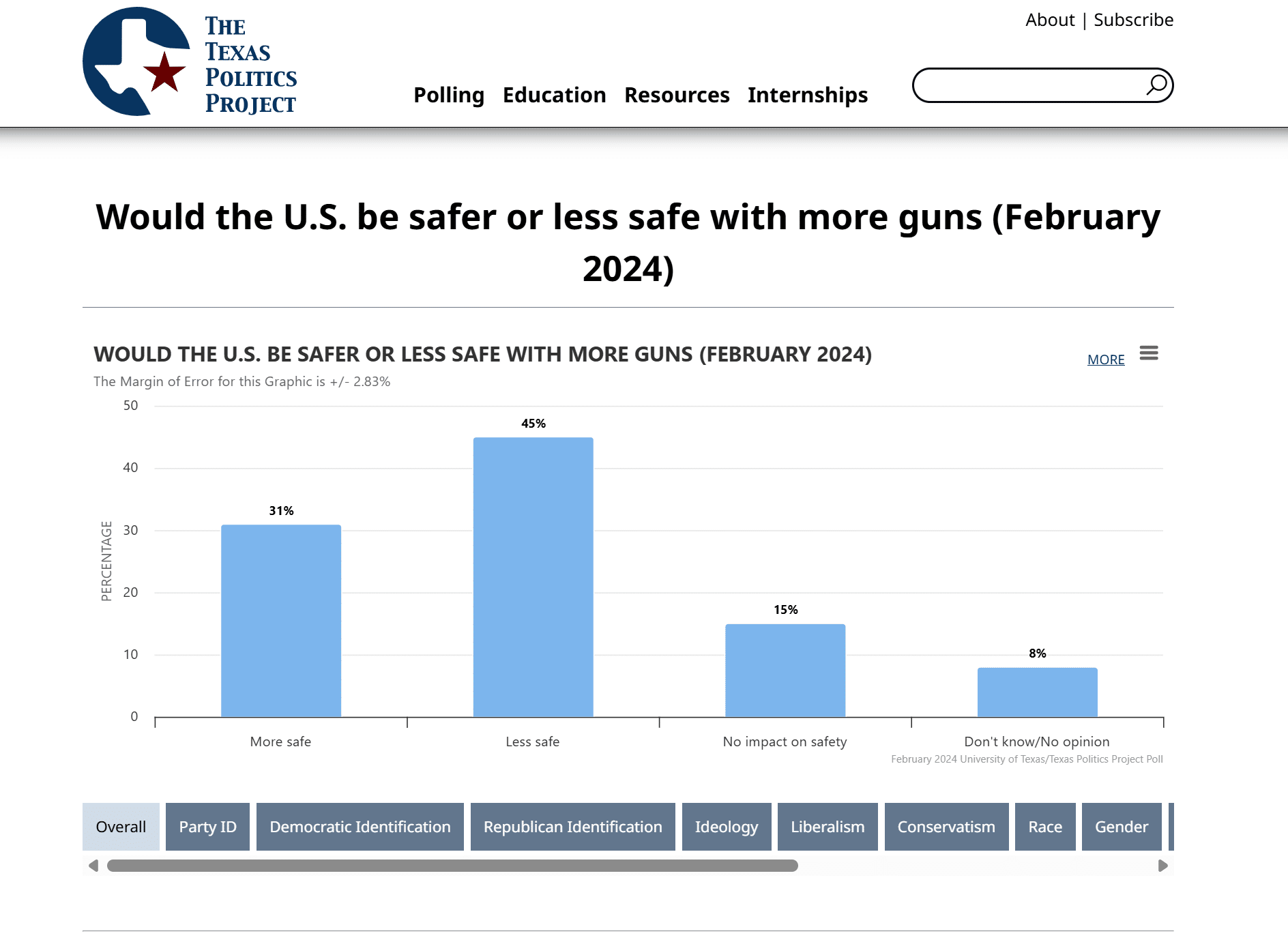
A long‑running polling series from the Texas Politics Project at the University of Texas at Austin has consistently found that more Texans think gun laws should be stricter than think they should be looser.
After the 2022 Uvalde school shooting, a UT poll highlighted by the gun safety group Everytown found that 52 percent of Texans supported stricter gun laws, while only 14 percent wanted laws loosened, with the rest preferring no change.
Another poll commissioned by the centrist think tank Third Way and GOP firm GS Strategy Group found that 80 percent of Texas voters said it is too easy to get a gun in America
That survey reported that 90 percent of Texans support requiring a background check before every gun purchase, including online and at gun shows, with three‑quarters of Republicans, conservatives, and gun owners backing the idea.
Broad support for specific reforms
A 2025 survey from the University of Houston’s Hobby School of Public Affairs, conducted as part of its Texas Legislative Issues 2025 study, found overwhelming support for a range of gun safety policies.
According to the Hobby School, 91 percent of Texans support requiring criminal background checks on all buyers at gun shows, and 89 percent support background checks on all gun buyers, including private sales.
Texans also back measures aimed at keeping firearms away from people considered dangerous. The same poll found that 90 percent of respondents favored banning gun possession for people with restraining orders for stalking or domestic violence, and 88 percent supported allowing judges to temporarily confiscate firearms from individuals deemed a danger to themselves or others.
Third Way’s Texas survey reported similar findings.
Seventy‑five percent of voters supported “red flag” laws that let family members or law enforcement ask a judge to temporarily remove guns from someone who poses a violent threat, and about 80 percent supported allowing authorities to examine sealed juvenile records when young adults try to buy firearms.
Even many Texas Republicans back safeguards

New polling released in 2026 by the gun safety group Giffords focused specifically on Texas Republican primary and runoff voters.
Among these GOP voters, 9 in 10 supported including juvenile criminal and mental health records in background checks for gun buyers under 21, and 86 percent supported making gun trafficking and straw purchasing federal crimes.
The same Republican respondents backed several other policies that go beyond current federal law.
Eighty percent supported blocking unmarried domestic abusers from owning guns, 76 percent favored requiring high‑volume unlicensed sellers to run background checks, and 66 percent supported red flag laws for people who pose an immediate threat.
What Texas lawmakers have done instead
Despite those polling numbers, Texas lawmakers have steadily loosened gun regulations.
In 2021, the Legislature passed and Governor Greg Abbott signed a permitless carry law that allows most adults to carry handguns in public without a license or training, even though national polls show relatively low support for permitless carry and more Texans say they want stricter gun laws overall.
Texas has also adopted a “Second Amendment sanctuary” posture and expanded access to certain types of firearms.
The Texas Tribune reports that lawmakers recently passed measures making it easier for gun owners to access and keep firearms, expanded the types of weapons they can possess, and considered bills that would block extreme risk protection orders and eliminate some gun buyback programs.
Save this article
Reform bills stall after mass shootings

After mass shootings in El Paso, Odessa, and Uvalde, Democrats and some Republicans introduced bills aimed at tightening gun laws, but most never made it to the governor’s desk.
The Hobby School survey notes that proposals such as universal background checks, raising the minimum age to buy certain rifles from 18 to 21, instituting a statewide red flag law, and requiring safe storage have broad public support, yet they repeatedly stall in the GOP‑controlled Legislature.
Gun violence prevention groups and Texas Democrats have called for “common‑sense” reforms — including closing the private‑sale and gun‑show loopholes, mandating safe storage, and adding waiting periods — but Republican leaders have largely declined to bring those bills to a vote.
At the same time, the Legislature has considered bills that would lower the age for some handgun carry rights and expand where firearms can be brought, such as schools and other sensitive locations, drawing criticism from gun safety advocates.
Texas’s gun death record
Texas consistently ranks among the states with relatively high rates of gun death, and national analyses show that states with weaker gun laws tend to experience higher gun violence.
Everytown Research’s state rankings give Texas low marks for the strength of its gun safety policies and note that states with stronger laws generally have lower gun death rates.
These trends have made gun violence a prominent concern in Texas polling.
In the Hobby School and Third Way surveys, Texans expressed strong worry about mass shootings, domestic violence, and suicides, and majorities said they believe new regulations can improve safety without disarming law‑abiding gun owners.
Why leaders and voters diverge
Political scientists and analysts point to several reasons why Texas policy diverges from public opinion on guns.
One factor is the structure of Texas elections: low turnout in party primaries, heavily gerrymandered districts, and strong pressure from gun‑rights organizations mean that a relatively small, highly motivated slice of voters can exert outsized influence on Republican lawmakers.
In this environment, GOP officials may see more risk in angering primary voters or influential groups than in defying broad public sentiment captured in statewide polls.
That dynamic helps explain why reforms with support from 70 to 90 percent of Texans — including many Republicans — have not yet become law, even as high‑profile shootings keep the issue in the spotlight.
So how long will voters put up with being ignored?
Despite years of headlines about mass shootings and rising concern over safety, Texas voters are far ahead of their elected leaders on basic gun reforms—backing policies like universal background checks and red flag laws that the Legislature still refuses to pass. The real question now isn’t what Texans want, but how long their leaders can ignore them.
Polls say Texans across party lines support some gun reforms. Do those numbers match what you hear from friends, family, and neighbors? Drop your take in the comments.
YOU MAY ALSO WANT TO READ:
- Just how armed are Americans? What the data say about U.S. gun owners
- 10 reasons legal gun owners are facing felonies in Chicago
- 12 legendary gunslingers known for their deadly precision in the Wild West
Texas lost its crown as America’s top moving destination — here’s where people are heading now
For much of the past decade, Texas was America’s undisputed relocation powerhouse, drawing waves of new residents with its lower taxes, booming job market, and relatively affordable housing. But new migration data suggests the state’s dominance may be starting to cool.
According to the 2025 National Movers Study from United Van Lines, Texas is now classified as a “balanced” migration state, meaning inbound and outbound moves are nearly even. After years of ranking among the nation’s top relocation destinations, the state no longer stands out as a major net-gainer of new residents.
READ Texas lost its crown as America’s top moving destination — here’s where people are heading now
10 best cities in Texas to call home

Texas added more residents than any other state last year, according to U.S. Census trends, and much of that growth is flowing into cities that few Americans talked about a decade ago.
Drive across the state, and you feel it right away. New rooftops stretch across old ranch land. School parking lots fill before 8 a.m. Coffee shops buzz on weekday afternoons with remote workers who once swore they would never leave a major metro. Texas is not just growing. It is reshaping where and how people want to live.





