You probably think you know the Ark of the Covenant—but the Bible hides a stack of wild details most people never notice.
The famous gold-plated chest from the Bible has captured the imagination of adventurers and scholars for centuries, thanks in part to Indiana Jones and endless documentaries. Most people know it as the box that holds the Ten Commandments, but there is so much more to this sacred object than just a container for stone tablets. The Bible mentions the Ark nearly 200 times, yet many of the fascinating specifics about its design and history remain overlooked by the average reader.
Beyond the Hollywood myths, the actual text provides a blueprint that is both incredibly specific and strangely mysterious, offering clues that historians are still trying to piece together. The stories surrounding its power are intense, ranging from toppling statues to stopping rivers in their tracks, making it one of the most feared items in history. We dug into the ancient texts to find ten surprising facts that paint a fuller picture of this legendary artifact.
Its Specific Dimensions

The Bible does not leave the size of this sacred object up to the imagination, as the instructions given to Moses were incredibly precise. Exodus 25:10 states the Ark was to be 2.5 cubits long, 1.5 cubits wide, and 1.5 cubits high, which roughly translates to 45 inches by 27 inches by 27 inches. This means the legendary chest was actually about the size of a standard seaman’s trunk, making it portable enough to be carried across deserts.
While it might seem small compared to the massive temples built later, the compact size was intentional for people constantly on the move. The craftsmanship required to overlay this acacia wood box with pure gold inside and out would have been an incredible feat for wanderers in the wilderness. Despite its modest physical size, the sheer weight of the gold and the stone tablets inside would have made it a heavy burden for the priests.
It Held Three Items

Most people assume the Ark was built solely to house the stone tablets containing the Ten Commandments, but the book of Hebrews reveals it was actually a time capsule for three distinct items. Hebrews 9:4 explains that inside the Ark were the golden pot that had manna, Aaron’s rod that budded, and the tablets of the covenant. These three objects represented God’s provision, His chosen leadership, and His holy standard for the people of Israel.
The inclusion of the manna was particularly significant because it served as a jar of evidence for future generations to see how their ancestors were fed in the desert. Placing Aaron’s rod inside was a permanent reminder of a rebellion that was squashed when his dead stick miraculously sprouted almonds. It effectively served as a divine museum case, preserving the physical proof of Israel’s supernatural history.
The Two Thousand Cubit Rule
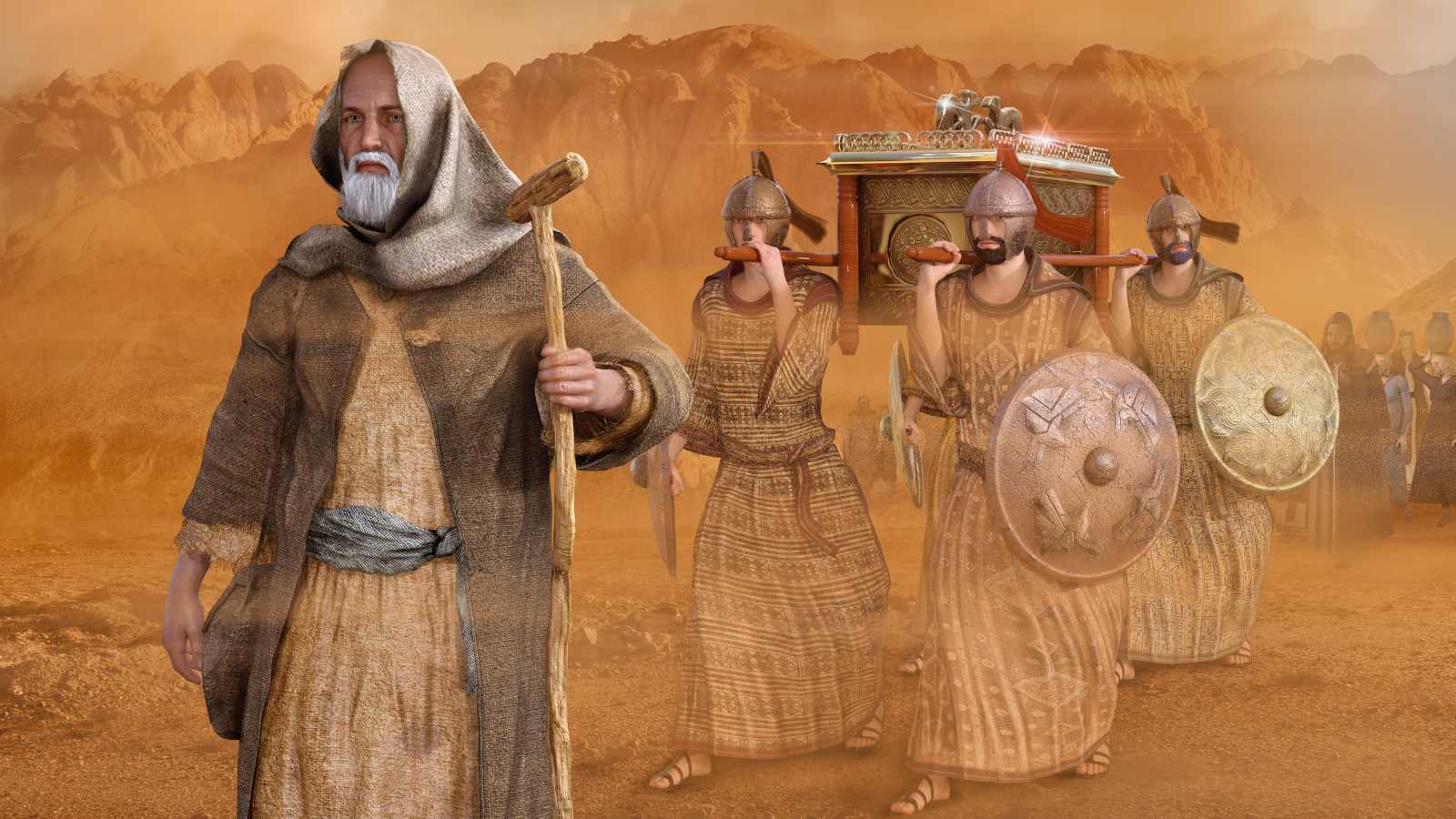
Approaching the Ark was strictly regulated, and the Israelites were often commanded to keep a healthy distance to ensure their safety during travel. Joshua 3:4 commanded the people to keep a gap of about 2,000 cubits, or roughly half a mile, between themselves and the Ark. This massive buffer zone was likely established to reinforce the holiness of the object and to prevent accidental contact that could prove fatal.
This distance also served a practical purpose by allowing the massive crowd of Israelites to see the Ark clearly as it led the way. If everyone had crowded around it closely, only the people in the front row would have known where they were going during the crossing of the Jordan River. By keeping it far ahead, the entire nation could look up and follow the symbol of their God into the Promised Land.
A Seven-Month Captivity

There is a strange chapter in history in which the Ark was captured by Israel’s enemies, the Philistines, during a chaotic battle. According to 1 Samuel 6:1, the Ark of the Lord remained in Philistine territory for seven months, a period that proved disastrous for the captors. Instead of bringing them victory, the stolen artifact caused outbreaks of tumors and panicked confusion in every city it visited.
The Philistines moved the chest from Ashdod to Gath, then to Ekron, treating it like a hot potato no one wanted to hold. The statues of their god Dagon were found toppled face down before the Ark, and the people begged their leaders to send it back to Israel. It is one of the few times in history where a conquering army voluntarily returned its most valuable war trophy to stop the curse.
The Deadly Mistake Of Uzzah

One of the most shocking stories involves a man named Uzzah who died instantly while trying to do something that seemed helpful. The oxen carrying the cart stumbled, and Uzzah reached out his hand to steady the Ark and prevent it from falling into the dirt. 2 Samuel 6:7 describes how the anger of the Lord burned against Uzzah for his irreverent act, and God struck him down right there beside the Ark.
This incident underlines the extreme seriousness with which the ancient Israelites had to treat the object, as good intentions did not exempt them from the rules. They had been explicitly told that the Ark must be carried on poles by Levites, never placed on a cart or touched by human hands. David was initially angry and terrified by this event, realizing that handling the presence of God required strict obedience rather than just casual care.
It Is Missing From Jeremiah

Save this article
The final fate of the Ark is one of the greatest mysteries in biblical archaeology, but the prophet Jeremiah offers a clue suggesting it will never be found or needed again. Jeremiah 3:16 predicts a time when people will no longer say “The ark of the covenant of the Lord,” nor will it come to mind or be remembered. This prophecy indicates a shift from a physical object that represents God’s presence to a new era in which His presence is everywhere.
Scholars often cite this verse to explain why the New Testament does not seem obsessed with finding the lost artifact. It suggests that the physical box was a shadow of better things to come and that searching for it might miss the point of the new covenant. For believers, the idea is that God no longer dwells in a wooden-and-gold box, but rather in the hearts of people.
The Casualty Confusion

There is a significant debate about a specific tragedy in the town of Beth Shemesh when the Philistines returned the Ark. Some translations state that God struck down 50,070 men for looking into the Ark. In contrast, others suggest the number was much smaller. Most modern scholars and translations believe the original text likely referred to 70 men, noting that 50,000 would have been an impossibly large population for a small village. Still, some say the number is accurate.
The confusion arises from the way numbers were written and copied in ancient Hebrew manuscripts, leading to variations in the text we have today. Regardless of the count, the impact on the town was devastating, causing immediate mourning and fear among the survivors. The people of Beth Shemesh famously asked, “Who can stand in the presence of the Lord, this holy God,” emphasizing the terror the Ark inspired.
The Ethiopian Claim

While most theories place the lost Ark in hidden tunnels beneath Jerusalem or destroyed by the Babylonians, one group claims to know exactly where it is. The Ethiopian Orthodox Tewahedo Church declares that the original Ark is currently kept in a chapel in Aksum, guarded by a single monk who never leaves the premises. According to their tradition, Menelik I, the son of King Solomon and the Queen of Sheba, brought the Ark to Ethiopia thousands of years ago.
This guardian is the only person allowed to see the Ark, and he appoints his own successor before he dies to maintain the chain of custody. While historians and archaeologists are skeptical due to a lack of visual evidence, the claim is central to the faith of millions in the region. It remains one of the most enduring and fiercely protected traditions in the religious world, inaccessible to outsiders.
The Mercy Seat Cover

The lid of the Ark was not just a simple cover; it was a distinct, holy object known as the Mercy Seat, or Atonement Cover. It was made of solid gold rather than wood covered in gold, and it featured two cherubim facing each other, their wings overshadowing each other. God promised in Exodus 25:22 that he would meet with Moses and give him all his commands from above this specific cover.
This lid was the focal point of the Day of Atonement, when the High Priest would sprinkle blood to atone for the nation’s sins. It symbolized the barrier between the law contained inside the box and the presence of God hovering above it. The imagery suggests that mercy literally covers the law, a concept that became central to later theology.
Seen In Revelation

Although the Ark disappears from the Old Testament historical narrative, it makes a dramatic encore appearance in the final book of the Bible. Revelation 11:19 describes the temple of God being opened in heaven, and there was seen in his temple the ark of his testament. This vision suggests that the earthly Ark Moses built was merely a copy of the true Ark that exists in the heavenly realm.
This passage is fascinating because it links the beginning of the biblical story to its end, presenting the Ark as an eternal symbol of God’s faithfulness. It appears right before a series of cosmic events, accompanied by lightning, thunder, and a great earthquake. For readers of the text, it assures that the covenant is secure in heaven, regardless of what happened to the wooden box on earth.
Disclaimer – This list is solely the author’s opinion based on research and publicly available information. It is not intended to be professional advice.
Like our content? Be sure to follow us.
How Total Beginners Are Building Wealth Fast in 2025—No Experience Needed

How Total Beginners Are Building Wealth Fast in 2025
I used to think investing was something you did after you were already rich. Like, you needed $10,000 in a suit pocket and a guy named Chad at some fancy firm who knew how to “diversify your portfolio.” Meanwhile, I was just trying to figure out how to stretch $43 to payday.
But a lot has changed. And fast. In 2025, building wealth doesn’t require a finance degree—or even a lot of money. The tools are simpler. The entry points are lower. And believe it or not, total beginners are stacking wins just by starting small and staying consistent.
Click here, and let’s break down how.