

Before you donate that old china set, toss the vintage tools, or let the grandkids haul boxes to Goodwill, you might want to take a closer look.
Across America, millions of Baby Boomers are beginning to downsize, and over the next two decades, an estimated $84 trillion to $124 trillion is expected to pass from one generation to the next. While much of that wealth is tied up in homes, investments, and retirement accounts, some of it is sitting quietly on bookshelves, in attics, and tucked away in closets.
The surprising part? Families often don’t recognize what’s valuable until it’s gone. Antique experts, estate planners, and collectors say some of the biggest regrets come from giving away—or throwing away—items that carried significant financial, historical, or sentimental value.
Before you start decluttering, here are 12 household items worth thinking twice about letting go.
Your Long-Time Family Home
For years, the story has been that Boomers would unleash a “Silver Tsunami” of housing inventory as they downsized. But the reality? It’s more like a Silver Standstill. And for good reason. A whopping 78% of older American homeowners are choosing to age in place, and it’s not just about sentimentality; it’s one of the most financially savvy decisions they can make.
Boomers are sitting on a dragon’s hoard of home equity, totaling an incredible $17 trillion, which is half of the entire nation’s home equity. Since the pandemic began, the average Boomer household’s wealth has increased by $486,000, with half of that gain attributed directly to the soaring value of their home.
Why sell when your biggest asset is still growing?
That Crate of Old Vinyl Records
Remember lugging those heavy milk crates full of records from the dorm room to the first apartment? Well, that collection you thought was made obsolete by CDs, and then MP3s, and then streaming, is having the last laugh.
The vinyl record market is in the middle of a massive resurgence. It’s not just a niche hobby; it’s a booming industry. The global market is projected to surge from $1.8 billion in 2023 to $3.4 billion by 2032, growing at a rapid pace of over 7% annually.
While most common records might only be worth a few bucks, the rare stuff can be a goldmine. An original pressing of Prince’s withdrawn The Black Album sold for $27,500, and a special audiophile box set of Led Zeppelin’s debut album fetched $20,000.
And for the true unicorns? The hip-hop group Wu-Tang Clan produced a single copy of an album, Once Upon a Time in Shaolin, which sold for an unbelievable $2 million. So, yeah, maybe it’s time to see what’s hiding in those cardboard sleeves.
First-Edition Books Gathering Dust
That bookshelf in the den might be holding more than just good stories. For book collectors, a “true first edition”—meaning the very first printing of a book’s first-ever commercial release—is the holy grail. It’s the closest you can get to the author’s original vision, complete with the original cover art and, sometimes, the original typos.
But here’s the million-dollar secret that most people literally throw in the trash: the dust jacket. For modern books, the flimsy paper dust jacket can account for a mind-boggling 80% to 90% of the book’s total value. A first edition without its jacket might be worth only 10-20% of its potential price. Why? Because dust jackets were designed to be disposable. Finding one in pristine condition after 50 or 60 years is incredibly rare, making it the key indicator of a truly well-preserved copy.
The values can be astonishing. The first printing of Harry Potter and the Philosopher’s Stone had a tiny run of just 500 copies; one recently sold for around $90,000. A beautiful first edition of F. Scott Fitzgerald’s The Great Gatsby, with its iconic cover intact, can command upwards of $190,000.
And the high end of the market is simply breathtaking. A copy of Shakespeare’s First Folio from 1623 sold for nearly $10 million, while the first book ever printed in the United States, the Bay Psalm Book, fetched a cool $14.2 million at auction. So, before you let go of Dad’s old library, it might be worth having an expert take a look.
The “Good” China and Sterling Silver Flatware
Let’s be honest. For many younger folks, that 12-person place setting of fine china and the heavy box of sterling silver flatware feels more like a burden than a treasure. Who has formal dinner parties anymore? However, before labeling it all as “clutter,” it’s crucial to understand that you’re looking at two fundamentally different types of assets.
First, the fine china. Think of it as art. Its value is subjective and depends on four key things: the maker, the pattern, the age, and the condition. A full set from a legendary manufacturer like Wedgwood, Spode, or Royal Doulton can be quite valuable. Rare or discontinued patterns are especially sought after. For example, a single dinner plate in Tiffany’s “Cirque Chinois” pattern is valued at $1,600, while a large set of Herend’s famous “Rothschild Bird” pattern sold for $12,000.
Now, the sterling silver flatware. This is a commodity investment. Sterling silver is, by definition, 92.5% pure silver, which means it has a built-in melt value that will never be zero. But its true value often goes far beyond its weight in silver. Certain patterns are extremely popular among collectors and command substantial premiums.
Designs like Wallace’s opulent “Grand Baroque,” Gorham’s elegant “Chantilly,” and Reed & Barton’s intricate “Francis I” are timeless classics that people actively seek out to complete their own family sets. While the kids might not want the whole set, a collector trying to replace a single missing fork from their grandmother’s collection might pay top dollar for it.
Heirloom Jewelry from Mom or Grandma
That velvet box tucked away in a dresser drawer holds more than just sparkling memories. It could also hold significant financial value—but navigating this market is a tricky proposition.
The global jewelry market is enormous, valued at over $232 billion in 2024, with the resale market alone projected to hit $5.5 billion by 2033. But here’s the hard truth most jewelers won’t tell you: much like a new car, the value of most fine jewelry plummets the second you walk out of the store.
Why? Retail markups are astronomical, often 250% to 300% over the actual value of the gold and gems. That means if you try to resell a piece, you should generally expect to get only 20% to 50% of the original purchase price. However, there are major exceptions to this rule, and they all come down to one word: brand.
Iconic design houses like Cartier, Tiffany & Co., and Van Cleef & Arpels produce pieces that are more like art than accessories. They hold their value incredibly well and can even appreciate over time. Certain famous collections, like Van Cleef & Arpels’ four-leaf clover “Alhambra” line, are in constant demand on the resale market.
What was once considered “old-fashioned” is also finding new life. A major trend for 2026 is the “Modern Heirloom,” a style that blends antique elegance with everyday wearability. This means that the very designs sitting in your jewelry box—delicate pearls, floral motifs, soft gold tones—are coming back into fashion, potentially boosting the value of pieces that might have otherwise been judged only by the weight of their materials.
Mid-Century Modern Furniture
Remember that low-slung sofa with the tapered wooden legs? Or the teak credenza that’s been holding up the TV for 40 years? That isn’t just “old furniture” anymore. It’s a design movement, and it’s hotter than ever.
Mid-Century Modern (MCM), the design style popular from the 1940s to the 1960s, has made a massive comeback. Its clean lines, organic shapes, and emphasis on function fit perfectly with today’s smaller living spaces and minimalist aesthetics. The market for modern furniture is booming, with a value of over $5.8 billion in 2024.
And this isn’t just a trend for young hipsters. A 2021 survey revealed that while MCM was the third most popular style among buyers aged 20-40, it was the number one style for buyers aged 60-80. This incredible cross-generational appeal makes it one of the few heirlooms that your kids or grandkids might actually fight over in a good way. The popularity has saturated the market with cheap knock-offs, which paradoxically makes authentic, period-specific pieces even more valuable.
Vintage Comic Books
If you ever bought a comic book for 10 or 12 cents, you might want to sit down for this. The childhood hobby of collecting superhero stories has exploded into a legitimate, multi-billion-dollar alternative investment market. Fueled by the non-stop marketing machine of Hollywood’s superhero blockbusters, the value of original source material has gone stratospheric. The overall market for comics and graphic novels hit nearly $2 billion in 2024, and the vintage end of that market is seeing jaw-dropping records fall every year.
In April 2024, a pristine copy of Action Comics #1, the 1938 debut of Superman, sold at auction for a world-record $6 million. And it’s not just the Man of Steel. Batman #1 has sold for $2.2 million, Captain America Comics #1 fetched $3.12 million, and the first appearance of Wonder Woman in All-Star Comics #8 brought in $1.62 million. These aren’t just old magazines; they are cultural artifacts marking the birth of modern myths.
The boom isn’t limited to the Golden Age, either. The record for the single best-selling comic issue of all time belongs to X-Men #1 from 1991, which sold over 8 million copies. While not as rare, high-grade copies of key issues from any era can be valuable. Even damaged comics can be worth a fortune. A professionally restored copy of Action Comics #1—meaning it had repairs done to it—still sold for an incredible $576,000. It’s a market where a little piece of paper can be worth more than a house.
Old Toys (Think Barbies and Star Wars Figures)
The toys you bought for your kids in the 70s and 80s were meant to be played with, taken out of the box, and loved until their plastic limbs fell off. But if any of them managed to survive intact—and especially if they’re still in the original packaging—you could be sitting on a small fortune.
Nostalgia is a powerful economic force, and the toy collectibles market is proof. It was valued at $13.9 billion in 2024 and is expected to more than double to $38.2 billion by 2034. This boom is largely driven by Gen X and Millennials, who now have the disposable income to buy back their childhoods.
Save this article
Take Barbie. The very first #1 Barbie from 1959, with her iconic black-and-white striped swimsuit, has sold for as much as $27,450 in mint condition. The ultimate prize, however, is the one-of-a-kind Stefano Canturi Barbie, which featured a real diamond necklace and sold at a charity auction for $302,500.
Or consider Star Wars. Between 1977 and 1983, Kenner sold an estimated $200 million worth of the action figures. Today, some of the rarest examples are worth more than a new car. The value often lies in the unusual details and manufacturing mistakes. An early version of the Jawa figure came with a vinyl cape, which was quickly replaced with a cloth one. That “error” version can now sell for $30,000. The holy grail for many is a Darth Vader figure with a “double-telescoping” lightsaber, a fragile feature that was quickly changed. One of those can be worth over $130,000.
Rare Stamps and Coins
Stamp and coin collecting might seem like quaint, old-fashioned hobbies, but at the highest levels, they are arenas of intense, multi-million-dollar transactions. Those albums and jars passed down from your parents could hold a few surprising treasures.
In the world of stamps, also known as philately, the ultimate prize is the British Guiana 1c magenta. Only one is known to exist, and it last sold for an incredible $9.48 million. More familiar to Americans is the famous “Inverted Jenny,” a 1918 stamp where the airplane in the center was accidentally printed upside down. A single stamp can be worth over $1.5 million, and a block of four sold for $4.8 million.
The single most expensive coin ever sold is the 1933 Double Eagle, a $20 gold piece. Nearly all were melted down before they were ever issued, but a few escaped. One sold at auction for a breathtaking $18.9 million.
Other American treasures include the 1794 Flowing Hair Silver Dollar, one of the first dollars ever struck by the U.S. Mint, which sold for $10 million, and the 1787 Brasher Doubloon, a rare gold coin made by a private goldsmith before the Mint was fully operational, which fetched $9.36 million. It’s a powerful reminder that sometimes, small change can be worth a life-changing fortune.
That Classic Car in the Garage
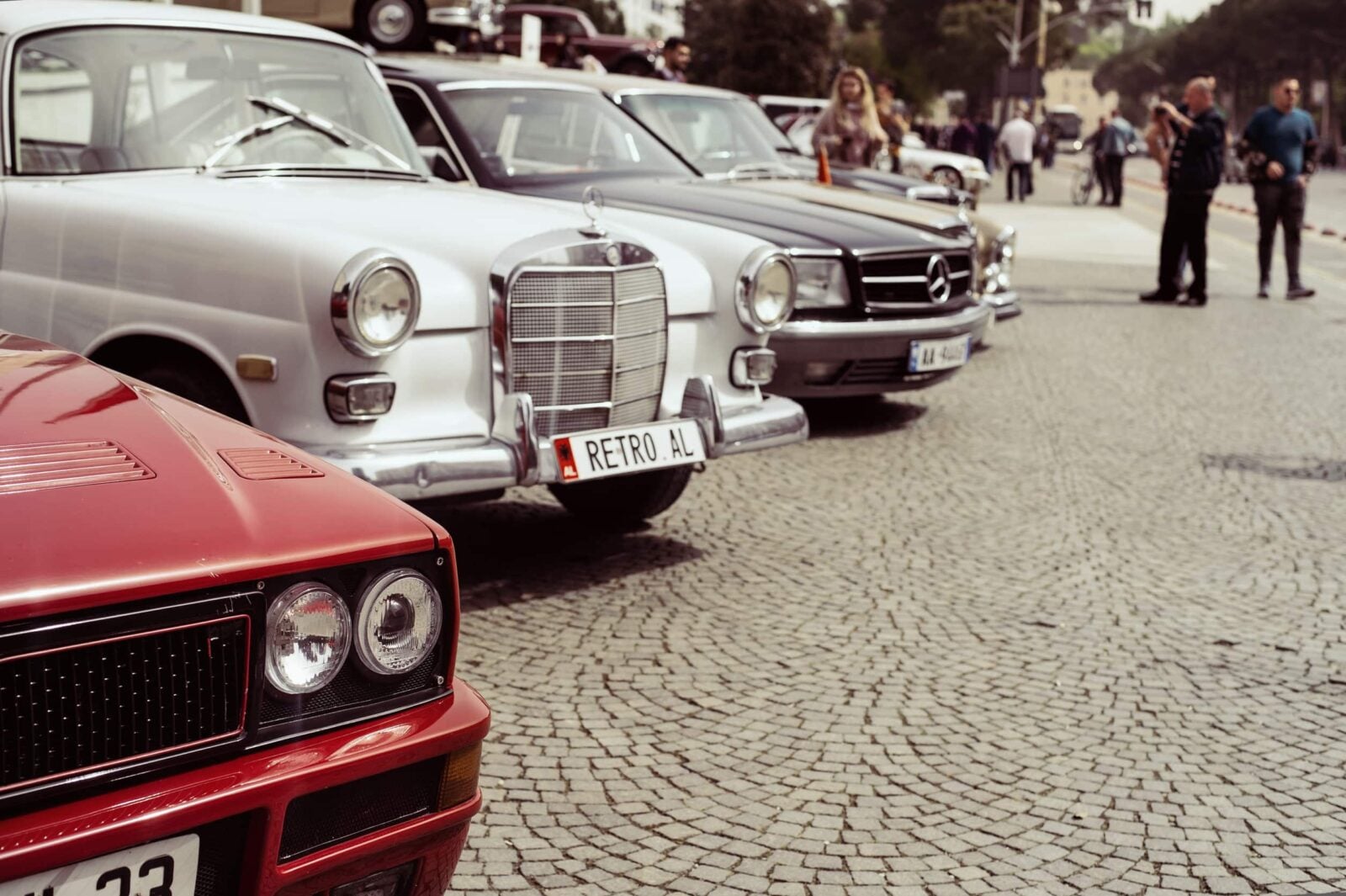
For many, the classic car is the ultimate passion asset. It’s an investment you can actually drive and enjoy. While the collector car market has cooled slightly in 2024, with prices down about 7-14%, it remains a massive $12.6 billion industry in the U.S. alone.
The high end of the market operates in a different universe. The most expensive car ever sold at auction was a 1955 Mercedes-Benz 300 SLR Uhlenhaut Coupe, which sold for an astonishing €135 million (approximately $143 million) in 2022. Ferraris from the 1960s also dominate the top sales, with a 1962 250 GTO selling for $48.4 million.
However, here’s the most important trend for Baby Boomers to understand: the very definition of a “classic car” is evolving. Market analysis indicates that while cars from the 1960s experienced the largest price drops in 2024, vehicles from the 2000s were the only decade that saw prices rise. This is the generational shift in action. Gen X and Millennials are now entering the market, and they’re not chasing the ’60s muscle cars their parents loved. They’re buying the “poster cars” from their own youth.
As a result, Japanese and European “youngtimers” are seeing explosive growth. The value of a 2000 Honda S2000 has jumped over 37%, and a 1999 Nissan Skyline R34—a hero of the Fast & Furious generation—has appreciated by 41%. The takeaway? The most valuable classic in your garage might not be the oldest one. It might be the one you bought for your kid to drive to college.
Original Artwork (Even If You Don’t Know the Artist)
You don’t need a Picasso or a Warhol hanging on your wall for it to be valuable. While a famous signature certainly helps, the art world is full of treasures by “Unknown Artist.” The value of a piece of art is a complex equation of quality, materials, size, condition, and—perhaps most importantly—its story.
Art appraisers confirm that while a well-known artist’s work is worth more, factors such as subject matter and historical context play a significant role. A beautiful oil painting will always be worth more than an acrylic of similar quality, simply because of the skill and time involved.
Online art marketplaces are filled with examples of unsigned pieces commanding serious prices. A listing for an anonymous “Portrait of Napoleon” asks for $50,000, while a “Cubist Face” is priced at $20,000. One of the most stunning examples is a “Florentine Pietre Dure Plaque” by an unknown artist, valued at an incredible $148,500.
For art by an unknown or amateur artist, the history of the piece—its provenance—becomes a critical part of its value. Where did you get it? When? Was it from a locally known artist who never achieved national recognition? You, the owner, are the keeper of that story. Before you get a piece appraised, gather all the information you can: the medium (oil, watercolor, etc.), the dimensions, and any history you have of its ownership. That narrative you provide can be the very thing that transforms a simple decoration into a desirable asset.
Handwritten Letters, Diaries, and Photo Albums
Of all the items on this list, this last category is truly the most priceless. In an age of emails that get deleted and social media posts that vanish, the tangible, physical records of a life are becoming an endangered species.
Historians and archivists consider these items to be sacred. They are, in many ways, “the most democratic of historical sources,” capturing the lives of ordinary people in their own words. The value here isn’t monetary. Simply keeping them in a shoebox isn’t enough. A box of unlabeled photos or letters without context can quickly become a mystery, and then a burden, to the next generation.
The greatest gift you can give your family is to become their first curator. Go through the photos and write names and dates on the back. Add a small note explaining the context of a letter. Preservation experts advise storing these treasures in a cool, dry, and dark place, never an attic or basement, and digitizing them as a backup. By adding your knowledge to these artifacts, you ensure the stories and the people in them are never forgotten.
Key Takeaway
The $84 trillion Great Wealth Transfer is about so much more than money. It’s about the transfer of stories, memories, and the physical objects that hold them. The items on this list, from your family home to a box of old letters, represent a complex portfolio of financial assets, cultural artifacts, and your unique family legacy. Many of these items, especially collectibles, are subject to a high capital gains tax rate of 28%, making planning even more critical. So, before making any decisions, take three simple steps:
Appraise what you have to understand its true market value. Plan with your family and financial advisors to avoid conflict and tax surprises. And most importantly, share the stories behind these items, because, as author Isak Dinesen said, “To be a person is to have a story to tell.” That’s the one thing that is truly priceless.
More articles:
- 12 Reasons People Believe America Is Completely Falling Short
- 12 things that used to be free but now cost money
- 10 money habits boomers see as normal that can lead to financial trouble
8 subtle ways money stress shows up in your gut and your eating

Money stress is quietly reshaping how millions eat, sleep, and digest—often showing up first in their gut before their bank balance.
Money worries rarely stay neatly contained in your bank account or your budget spreadsheet. For many adults over 45, financial pressures from aging parents, grown children, housing costs, or healthcare bills spill over into sleep, mood, and everyday choices around food. You might notice that on the days when you are most anxious about bills, you feel more knotted up in your stomach, have more heartburn, or find yourself eating whatever is closest without really tasting it. Learn more.
These 10 middle-class money rules were gospel in 1990—now they’re financial sabotage

The playbook that once promised stability for the middle class has slowly turned into a blueprint for falling behind.
Think back to the days of neon windbreakers and dial-up internet when financial advice felt simple and safe. Your parents probably handed you a set of money rules that seemed practically guaranteed to build wealth over time. You were told to go to college, buy a house, and faithfully stash cash into a savings account until retirement. That classic playbook worked beautifully for a completely different economy that simply no longer exists. Learn more.
12 money habits that can make your savings run out faster

Saving money has become more challenging for many Americans as living costs continue to rise. Recent data from Trading Economics show the U.S. personal Costs continue tosaving rate has fluctuated between about 3% and 5% in recent years, significantly lower than the historical average of above 8% seen in earlier decades.
Financial surveys reveal that many households struggle to maintain emergency funds. According to the Federal Reserve’s Survey of Household Economics and Decision making, nearly 37% of Americans say they would have difficulty covering an unexpected $400 expense without borrowing or selling something. Learn more.





