

With nearly one-third of Thailand still covered by forests, the country has emerged as one of Southeast Asia’s most diverse and underrated hiking destinations.
Hiking across Thailand reveals a side of the country that many travelers never see, far beyond beaches and busy cities. Lush jungles, limestone cliffs, misty mountains, and hidden waterfalls unfold along trails that reward curiosity and patience. These paths invite walkers to slow down, listen to wildlife, and experience landscapes shaped by monsoons, rivers, and centuries of natural change.
Thailand’s trail network reflects the country’s remarkable biodiversity. About one-third of the nation remains covered by forests, a figure that helps explain why so many hikes pass through dense canopies, protected parks, and wildlife-rich terrain. From northern highlands to southern rainforests, these trails highlight how deeply nature still defines the country. Exploring them offers not just scenic views, but a clearer sense of Thailand’s ecological wealth and the quiet power of its outdoors.
Doi Inthanon National Park, Thailand’s roof above the clouds
At 2,565 meters, Doi Inthanon National Park rises high enough to collect weather, light, and silence. The Department of National Parks of Thailand formally records it as the country’s highest peak, but hikers know it more intimately as a place where the air cools, and the land exhales. Trails like Kew Mae Pan and Pha Dok Siew wind through cloud forest and terraced hillsides, designed not for conquest but for communion, with boardwalks and benches that encourage stopping, looking, breathing.
Park trail documentation describes these routes as non-technical and moderate in length, making them accessible to beginners who still want the reward of altitude. The Ang Ka Nature Trail, just a few hundred meters long, offers a rare glimpse of a high-elevation moss forest that clings to moisture year-round. This is the mountain that lets you walk above the clouds without needing to prove anything to anyone.
Khao Sok National Park, an ancient rainforest and limestone peaks
In southern Thailand, Khao Sok National Park shelters one of the oldest evergreen rainforests on Earth, dated by Thai park authorities to over 160 million years old. Towering limestone karsts rise from jungle valleys, their reflections rippling across Cheow Lan Lake, a reservoir administered by the Royal Irrigation Department. The terrain feels primordial, humid, alive, with trails that slip past waterfalls, bamboo groves, and dense canopy alive with sound.
Wildlife records from the Department of National Parks list gibbons, hornbills, Malayan tapirs, and Asian elephants among the species that still move through this forest. Unlike the cooler pine and montane landscapes of the north, Khao Sok stays green year-round, its trails shaded and close. It is often described by park guides as Thailand’s Jurassic Park, especially when hikes are paired with floating raft house stays on the lake.
Phu Kradueng National Park, a sea of clouds on a sandstone plateau
For many Thai hikers, Phu Kradueng National Park is less a destination than a rite of passage. The park’s sandstone plateau rises sharply from the plains, accessed by a 5.5-kilometer ascent officially rated moderate to hard by park authorities. Rest shelters and small food stalls punctuate the climb, turning endurance into a shared ritual rather than a solitary test.
Once on top, the landscape opens into pine forest, cliffs, and viewpoints that catch sunrise seas of clouds drifting across the valley. The Department of National Parks closes Phu Kradueng during the rainy season each year to allow ecological recovery, a policy that has only strengthened its cultural status. This is the pilgrimage trail, where effort is exchanged for dawn light and collective memory.
Khao Yai National Park, waterfalls, wildlife, and jungle boardwalks
Just a few hours from Bangkok, Khao Yai National Park spreads across grasslands and evergreen forest as one of Thailand’s oldest national parks and a UNESCO World Heritage site. Maintained trail networks guide visitors through mixed habitats, including the Kluai Mai to Haew Suwat route, which ends at the waterfall immortalized in the film The Beach.
Wildlife monitoring reports from the Department of National Parks regularly confirm elephant movements, hornbill nesting sites, and signs of other large mammals along these trails. For urban residents, Khao Yai functions as a nearby wilderness classroom, a place where boardwalks and viewpoints make biodiversity visible without diluting its presence.
Erawan National Park Trail, Emerald Pools, and seven-tiered falls
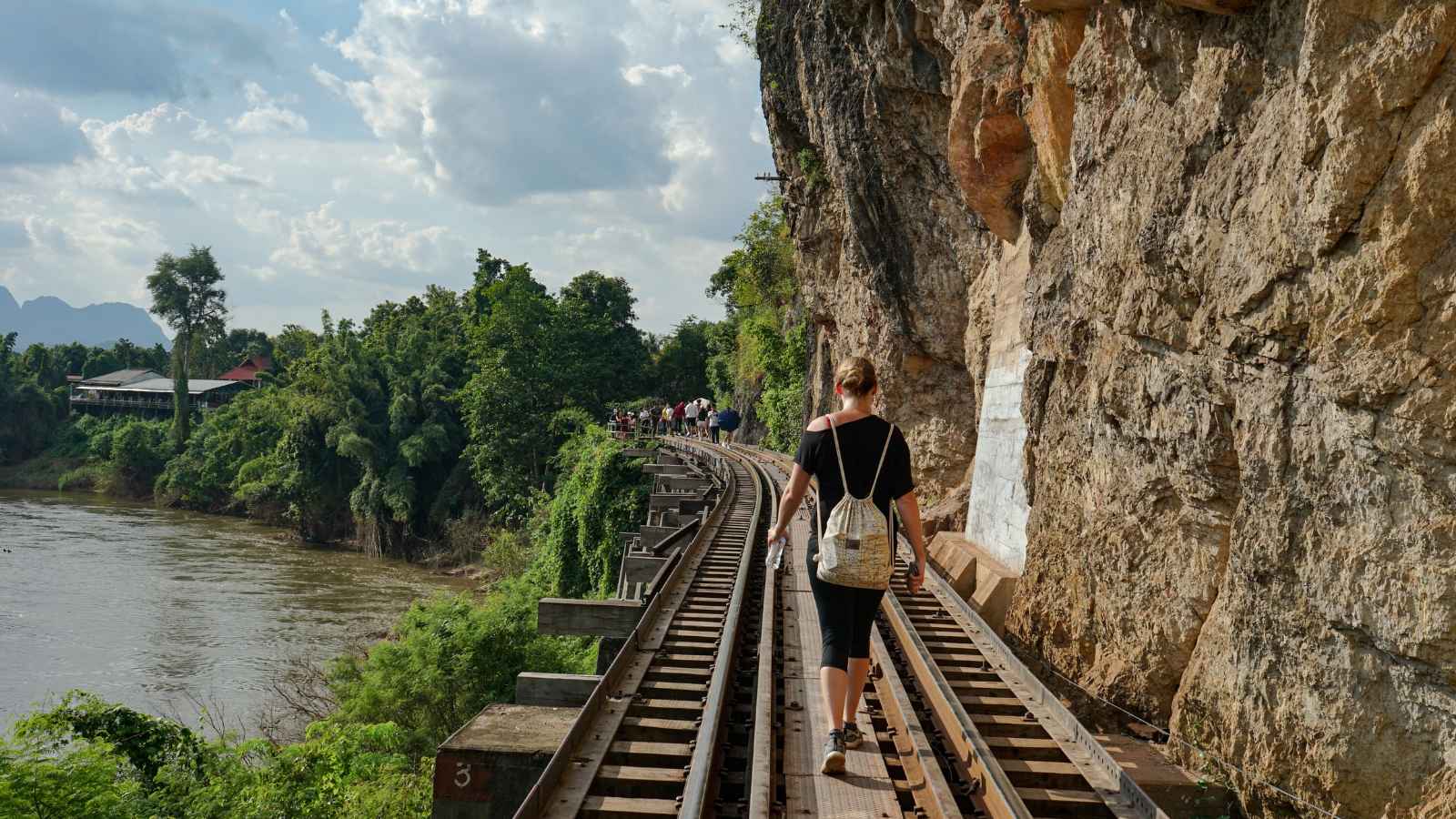
In western Thailand, Erawan National Park draws visitors upward along a forest path that traces the seven levels of Erawan Falls. The park’s official trail maps mark each tier, beginning with broad, accessible pools and gradually narrowing into steeper, rockier terrain for those willing to climb higher.
The striking turquoise color of the water, caused by limestone filtering and mineral content documented by Thai park authorities, has made Erawan one of the most photographed short hikes in the country. While the lower tiers bustle, the upper levels reward persistence with quieter cascades and cooler air. It is the rare Instagram-famous trail that still earns its reputation underfoot.
Dragon Crest Mountain, Andaman Sea panoramas
Near Krabi, the trail up Dragon Crest Mountain, also known locally as Khao Ngon Nak, climbs steadily through forest toward a bare rocky outcrop. Local ranger signage rates the round-trip hike at three to four hours for fit walkers, with natural rest points carved by roots and stone.
At the summit, the land falls away to reveal the Andaman Sea, scattered with islands and karst towers. The narrow crest itself has become iconic, a place where hikers stand against vastness rather than pose for it. This is a trail built almost entirely around its payoff, a lesson in patience rewarded by panorama.
Doi Suthep Monk’s Trail, a forest path to a hilltop temple
Threading up the slopes outside Chiang Mai, the Monk’s Trail on Doi Suthep-Pui National Park follows a route historically used by monks traveling between temples. Marked by strips of orange cloth, the path climbs from the city’s edge through the jungle to Wat Pha Lat, a forest temple maintained by the Thai Sangha.
Save this article
From there, hikers can continue toward Wat Phra That Doi Suthep, where gold spires rise above the canopy. Cultural historians in Chiang Mai describe this trail as a living corridor between urban life and spiritual retreat. Mossy rocks, trickling streams, and sudden city views make it a staircase where nature and belief ascend together.
Ban Jabo hilltribe trek, misty ridges, and village life
In Mae Hong Son Province, the Ban Jabo region sits along high ridgelines where morning fog pools between peaks. Community-based tourism groups working with the Tourism Authority of Thailand describe treks here that range from gentle village walks to multi-day routes linking Lahu and other hilltribe settlements.
These trails pass terraced fields, limestone formations, and homes where travelers are welcomed into homestays rather than hotels. Operators emphasize cool-season temperatures and frequent cloud cover as part of the experience, not obstacles to it. Ban Jabo offers a version of hiking that is less about summits than about staying, listening, and waking up inside the mountains.
Key Takeaway
Thailand’s most memorable trails are not defined by difficulty alone but by contrast, altitude, and intimacy, jungle and cloud, effort and ease. From national park data to local guiding traditions, the evidence points to a hiking landscape that rewards curiosity more than bravado.
These routes show that Thailand’s mountains and forests are not hidden behind extreme treks but revealed through paths that invite people in, one careful step at a time.
More articles:
- 12 cruise dress code rules that spark debate every time
- 16 things you should never leave in your cruise cabin on port days
- 13 Hidden Cruise Risks Most Travelers Don’t Realize Until It’s Too Late
Disclosure: This article was developed with the assistance of AI and was subsequently reviewed, revised, and approved by our editorial team.
Like our content? Be sure to follow us on Newsbreak.
10 Insanely Fast Trains That Make Air Travel Look Slow

Rail travel has come a long way from the slow chugging of steam engines. Today, the race for the fastest train has become a high-speed pursuit of groundbreaking technology, pushing the boundaries of what’s possible on rails. From maglev marvels to sleek bullet trains, these trains don’t just break records; they redefine them. Here’s a look at the 10 fastest trains on Earth, each moving faster than most airplanes. Learn more.
8 financial mistakes travelers should avoid in Mexico

Traveling through Mexico can feel effortless, from booking boutique hotels to paying for street tacos on the go. Yet money mistakes can quietly turn a dream trip into an expensive lesson. Many travelers focus on flights and itineraries but overlook everyday financial decisions that shape their budget once they arrive. Exchange rates, payment methods, and local banking norms differ from those at home, and misunderstandings can drain funds faster than expected.
The stakes are higher than most people realize. According to data from the Consumer Financial Protection Bureau, international travelers can lose money on each transaction. Losses typically range from 3 to 10 percent when foreign transaction fees, poor exchange rates, and ATM charges are combined. Learn more.
10 travel scams targeting tourists

Vacations are supposed to be carefree, but a single clever scam can empty your wallet faster than any overpriced souvenir.
Planning a vacation is usually the highlight of the year, but falling for a scheme can ruin the fun before it even starts. Scammers are getting smarter and using advanced technology to trick even the most experienced globetrotters into handing over their hard-earned cash. You need to stay alert because these criminals often target distracted visitors who are just trying to relax. Learn more.





