

A 29-year-old American man from Kansas died Sunday evening after being struck by lightning while hiking Mount Etna in Sicily. At the same time, one of Europe’s most recognizable active volcanoes was already commanding international attention.
The man, whose name has not been released, was found in an isolated section of the mountain above the treeline and airlifted by a firefighter helicopter to a hospital in Catania, where he later died.
His death unfolded against an unusually complicated backdrop: Etna had been erupting for weeks, volcanic ash had disrupted Sicily’s peak summer travel season, and authorities had restricted access to parts of the mountain. Yet the eruption itself didn’t kill him. As travelers watched lava flows, airport closures, and ash clouds, a severe thunderstorm swept across the slopes.
On a mountain famous for fire, the immediate danger came from the sky.
The Strike in Etna’s Valle del Bove
The emergency call reportedly came in shortly before 8 p.m., as a thunderstorm moved across the mountain and reached a hiker in one of its most isolated stretches.
Italian firefighters, in a statement, said the man had been hiking in the Rocca Capra area, a remote section within Etna’s Valle del Bove, at an elevation of roughly 1,400 meters, or about 4,600 feet above sea level.
The terrain there is barren, exposed, and above the treeline, leaving little natural shelter when weather moves in. A firefighter helicopter reached the hiker and transported him to Cannizzaro hospital in Catania while he was in cardiac arrest. He was pronounced dead at approximately 9:30 p.m.
Police reportedly opened an investigation into the circumstances surrounding the death. Authorities had not publicly released his identity, and family members had not yet been traced at the time of the initial reports.
Was He in a Restricted Area?
Whether the hiker was inside a formally closed zone when lightning struck him is the most significant unresolved question in the case, and the reporting doesn’t agree.
The New York Times reported that the man had been hiking in an area closed to visitors because of Etna’s recent volcanic activity. That distinction matters. Officials have not established what warnings, if any, were posted along his route, how clearly any closure boundaries were marked, or whether he knowingly entered an area that visitors had been told to avoid.
For now, the exact status of the Rocca Capra location remains unsettled. The police investigation may eventually answer where the boundary was and how the hiker reached that section of the mountain.
The Hazard That Caught Nobody’s Attention
This volcano’s reputation runs toward lava, ash, and eruptions. The danger that killed this hiker arrived in a thunderstorm.
According to reports, lightning has claimed more lives on Mount Etna in recent decades than volcanic activity. The last eruption-related fatalities on the mountain occurred in 1987, nearly four decades ago.
For people heading toward Etna’s upper slopes, weather can become a threat quickly. Sudden storms at altitude can leave hikers exposed in open terrain with nowhere obvious to shelter. Sunday’s thunderstorm was described as severe, and the hiker was in precisely the kind of landscape where lightning becomes especially dangerous: high, barren ground above the treeline.
Save this article
It is a striking contrast on a mountain whose eruptions naturally dominate photographs and headlines. Lava may be the spectacle visitors expect to worry about, but on Sunday evening, geology was not the threat that proved fatal.
What the Volcano Was Already Doing
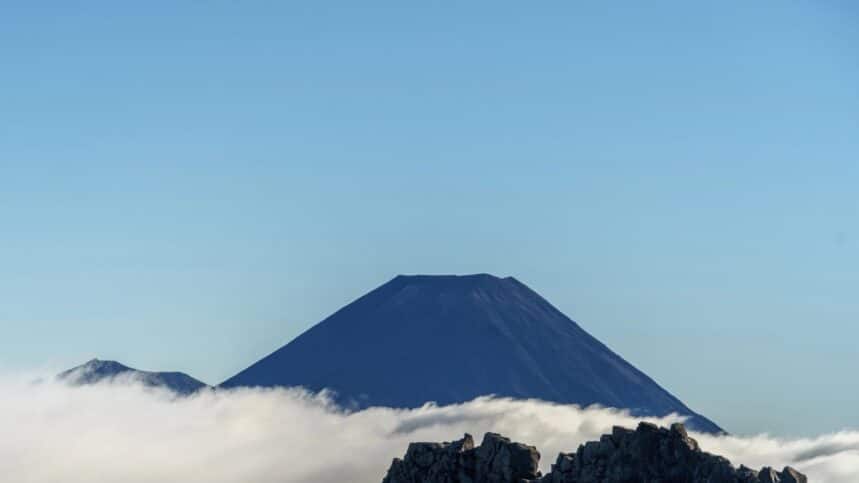
Mount Etna had been in an active eruptive phase for weeks. What made it unusual wasn’t its scale.
Italy’s National Institute of Geophysics and Volcanology reported that a new vent had opened in the Valle del Bove after part of the eastern flank of a summit cone collapsed. The vent, at roughly 2,350 meters, produced a lava flow of about 500 meters that later cooled and stopped.
A separate active vent at around 1,900 meters remained in operation, with lava reaching roughly 1,600 meters. Explosive activity was also continuing at Voragine, one of Etna’s summit craters. The eruption plume rose to about 6,000 meters before drifting southeast, while volcanic tremor remained high and steady.
Boris Behncke, a researcher at the INGV Etna Observatory, told the Associated Press what distinguished this episode from other recent activity: “There have been many shorter interruptions, and stronger eruptions, over the past few decades, but this event is different because the ash emission from Etna’s summit has been much more persistent.”
What Still Needs Answering
Many of the most important details about the hiker’s final hours remain unconfirmed.
Authorities have not said whether the man was hiking alone or with companions, which route brought him into the Rocca Capra area, or what weather information he may have had before heading onto the mountain. It also remains unclear whether weather alerts specifically covering the upper slopes had been issued that evening.
Then there is the access question. How restricted areas were marked or enforced along the routes leading toward that part of Etna has not been publicly explained, and investigators have yet to settle whether the place where he was struck was formally closed to visitors.
Those details could significantly change how the final hours of the hike are understood. For now, what is known is stark enough: while an eruption reshaped travel across Sicily and drew attention to the dangers of Europe’s most active volcano, a severe storm reached an exposed hiker high on its slopes first.
If you were planning a hike in an area like this with active volcanic restrictions and uncertain weather, what warning would make you decide it was time to turn around?





