

A day at Boulder Beach took an unexpected turn. Two visitors were enjoying Lake Mead when an ordinary day at the reservoir suddenly became a police investigation.
Human remains were discovered at Boulder Beach in Nevada on August 16, just days after Lake Mead reached its lowest recorded water level since the reservoir began filling. Las Vegas Metropolitan Police and the Clark County Office of the Coroner responded after visitors reported what appeared to be human remains in shallow water.
One visitor, Dianelis Molina Cruz, told local media that her friend was looking through the water while his daughter played with rocks along the lake’s shoreline when he picked up what appeared to be a human jawbone. The bone reportedly still had teeth and dental fillings, prompting the visitors to contact authorities rather than investigate further themselves.
Police classified the incident as a noncriminal dead-body report. Officials have not released an identity, cause of death, or manner of death.
The Discovery Came as the Reservoir Hit a Record Low
The timing is striking because Lake Mead has never been this low since it was filled.
On August 7, the reservoir fell to approximately 1,040.50 feet above sea level, breaking the previous record of 1,040.58 feet recorded in July 2022. Lake Mead is the largest reservoir in the United States and a critical water source for more than 40 million people across the Southwest.
The record decline follows years of drought, reduced runoff and continuing pressure on the Colorado River system. The latest conditions are particularly concerning because the river supplies water to major farms, communities and industries across several states.
As the water retreats, parts of the lakebed that have remained underwater for decades are becoming accessible again.
Investigators Have Not Called It a Crime
Despite the unsettling circumstances, authorities have not said the remains are connected to a murder or any other criminal act.
That distinction is important because Lake Mead has developed a reputation for revealing human remains whenever water levels fall dramatically. The latest discovery, however, has been treated differently from a confirmed homicide.
Investigators must first establish who the remains belonged to before they can determine what happened. Dental records could be particularly useful because the jaw reportedly contained teeth and dental fillings. DNA testing and comparisons with missing-person records could also help provide an identity.
The coroner’s office will ultimately have to determine the person’s identity and, if possible, establish when and how they died.
Lake Mead Has Revealed Other Remains
The latest discovery is not without precedent, because falling water levels have exposed human remains at Lake Mead before.
In 2022, four separate sets of remains were discovered as the reservoir reached extremely low levels. One involved a man’s body found inside a barrel near Hemenway Harbor, and investigators determined that he had been shot, making that case a homicide investigation.
Save this article
Other discoveries had very different endings.
Remains found in the reservoir have previously been identified as people who drowned decades earlier. Donald P. Smith, for example, was identified as a man who drowned in Lake Mead in 1974. Another set of remains was connected to Thomas Erndt, who disappeared while swimming in the lake in 2002.
Those cases demonstrate why investigators cannot assume the circumstances surrounding the latest discovery.
The Receding Water Is Exposing Lost History
Human remains are the most disturbing discovery, but they are far from the only pieces of history emerging from Lake Mead.
Falling water levels have exposed parts of St. Thomas, a former Mormon settlement that was submerged after Hoover Dam created the reservoir. When the lake falls far enough, ruins of the old community become visible, offering visitors a glimpse of a settlement that spent decades beneath the water.
Lake Mead also holds the wreckage of a B-29 Superfortress that crashed during a 1948 research flight. The aircraft remained underwater for more than 50 years before divers discovered it in 2000.
These discoveries may attract curiosity, but the disappearing water behind them represents a much larger concern. Lake Mead’s record low is not simply an unusual sightseeing opportunity; it reflects the pressure facing the Colorado River.
A Mystery Still Waiting for an Identity
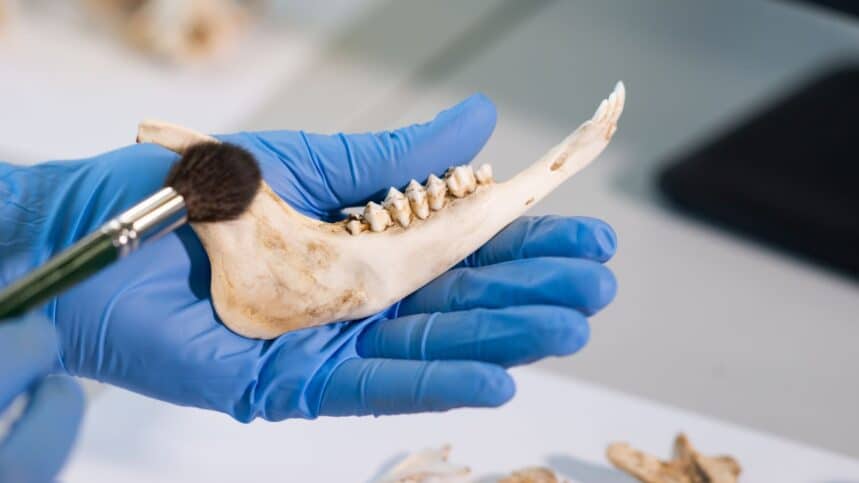
Visitors found the first clue, but investigators now face the difficult work of identifying the person.
Authorities may examine dental records, DNA, and missing-person databases in an effort to determine who the remains belonged to. Investigators will also need to establish whether the person died accidentally, naturally or under circumstances requiring further investigation.
Until then, speculation about old disappearances and Lake Mead’s notorious past will likely continue. But there is currently no official connection between the newly discovered remains and the organized-crime stories that have surrounded some previous discoveries.
For the visitors who made the discovery, the experience began with something they noticed in the shallow water. For investigators, it could be the first step toward naming someone who has remained unidentified for years.
Should the discovery prompt authorities to take a closer look at long-standing missing-person cases around Lake Mead, or should the focus remain entirely on determining what happened to these newly discovered remains?
Read More:
- 10 Riveting Underwater Ghost Towns and Their Tragic Histories
- 12 safe havens in America from heat and drought
- The Mysterious Dangers of Large Bodies of Water: 10 Compelling Reasons to Stay Away
- Puerto Rico’s Water Crisis Has Reached a Breaking Point: Why the Island Is Turning Off Taps





