

A surge in public opposition to artificial intelligence infrastructure is transforming localized land-use disputes into major national political liabilities.
The rapid nationwide expansion of artificial intelligence facilities has encountered an unexpected wave of voter resistance across traditional party lines. Once promoted as clean economic drivers, modern hyperscale data centers face mounting criticism over rising residential utility bills, severe water usage, and industrial noise pollution.
A leaked internal memo from the National Republican Senatorial Committee (NRSC), titled “Ohio Data Center Risk,” warns that voter hostility toward tech infrastructure is actively threatening key political races. The committee cautioned top technology executives that public pushback against data centers has become a central campaign issue in states hosting dense infrastructure development.
Electoral Dynamics and the Ohio Senate Race
Public backlash against hyperscale computing centers has emerged as a decisive vulnerability in high-stakes electoral contests.
In the Ohio Senate race, Democratic challenger Sherrod Brown has built an eight-point lead over incumbent Republican Jon Husted in recent statewide polling. Brown has centered his campaign messaging on opposing unvetted data center expansion, characterizing Husted as the state’s primary proponent of industrial tech projects.
The NRSC memo explicitly described data center development as “the anchor hanging around Husted’s neck.” Party strategists warned that if Husted loses his seat over data center backlash, elected officials nationwide will refuse to approve future technology projects.
Recent national polling highlights the widespread political risk facing pro-development candidates. A Gallup survey found that 70% of Americans oppose building a data center in their local community. A Reuters poll found that 64% of respondents oppose rapid AI data center buildouts, while 77% fear that high computational loads will drive up home electricity costs.
Grid Constraints and Resource Consumption
The exponential growth of generative artificial intelligence is placing severe demands on electric grids and local water tables.
Data center power consumption has expanded significantly following the widespread deployment of large language models. Goldman Sachs Research projects that global electricity demand from data centers will rise 160% to 165% by 2030 relative to 2023 levels.
A single artificial intelligence query requires approximately 2.9 watt-hours of electricity, compared to 0.3 watt-hours for a standard web search. Furthermore, AI Business Weekly reports that modern high-density GPU server racks consume up to 11 times as much energy as typical servers deployed five years ago.
The International Energy Agency estimates global data center electricity usage will double to roughly 945 TWh by 2030. In the United States, data center energy consumption is projected to grow from roughly 4% of total electricity in 2023 to 8%-12% by the end of the decade.
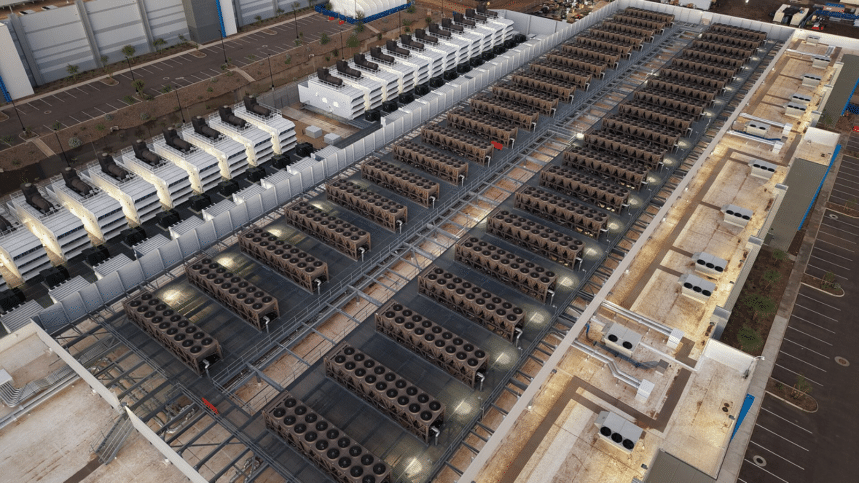
Water resource depletion has become an equally critical issue for surrounding communities. Large hyperscale facilities consume between 1 million and 5 million gallons of water daily for cooling, matching the daily water needs of a town of 30,000 to 50,000 residents.
Economic Disconnect and Local Backlash
Skepticism is intensifying as data centers receive substantial tax abatements while generating few permanent local jobs.
Local governments routinely grant long-term property tax exemptions to attract multi-billion-dollar tech investments. However, municipal studies show these facilities create relatively few long-term jobs once initial construction is complete.
Save this article
A major Central Ohio AI development project, PORTS-Pike Technology Campus in Pike County, Ohio, involved $105 billion in power commitments, promising 35,000 temporary construction jobs but only 2,500 permanent operational roles. This disparity has led local communities to question the net economic return of hosting computational facilities.
Quality-of-life concerns continue to fuel grassroots civic pushback. Residents living near facilities report continuous noise pollution from industrial cooling systems and diesel backup generators. As a result, organized local opposition delayed or blocked at least 75 data center projects across the United States in the first three months of 2026 alone.
Industry Response and National Policy Outlook
Technology executives and political strategists face growing friction between federal AI ambitions and grassroots municipal opposition.
At a White House event with business and technology leaders in August 2026, President Donald Trump addressed the growing local pushback against large-scale tech infrastructure. He has actively promoted AI data center expansion, arguing that cities will be left behind economically if they reject facilities. However, Trump acknowledged that the artificial intelligence industry “could use a little public relations help” to counteract rising public hostility.
The NRSC memo urged technology companies to take direct responsibility for public relations rather than relying on political candidates to defend the projects. Party leaders stated that developers must clearly explain to voters “who benefits, who pays, and why a community should want one.“
Industry groups are deploying significant political capital to manage the shifting regulatory environment. For example, the AI-focused political action committee Leading the Future raised $140 million to influence federal policy and election outcomes.
Strategic Horizon and Policy Realities
The intersection of energy constraints and voter pushback is fundamentally altering digital infrastructure governance.
Growing friction around data center development shows that digital expansion cannot be separated from physical resource limits and municipal approval. Lawmakers across the political spectrum are increasingly forced to balance national technological goals against local demands for grid reliability and price stability.
Macro Synthesis: The New Frontier of Infrastructure Risk
Civic resistance to high-density technology facilities is driving a major recalibration of American energy policy and digital infrastructure planning.
Voter opposition to data center construction highlights a growing divide between federal tech initiatives and community concerns regarding grid capacity, residential electricity rates, and municipal water supplies. With 75 major projects delayed in early 2026 alone, technology developers must adopt transparent resource models and co-located power solutions to mitigate political and operational risks.
How can utility regulators, municipal planners, and technology firms establish a balanced infrastructure framework that supports artificial intelligence development without overburdening local energy grids and municipal resources?
More Articles:
- Trump’s Voter Purge Got Blocked by a Trinidad-Born Judge. Now Republicans Want to Ban Foreign-Born Judges
- Trump Family Business Empire Faces Fresh Scrutiny as Republicans Join Calls for Answers
- Trump Shares Fake ‘Dr. Trump’ Video Mocking Celebrities Over ‘TDS’
- The Democrats’ biggest political challenge may not be Republicans at all





