

America’s computational engine is drinking more freshwater than ever before, creating an urgent environmental and economic challenge.
According to estimates from the Lawrence Berkeley National Laboratory, data centers across the United States directly consumed roughly 17 billion gallons (64 billion liters) of water in 2023. That is three times the 5.6 billion gallons used back in 2014.
As cloud computing and artificial intelligence expand, server farms are putting unprecedented pressure on local utility resources. Most of this water comes straight from public drinking networks.
The Sudden Spike in Digital Water Demand
Direct water consumption by domestic server farms tripled over nine years, putting major strain on public drinking systems.
To keep thousands of powerful computer chips from overheating, data centers rely heavily on liquid cooling. Evaporative cooling systems spray water over radiators to dissipate thermal energy into steam.
That process removes freshwater entirely from the local watershed. Roughly 97 percent of U.S. data centers draw their water directly from municipal drinking utilities. Why tap into city water? Potable water meets strict standards, preventing pipe corrosion and mineral buildup inside complex cooling machinery.
A single 100-megawatt data facility directly drinks as much water daily as 2,600 households. Add the water needed to generate its power, and that figure jumps to 6,500 households.
View on Threads
The AI Boom and the Hidden Grid Connection
The surge in artificial intelligence requires immense electricity, which multiplies the tech industry’s overall water footprint through power plants.
High-density AI server racks generate intense heat, requiring far more cooling capacity than standard cloud storage. But direct cooling inside the facility is only part of the story. Generating the electricity to run those servers used an estimated 211 billion additional gallons of water in 2023. Thermal power plants rely on massive amounts of water for steam generation and cooling.
When data centers switch to dry air cooling to save on-site water, they use more electricity. If that electricity comes from fossil-fuel plants, off-site water consumption actually goes up.
Research from Cornell University shows power generation accounts for over 70 percent of a data center’s total water footprint. This energy-water nexus makes facility location and regional grid sources critical.
Related: 10 Common Myths About Artificial Intelligence
Save this article
What the Experts Say About Local Impacts
Leading researchers warn that heavy server cooling competes directly with household drinking water while creating public health externalities.
“For truly sustainable AI, we need to take a holistic view of water and carbon footprints,” explains Dr. Shaolei Ren, associate professor at UC Riverside. Ren points out that data centers often compete “for the same water people drink, cook, and wash with.”
His research reveals that training an AI model like GPT-3 consumed roughly 700,000 liters of direct evaporative water. When including electricity generation and supply chains, that total jumped to 5.4 million liters.
Ren suggests simple operational adjustments, like shifting heavy training workloads to cooler night hours. “We don’t water our lawns at noon because it’s inefficient,” Ren notes. “Similarly, we shouldn’t train AI models when it’s hottest outside.“
Beyond water scarcity, data centers’ power generation creates significant public health impacts. Fossil-fuel peaker plants supply emergency power and release fine particulate matter into downwind neighborhoods.
Ren’s research estimates the public health burden of U.S. data center emissions could exceed $20 billion annually by 2030. Lower-income communities often bear the brunt of these air quality impacts.
Sustainable Solutions and the Legislative Outlook
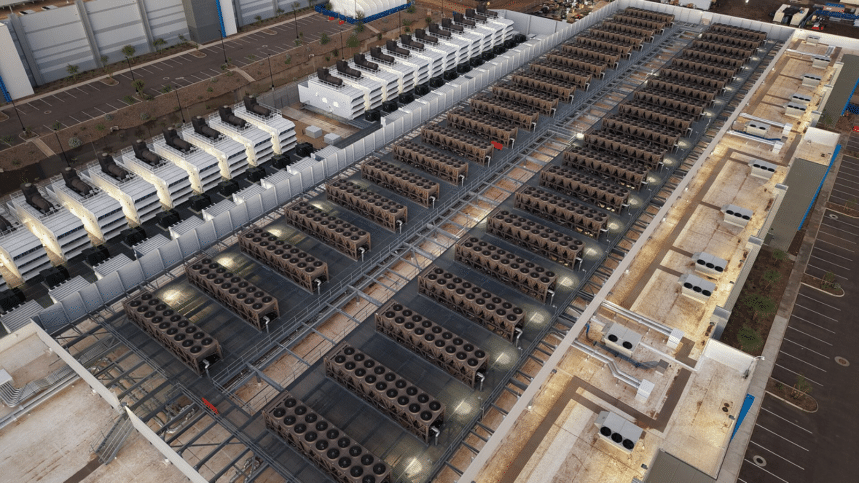
Innovative closed-loop cooling tech and new congressional bills are emerging to fix a long-standing regulatory void.
The federal government currently lacks central oversight on data center water consumption. In fact, the U.S. Geological Survey hasn’t tracked data center water use separately since 1995.
To address this governance gap, lawmakers introduced H.R. 7858, known as the Data Center Community Impact Act. The bill aims to track facility resource usage and protect local residents from rising utility rates. State leaders in Washington, Oregon, and North Carolina are also forming task forces to evaluate zoning and water protections.
Meanwhile, tech firms are investing in next-generation cooling technologies. The data center liquid cooling market is projected to skyrocket from $3.39 billion in 2025 to $23.24 billion by 2035.
Techniques like direct-to-chip liquid cooling and two-phase immersion submerge hot chips in non-conductive fluid. These closed-loop systems recycle cooling fluids, dramatically cutting direct water loss.
The Big Picture on Tech’s Thirst
Balancing modern computing needs with environmental sustainability requires clear data, smarter technology, and stronger public policies.
- Soaring Demand: U.S. data centers used 17 billion gallons of water in 2023, tripling over nine years.
- The Power Link: Indirect water use for power generation adds another 211 billion gallons annually.
- Community Tension: Drawing 97 percent of water from municipal utilities creates local resource competition and potential rate increases.
- Innovations Ahead: Closed-loop liquid cooling and targeted federal legislation like H.R. 7858 offer promising paths forward.
What steps should tech companies and local officials take to make sure expanding AI infrastructure doesn’t compromise your community’s drinking water?
More Articles You Might Like:
-
- Larry Ellison Quietly Gave $45 Million to a Pro-Trump Group—Then Oracle Landed a Starring Role in a $500 Billion AI Buildout
- Republicans Are Learning the Hard Way That Many Americans Don’t Want Data Centers
- Amazon Built a $2 Billion Data Center in Gilroy, and Half the Town Says They Found Out By Accident





