

Alaska voters thought they had settled the debate in 2024. They were wrong.
A razor-thin vote kept the state’s ranked-choice voting system alive after a repeal effort failed by just 743 votes. Now, the same battle is returning to the November 2026 ballot, but this time the fight has drawn national attention, millions of dollars, and one of the world’s most powerful political donors.
The question facing Alaskans is: Should the state keep the election system voters approved in 2020, or return to traditional party primaries and single-choice voting?
But when a state’s election rules become the target of national political spending, who is really deciding the future of democracy? The voters who live there or the groups with the deepest pockets?
That question intensified after the Alaska Daily News reported that Elon Musk contributed $1.5 million to Aurora Action Network, which later contributed $1 million to the campaign seeking to repeal Alaska’s ranked-choice voting system. The donation has turned what was once a state-level election debate into part of a larger national fight over how Americans choose their leaders.
The upcoming vote is not only about ranked-choice voting. Ballot Measure 2 would also roll back several campaign-finance rules approved by Alaska voters in 2020, including requirements involving donor disclosures, political advertising transparency, and “true source” reporting.
For supporters, the measure is about restoring a simpler election process. For opponents, it represents something much larger: a reversal of voter-approved reforms that made it easier to see who was funding political campaigns.
A voting experiment that barely survived its first repeal attempt
Alaska became one of the first states in the country to adopt a new election model when voters approved Ballot Measure 2 in 2020.
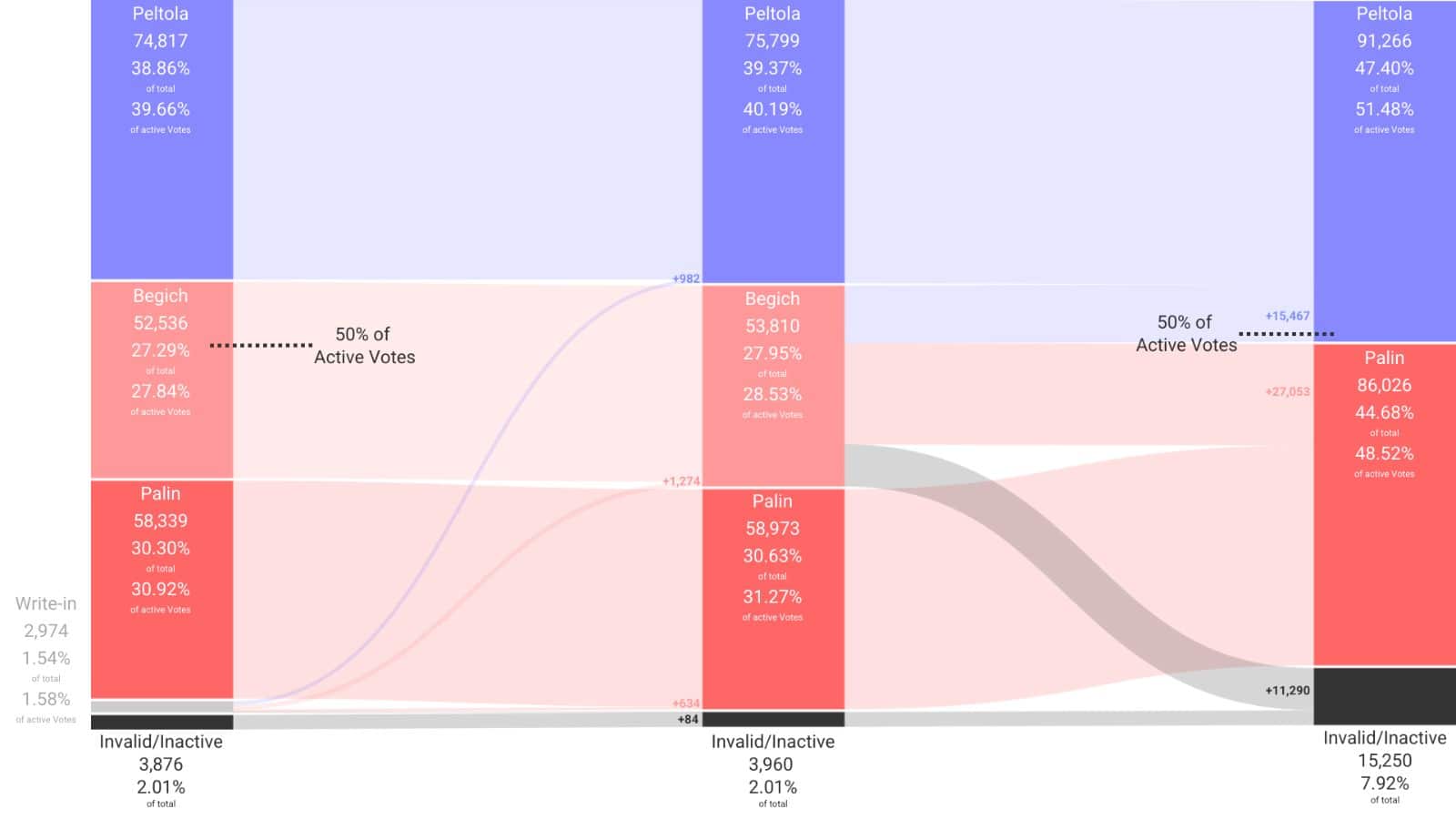
The system replaced traditional party primaries with an open top-four primary, meaning all candidates compete in one primary regardless of party affiliation. The top four finishers then advance to a ranked-choice general election, where voters rank candidates by preference.
The 2020 vote was extremely close.
The measure passed with 174,032 votes compared with 170,251 votes against it, a margin of just over 3,700 votes.
Four years later, opponents tried to undo the system.
The 2024 repeal campaign appeared to succeed on election night, but after a recount, the result flipped. The repeal effort lost by 160,973 votes to 160,230 votes, a difference of only 743 ballots.
Few election debates in America have been decided by such a narrow margin.
Now Alaska voters are being asked the same question again.
The new repeal initiative, known as 24ESEG, collected enough signatures to qualify for the November 2026 ballot. The Alaska Division of Elections verified 42,837 qualified signatures across 40 House districts, exceeding the requirement of 34,098 signatures across 30 districts.
The result is a rematch between two visions of elections: one focused on simplicity and traditional party structures, and another focused on giving voters more choices.
Why millions of dollars are flowing into an Alaska election fight
Alaska has fewer than 750,000 residents, so why has its voting system attracted national attention?
The answer is influence.
Election rules adopted by one state can become a model, a warning, or a political symbol for campaigns across the country. Ranked-choice voting has expanded in recent years, but it has also faced growing opposition.
The Alaska campaign has become one of the most expensive fights over election structure in the country.
According to Alaska Public Media reporting, the pro-repeal group Repeal Now had raised about $1.1 million by late July 2026, including $846,000 from Aurora Action Network.
The opposing campaign, Protect Alaska’s Elections / No on 2, had raised significantly more at that point, reporting $5.75 million, including $4 million from Unite America PAC and $1.5 million from Voters for the American Center.
The money is coming from outside Alaska on both sides.
That fact has created an unusual political reality: a debate about Alaska’s elections is being financed largely by organizations far beyond Alaska’s borders.
The central disagreement is no longer only about how ballots are counted. It is also about who gets to shape the rules.
The fight is bigger than ranked-choice voting
One of the most overlooked parts of Ballot Measure 2 is that it would do more than eliminate ranked-choice voting.
The measure would also repeal or modify several campaign-finance provisions passed in 2020.
Those changes include rules involving:
- “True source” disclosures showing the original source of certain political contributions.
- Digital political advertising disclosures.
- Certain rules involving out-of-state and undisclosed contributions.
- Definitions related to campaign expenditures.
- Some civil penalties tied to those provisions.
Save this article
Supporters of repeal argue these rules created unnecessary burdens for campaigns and required political groups to spend too much money on disclosure requirements.
Bethany Marcum, treasurer of the Repeal Now campaign, argued that the rules make it harder for smaller campaigns to operate.
“Our campaign is about one person, one vote,” Marcum said. “That’s been the bedrock of the American Republic for the last 250 years.”
Opponents see the issue differently.
They argue the campaign-finance changes are not a side issue but a major part of the proposal. Scott Kendall, a strategist supporting the opposition campaign, described the measure as going beyond ranked-choice voting.
“Ballot Measure 2 is a bit of a Trojan horse,” Kendall said. “Repealing RCV, that is only a fraction of what the measure does.”
The disagreement reveals why the measure has become so controversial. Voters are not simply deciding how they rank candidates. They are also deciding how much information voters should have about political spending.
Supporters say voters want simpler elections
Supporters of Ballot Measure 2 argue Alaska’s current system created confusion.
They say many voters prefer the traditional approach: choose one candidate in a primary, then choose one candidate in the general election.
They also argue ranked-choice voting can produce unexpected outcomes because the candidate with the most first-choice votes does not always win.
Critics point to the complexity of ranking candidates, explaining the system to voters, and waiting for final results after multiple counting rounds.
The Alaska Public Offices Commission estimated implementing the system has cost the state about $2.6 million, another point supporters use to argue that returning to traditional elections would simplify administration.
But critics say those arguments overlook what ranked-choice voting was designed to change.
Opponents say the system gives voters more power
Supporters of Alaska’s current system argue ranked-choice voting gives voters more freedom.
Instead of choosing only one candidate, voters can rank multiple candidates. If their first choice does not survive, their vote can move to their next preference.
Supporters say this reduces the fear of “spoiler” candidates, where a popular third-party or independent candidate can divide votes and change the outcome.
They also argue the open primary system prevents elections from being dominated only by the most partisan voters.
Under the previous system, candidates competed within party primaries before facing each other in the general election. Under the current system, every voter participates in the same primary regardless of party affiliation.
Opponents worry repealing the system could reduce the influence of independent voters.
Alaska’s vote could influence the national debate
Only a few states use ranked-choice voting statewide.
Alaska and Maine are currently the only states using the system for regular statewide elections, although several cities across the country use ranked-choice voting in local elections.
At least 19 states have laws restricting or banning ranked-choice voting, showing how quickly the issue has moved from an election-reform experiment to a national political fight.
But Alaska’s decision will be closely watched because it represents one of the largest real-world tests of whether voters want to keep the system after using it.
The outcome will not settle the national debate over ranked-choice voting.
Supporters will still argue it gives voters more choices. Critics will still argue it creates unnecessary complexity.
But Alaska’s 2026 vote will answer one important question:
After six years of living with a new way of voting, do Alaskans believe the experiment improved their elections, or do they want to return to the system they replaced?
More Articles:
- Trump’s Voter Purge Got Blocked by a Trinidad-Born Judge. Now Republicans Want to Ban Foreign-Born Judges
- Making Fauci Public Enemy Number One Could Cost America the Next Health Fight
- Hillary Clinton Says Joe Biden Made a “Terrible Mistake” Running for Reelection… And She’s Done Beating That “Horse”
- Ways cities are planning for residents too young to vote





