

When the screen failed during a Toronto housing announcement, the Canadian prime minister used the silence to revive Trump’s United Nations “sabotage” claims, with a 50% U.S. tariff deadline days away.
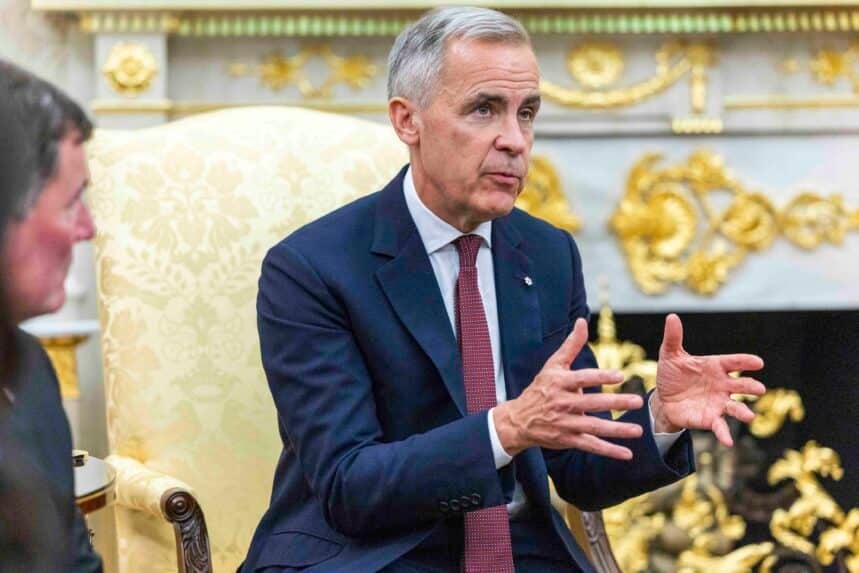
Mark Carney was midway through a housing announcement in Toronto on Wednesday, gliding between English and French, when the teleprompter carrying his script went dark. He stopped, told the room the machine had failed, and reached for a line aimed squarely at Donald Trump.
“Unlike a certain world leader, I do not view this as a conspiracy,” the prime minister said, to laughter, before slipping back into French, Reuters reported.
He never mentioned Trump by name. He didn’t have to. Neither Carney’s office nor the White House immediately responded to requests for comment.
The timing gave the line teeth. Carney’s aside resurrected one of the stranger set pieces of Trump’s year, and it came only hours before the president, at a rally-style event in Las Vegas, called Canada “nasty.” Nothing suggests Trump had heard the joke. Behind both jabs sat a hard date: a 50% U.S. tariff on a range of Canadian goods is set to take effect Aug. 19.
The C$2.7-billion plan the joke nearly buried
Carney had come to Toronto to stand with Mayor Olivia Chow and unveil a substantial housing plan, the kind of policy news that rarely travels far. Over three years, the federal government and the city say they will invest more than C$2.7 billion (about US$2 billion) in at least 18 projects, delivering more than 5,600 rental homes, with construction underway on over 4,500 of them before the end of the year, according to the Prime Minister’s Office. Every home in the portfolio is a rental, from market units to affordable, supportive and rent-controlled housing.
The money runs through two channels: more than C$310 million from a federal agency called Build Canada Homes for nine projects on city land, over C$530 million in discounted land from Toronto, and more than C$1.8 billion in low-cost federal financing for nine more developments. The list includes a 100-unit, Indigenous-led supportive housing project and two buildings using mass-timber and modular construction that Ottawa says cut waste and emissions.
Save this article
The work is expected to support roughly 2,100 construction jobs a year and to run on Canadian steel and lumber under the government’s Buy Canadian rules, a pointed choice in the middle of a tariff war. Carney called Toronto “a model for how a great city can build its way forward.” The Toronto deal is part of a wider push; the government says Build Canada Homes, launched last year, has already committed to nearly 17,000 homes nationwide.
The United Nations moment Carney was needling
The “certain world leader” was not hard to place. Last September, as Trump began an address to the United Nations General Assembly in New York, his teleprompter went dark, an escalator he and first lady Melania Trump had stepped onto lurched to a stop, and he complained that the hall’s sound had cut out. In the moment, he made light of it, telling the assembly that whoever was running the teleprompter was “in big trouble.”
The next day, he escalated. Trump alleged “sabotage,” demanded an investigation, and asked the U.N. to preserve the escalator’s security footage. U.N. officials offered a more mundane account: a safety mechanism had stopped the escalator after a member of the U.S. delegation appeared to trigger it, and running the teleprompter had been the Trump team’s own responsibility.

‘You can change the adjective’
A dead teleprompter is usually a shrug. This one landed during the sharpest downturn in U.S.-Canada relations in years. Since returning to office, Trump has piled tariffs on Canadian goods, let the U.S.-Mexico-Canada trade pact lapse in early July, and repeatedly floated the idea of annexing Canada as the 51st state, which Carney has flatly rejected. Late last month, Trump ordered the 50% tariff now due Aug. 19, which the White House cast as a response to Canada’s “discriminatory” treatment of American products. Carney has answered by leaning into Canadian sovereignty and courting trade partners beyond the United States.
That was the backdrop when Trump took the stage in Las Vegas on Wednesday, ahead of November’s midterm elections, and ran through a list of countries he said had taken advantage of the U.S. on trade. He landed on Canada. He said he loved its people, “but they’re nasty,” and called the country’s leadership nasty too.
Carney’s reply waited until Thursday. Asked about the insult, he laughed and brushed off the wording. “You can change the adjective and say ‘nasty,'” he said, before turning to what he framed as the real stakes: Canadian jobs and Canadian businesses that he vowed to keep defending as negotiations continue.
For now, the most cutting weapon either leader has drawn is a sentence. That changes on Aug. 19, when the tariffs are set to take effect, and the two sides are still at the table.





