

A woman walked into a New Hampshire thrift store looking for old frames. She left with a painting that cost about the same as a cup of coffee.
For years, it did not seem like a life-changing purchase. The artwork hung in her home, then ended up stored away. It was easy to overlook: an old oil painting in a white frame, bought for $4 at a Savers store in Manchester in 2017.
Then came the detail that changed everything.
When the painting resurfaced years later, the owner noticed clues that suggested it might not be an ordinary thrift-store find. After images were shared online, people familiar with the Wyeth family of artists began taking a closer look. Eventually, experts connected the painting to N.C. Wyeth, one of the best-known American illustrators of the early 20th century.
The painting was identified as “Ramona,” an oil-on-panel illustration connected to a 1939 edition of Helen Hunt Jackson’s novel Ramona. Bonhams Skinner, the auction house that handled the work, listed it as Newell Convers Wyeth, “Ramona,” frontispiece illustration showing Señora Gonzaga Moreno and Ramona, with an estimate of $150,000 to $250,000.
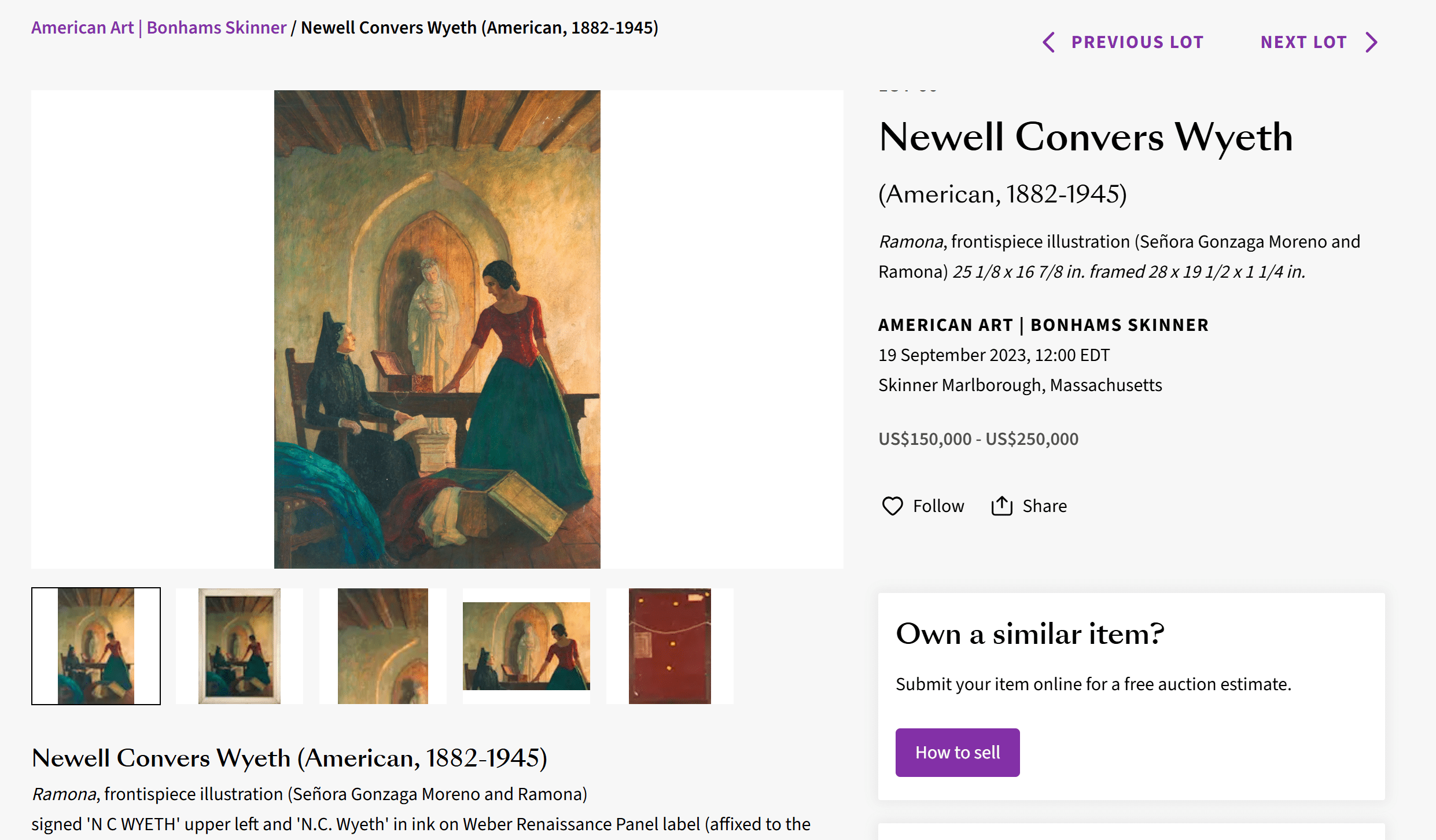
That is a staggering leap for something bought casually at a thrift store.
N.C. Wyeth was not just any artist. He was a major American illustrator whose work appeared in books and periodicals, and he was also the father of painter Andrew Wyeth and grandfather of Jamie Wyeth. NPR described him as one of the “preeminent illustrators” of his era, known to many readers through his illustrations for adventure books such as Treasure Island.
The painting’s path from Wyeth’s studio to a discount store remains part of the mystery. According to reporting from Smithsonian Magazine, the work was one of four illustrations Wyeth created for the 1939 edition of Ramona. The back of the frame reportedly helped provide additional clues during the authentication process.
For anyone who has ever browsed a thrift shop and wondered whether something valuable might be hiding in plain sight, the story had the perfect hook. An ordinary shopper. An ordinary store. A forgotten object. Then, suddenly, a possible six-figure discovery.
In September 2023, the painting went to auction at Bonhams Skinner. It sold for a hammer price of $150,000, with fees bringing the reported total to $191,000.
But the story did not end there.
In a twist that made the tale even stranger, later reporting found that the winning bidder did not pay. Hyperallergic reported that after the auction, the buyer failed to complete the purchase, and the painting was returned to its owners.
Save this article
That detail turns the story from a simple “thrift store treasure” headline into something more complicated. On paper, the painting had gone from $4 to $191,000. In reality, the owners were left with the painting again, along with the difficult question of what to do next.
After the September 19, 2023 Bonhams Skinner auction produced a reported $191,000 sale that later fell through because the buyer did not pay, the painting was sold privately with help from Aviva Lehmann of Heritage Auctions. Artnet reported on December 19, 2023 that the N.C. Wyeth painting was sold at a public library in Keene, New Hampshire to a private collector for more than $100,000.
Still, the discovery itself was real. The painting was not just a lucky decorative find. It was authenticated, cataloged, and publicly offered by a major auction house. The official Bonhams listing placed its estimate in the six figures, and the auction result showed how much interest a rediscovered Wyeth could generate.
The case also shows why old objects can be so hard to judge. Most thrift-store paintings are worth little beyond their decorative appeal. Many signatures are hard to read, many frames are newer than the art inside them, and many pieces that look old are simply reproductions. But occasionally, provenance, materials, subject matter, and expert review line up in a surprising way.
That is what makes this story so irresistible. It is not really about getting rich from a $4 purchase. It is about the possibility that history can pass through ordinary hands without anyone recognizing it at first.
A painting once connected to one of America’s most famous illustration families somehow ended up in a New Hampshire thrift store. It hung in a home, disappeared into storage, resurfaced during cleaning, and then drew the attention of art experts.
The owners may not have walked away with the expected auction payout. But they did end up with something rare: a real-life art mystery that began in a secondhand store and led all the way to a major auction house.
The lottery of thrifting… will you be the lucky thrifter next?
Most thrift-store finds are exactly what they appear to be, but the rare exceptions explain why people keep looking. Sometimes the thing everyone walks past is the one object with a hidden story.
Read Next:
- Is That Old Jewelry or Art Worth Something? How to Find Out Without Getting Scammed
- Visit A Museum: Why Art IRL Matters in a Digital World
- How a thief, not da Vinci, made the Mona Lisa iconic
Disclosure: This article was developed with the assistance of AI and was subsequently reviewed, revised, and approved by our editorial team.
**Like our content? Be sure to follow us on Newsbreak.





