

A prosthetic hand that can close around an object is useful, but everyday life demands much more than basic grasping. People need to pinch tiny objects, reposition their fingers, control grip strength and adapt instantly to objects that bend, slip or break. Engineers have now developed a soft robotic hand designed to handle exactly those kinds of tasks.
Four people with upper-limb amputations tested the experimental neuroprosthetic hand. They used it for activities including braiding hair, handling pills, cutting with scissors, steering a car and continuously screwing in a light bulb.
The difference came from a design that gave the robotic hand far more independent movement than many existing prostheses, while still allowing users to control it through muscle signals from their remaining limb.
The robotic hand has 11 independently controlled movements
Human hands are extraordinarily difficult to reproduce because their dexterity comes from many joints and movements working together. Conventional prosthetic hands often simplify that problem by concentrating on a smaller number of grasping patterns, which can make delicate everyday manipulation difficult.
The study describes a soft neuroprosthetic hand with 11 active degrees of freedom. In simple terms, different parts of the hand can move in several independently controlled ways rather than behaving like one rigid gripping mechanism.
The design combines soft pneumatic fingers with motor-driven movement involving the thumb and palm. This allows the thumb to oppose the fingers while the fingers bend and adapt around different objects.
The soft materials also give the hand some natural compliance. Instead of forcing every object into one predetermined grip shape, the fingers can conform around objects as they make contact.
Takeaway: The researchers increased both the number of controllable movements and the hand’s ability to adapt physically to the objects it touches.
Users controlled it using muscles in their remaining limb
The hand may look mechanically complex, but the researchers tried to keep the control system relatively simple for the person wearing it. Users controlled the prosthesis through electrical signals produced by muscles in the residual limb.
The system uses two channels of surface electromyography, or sEMG. Sensors placed on the skin detect electrical activity from two opposing muscle groups when the wearer attempts particular movements.
A decoding system then translates those signals into commands for the prosthetic hand. It can interpret not only which movement the person intends but also aspects of movement speed.
That matters because adding more mechanical capabilities is not useful if controlling them becomes so complicated that the person cannot use the hand naturally during everyday activities.
Takeaway: The prosthesis translated muscle activity from the residual limb into multiple hand movements without requiring an extremely complicated control interface.
Four amputees tested it on real-world tasks
Researchers tested the hand with four people with upper-limb amputations, ranging in age from 38 to 70. Instead of limiting the evaluation to laboratory gripping tests, they also asked participants to use the hand during recognizable daily activities.
The prosthetic hand could hold a pill bottle securely enough for the person’s other hand to open it and remove medication. Participants manipulated scissors, handled fragile objects during food preparation and continuously turned a light bulb while screwing it into place.
The hand could also maintain a stable grip on a steering wheel or handlebars. That allowed the user’s unaffected hand to briefly perform another action without completely losing control of the vehicle.
Those examples help explain what additional dexterity actually means. The goal is not simply producing more impressive finger movements in a laboratory. It is giving someone enough control to participate more naturally in tasks that normally require two hands.
Related: 7 Ways Technology Is Transforming Healthcare
Takeaway: The hand’s extra movement translated into practical abilities involving medicine, cooking, tools and transportation.
One participant used it to style her daughter’s hair
One of the most striking demonstrations involved a female participant using the prosthetic hand while styling her daughter’s hair. Hair is particularly difficult for a robotic hand because it is soft, flexible and constantly changes shape as it is handled.
The participant used the prosthesis to gather and align strands of hair, release and grasp them again, guide the hair and help form a ponytail and bun.
Save this article
The soft covering around the fingers and palm was important because rigid mechanical components could catch or entangle the hair. The compliant design allowed the hand to interact more gently with it.
This task also highlights something that standardized prosthetic tests can miss. Hand function is not only about independence in eating or dressing. It can affect family interactions, hobbies and physical contact with other people.
Takeaway: The soft hand was capable of adapting to delicate, unpredictable materials rather than only rigid objects with predictable shapes.
The hand performed better on standardized tests too
Researchers did not rely solely on impressive demonstrations. The participants also completed established prosthetic-hand tests, allowing the new design to be compared with existing approaches under more controlled conditions.
The high-dexterity hand performed strongly in tests involving grasping and manipulation, and users were able to maintain reliable control despite relying on only two muscle-signal channels.
The researchers also observed fewer compensatory body movements. People using limited prostheses sometimes have to move their shoulders, torso or unaffected arm in unusual ways because the prosthetic hand itself cannot achieve the required position or grip.
Giving the hand more adaptable movement may allow the rest of the body to work more naturally.
Still, the system has limitations. Tasks requiring very high forces could exceed its current capabilities, and researchers say future versions will need to increase strength without sacrificing comfort, softness or wearability.
Takeaway: Greater hand dexterity may reduce the need for users to compensate with awkward movements elsewhere in the body.
Four participants are not enough to prove how well it will work broadly
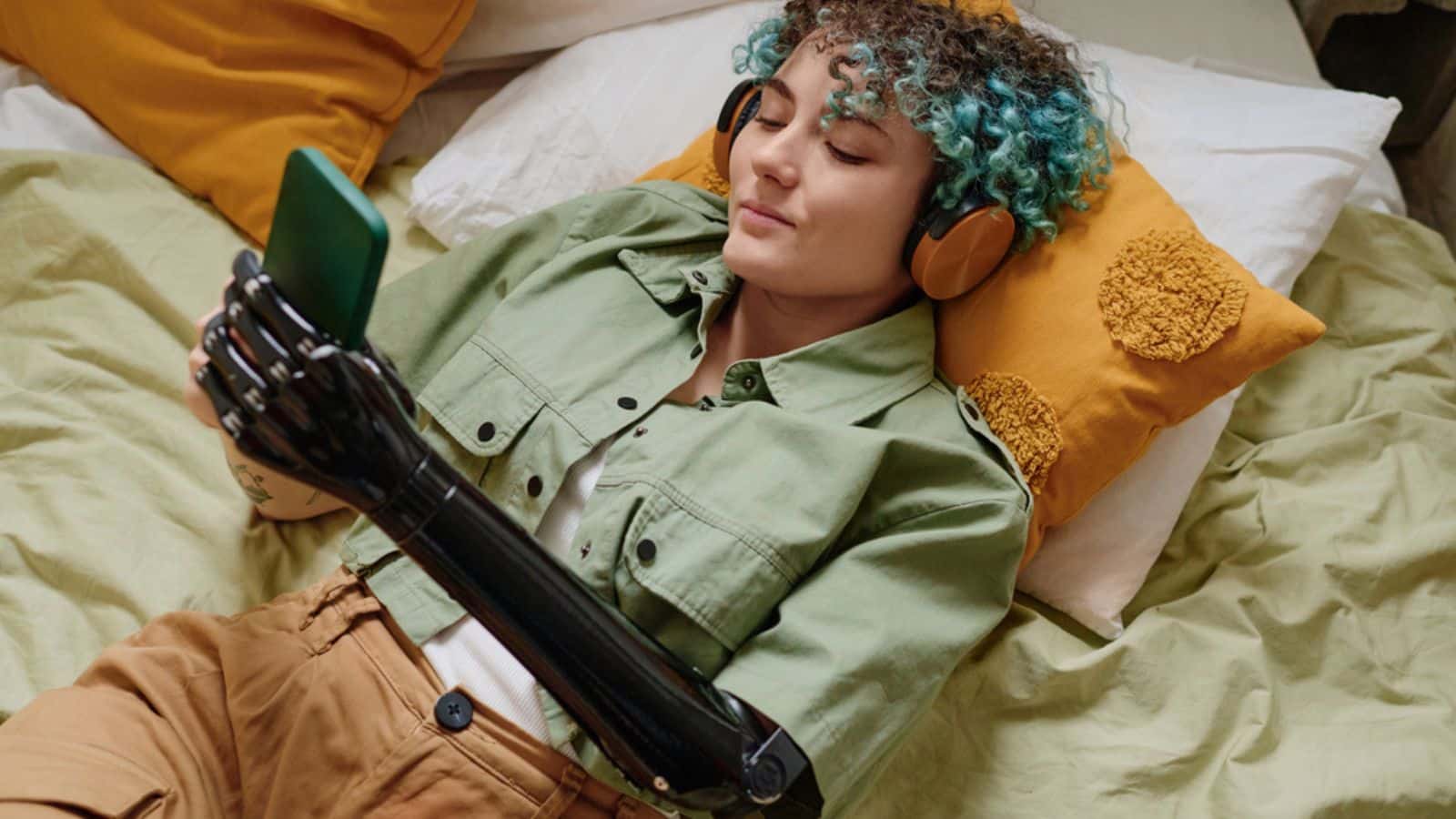
The results show what the technology can do, but the study involved only four people. That is enough for an early demonstration, not enough to establish how reliably the prosthesis would perform across the much larger and more diverse population of people with upper-limb amputations.
Different amputations leave different amounts of muscle and nerve function available for controlling a prosthesis. Comfort, long-term durability, learning time and performance outside a supervised research environment will also matter.
The current system contains supporting actuation components and electronics that users carry separately, meaning engineers still have practical work to do before a hand like this could become an easy everyday replacement for conventional devices.
Larger studies will also need to examine how people perform after months or years of regular use rather than during a limited experimental period.
Takeaway: The study is an encouraging proof of concept, but it does not yet show that this hand is ready to replace existing prostheses for most amputees.
The real breakthrough may be making prosthetic hands feel useful in ordinary life
Advanced robotic hands can look impressive without necessarily making everyday tasks easier. What makes this research stand out is that the engineers focused on the kinds of small, continuous adjustments that human hands make almost without thought.
Braiding hair requires one kind of control. Taking a pill from a bottle requires another. Scissors, steering wheels and light bulbs all demand different finger positions, pressures and movements.
Giving a prosthetic hand enough flexibility to move between those tasks brings engineers closer to a device that acts less like a specialized gripping tool and more like a general-purpose hand.
The technology still has a long path before widespread use, but its success with ordinary activities shows why increased robotic dexterity matters. For someone missing a hand, the most meaningful breakthrough may not be a spectacular laboratory feat. It may be being able to do an everyday task without having to think twice about it.
Question for you. Which everyday task in this study best demonstrates to you how advanced this robotic hand has become?





