Got bad breath? Yes, we asked! Or maybe you have a dry mouth or just want a piece of gum, but are following the low FODMAP diet. We have suggestions for you that are Elimination Phase compliant; you have many choices, as you will see below!
Breath mints and certainly gum are part of the world of candy, and if you are following the low FODMAP diet, there are many ingredients to be aware of that are best left on the shelf.
General Candy Label Information
We have an in-depth article, The Comprehensive Guide to Low FODMAP Candies: Indulge Without Discomfort, that we suggest reading, but here we will dive into breath mints and gum in particular.
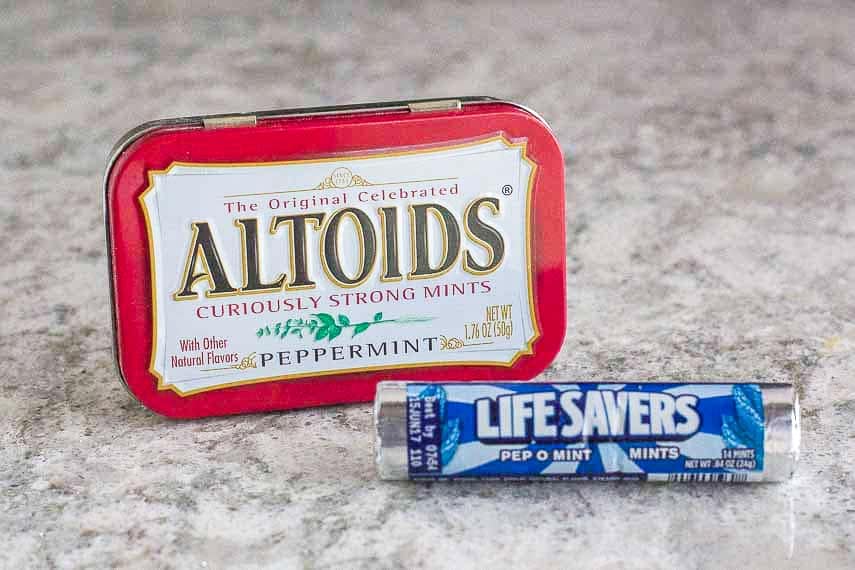
Image credit FODMAP Everyday.
Bad Breath

Bad breath, or halitosis, usually starts in the mouth, and most often it comes down to bacteria. Throughout the day, bacteria break down leftover food particles, dead cells, and proteins in saliva, releasing sulfur-containing compounds that have that unmistakable unpleasant odor.
If brushing and flossing are inconsistent, or if food gets trapped between teeth or along the gumline, those bacteria have more fuel to work with. Dry mouth makes things worse, because saliva normally helps wash away debris and keep bacterial growth in check. Beyond oral hygiene, certain foods can temporarily contribute, while underlying issues such as gum disease, cavities, sinus infections, or even digestive conditions can create more persistent problems.
In many cases, bad breath isn’t just about what you ate, but about the overall balance of bacteria and moisture in your mouth. But no fear! Breath mints can help. Of course, we also encourage you to address any underlying issues with your doctor, as well.
Dry Mouth Is An Issue
In addition to bad breath, some of us experience dry mouth. It could be that we are taking medications that have dry mouth as a side effect, or maybe we are in a very dry environment – there are many reasons for dry mouth.
But regardless of the reasons, we need a low FODMAP choice; something to suck on that doesn’t trigger irritable bowel syndrome (IBS) symptoms.
A Note About Chewing Gum

Some folks are mint people, and some like gum. It is your choice, but one caveat is that the act of chewing gum can introduce gas into your system, which is something that can be problematic for people with IBS. Know your tolerance and limits.
And perhaps, you have been a gassy person who chews gum and never thought of the connection? If this is you, try not chewing gum to see if there is an improvement.
Low FODMAP Mint & Gum Ingredients
In the pre-FODMAP days, we could run into a convenience store, gas station, or drug store and take our pick of breath mints or chewing gum. But if you are a label reader, you know that all of these are potential minefields containing high-FODMAP ingredients, specifically Polyols. Luckily, there is an easy way to know what to look for on labels. To begin, look for these ingredients ending in -ol:
Steer Clear Of These Sugars
- Sorbitol
- Xylitol
- Mannitol
- Maltitol
- Lactitol
- Isomalt
You want to avoid all of these, but when reading breath mint, candy, or gum labels, keep an eye out for sorbitol, xylitol, and maltitol in particular. Statistically, they seem to really trigger IBS symptoms in many people.
A Special Note About Erythritol
According to Monash University:
“Erythritol appears to be well absorbed in the small intestine… One study showed that Erythritol is more difficult for bacteria in the large intestine to break down, so might be less likely to cause gas or bloating symptoms than other sugar polyols (even when it is malabsorbed), but more research is needed to clarify this… Unfortunately, the effects of Erythritol have not been studied in people with IBS, so whether or not this is a problematic polyol for people with IBS remains unclear…”.
Low FODMAP Sweeteners
Here are sweeteners that are appropriate while following the low FODMAP diet:
Did you know that cane sugar contains no FODMAPs at all? It’s true! Read more in our Explore and Ingredient: Sugar & Sweeteners.
We have added amounts for those sweeteners that have small servings, but when it comes to one piece of gum or a single mint, these numbers are usually compliant.
- Cane sugar
- Beet sugar ((up to 7 g per serving)
- Maple syrup
- Corn syrup (not high fructose corn syrup)
- Rice syrup
- Golden syrup (up to 7 g per serving)
- Rice malt syrup
- Barley malt extract syrup (up to 12 g per serving)
- Honey (up to 4 g per serving)
- Stevia (up to 5 g per serving)
- Agave (up to 5 g per serving)
- Sorgum syrup
- Tapioca syrup
- Dextrose
Artificial & Natural Flavorings
Some mints and gums have “natural flavors,” and those can be problematic, but they are used in small amounts. Please read our article, How To Decipher “Natural Flavors” & “Spices” on Food Labels for the Low FODMAP Diet.
Artificial flavors are low FODMAP and never a FODMAP issue.
Carrageenan, Guar Gums, Other Gums & Additives
Some people with IBS do not tolerate gums well, but they are low FODMAP, and that is what we are focused upon. And, let’s take a moment to differentiate between chewing gum itself, and “gums” used as ingredients.
When you look at the ingredient list on candy or chewing gum, the word “gum” usually refers to plant-derived thickeners or stabilizers—not chewing gum itself. These ingredients help give candy its texture, chew, and shelf stability. Here are the most common ones you’ll see, and what they actually are:
Gum arabic (acacia gum)
One of the oldest and most widely used. It comes from the sap of acacia trees and is used in gummies, hard candies, and coated sweets to create a smooth texture and prevent crystallization.
Guar gum
Derived from guar beans. It’s a thickener often used in chewy candies, ice cream, and even gluten-free baking to improve texture and moisture retention.
Xanthan gum
Produced through fermentation (usually from corn or sugar). It’s very effective at stabilizing mixtures and is commonly used in both candies and processed foods. We have an article for you that delves deeper into Guar Gum and Xanthan Gum.
Save this article
Carrageenan
Extracted from red seaweed. It helps create gel-like textures and is often found in softer candies, jellies, and puddings.
Gum tragacanth
Less common today but traditional. It comes from a Middle Eastern shrub and is used in some specialty confections for a firm yet elastic texture.
Gellan gum
A newer, fermentation-derived gum that can create very specific gel textures. You might see it in modern or specialty candies.
Agar (agar-agar)
Another seaweed-derived gelling agent, often used in place of gelatin in vegan candies.
When it comes specifically to chewing gum, the “gum base” is different. Traditionally, it was made from chicle, a natural latex from sapodilla trees. Today, most commercial chewing gum uses a synthetic gum base, which is a blend of food-grade elastomers, resins, waxes, and softeners designed to create that long-lasting chew.
So while the word “gum” shows up a lot on labels, it usually means a natural thickener or stabilizer—and only in chewing gum does it refer to the actual chewy base.
Low FODMAP Breath Mint & Gum Choices

We suggest looking for breath mints and gum made with cane sugar, to begin your search, since it contains no FODMAPs at all. This confuses some people because they think sugar is “bad.” It is true that excess sugar can be an IBS trigger for some people, but that is a different thing from being high FODMAP; to repeat, white cane sugar contains no FODMAPs at all.
Mints
Here are our recommendations for low FODMAP mints:
- Simply Gum Breath Mints Peppermint: Cane sugar and pure peppermint oil.
- Good Times Organic Mints: Cane sugar and several flavors.
- Clawhammer Organic Mints Hot Cinnamon: Cane sugar and flavor choices.
- Vermints Organic Cinnamon Mints, Wintergreen, Ginger and other flavors, too: Cane sugar, tapioca syrup, and organic maple syrup.
- Altoids Classic Peppermint; Cinnamon, Wintergreen, and Spearmint, too: Sugar.
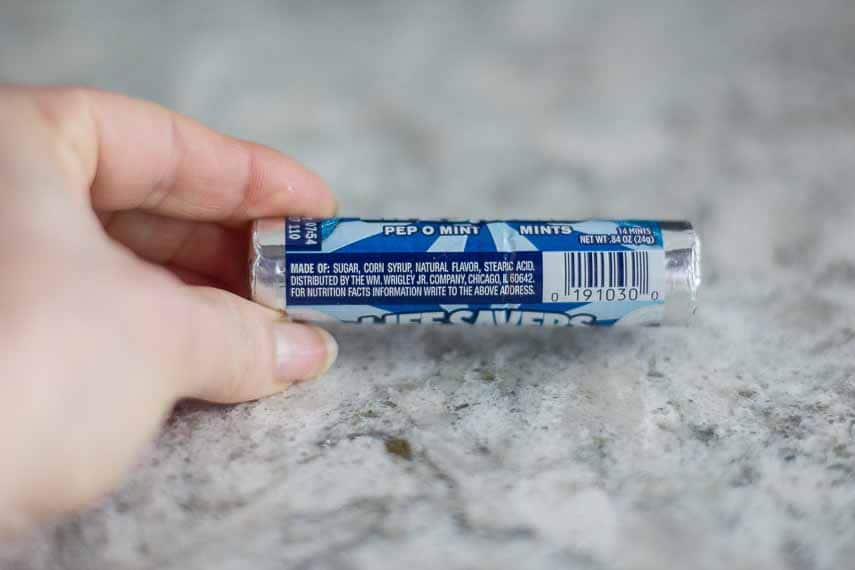
- PepOMint Life Savers: Sugar and corn syrup.
- Wint-O-Green Life Savers: Sugar and corn syrup.
- Trader Joe’s Organic Peppermints: Sugar, tapioca syrup, maple syrup.
- 365 by Whole Foods Market, Peppermints: Sugar, invert sugar, dextrose.
Chewing Gums
Here are our recommendations for low FODMAP gum:
- Simply Gum: Organic cane sugar; spearmint, cinnamon, ginger, and maple flavors. Easy to find.
- Glee Gum: Sweetened with cane sugar, or brown rice syrup, depending on variety. Stick and pellet form.
- Real Good Gum: A few flavor choices, including “Hello, Bubbleful”, a cane sugar-sweetened bubble gum!
A Peek at Labels
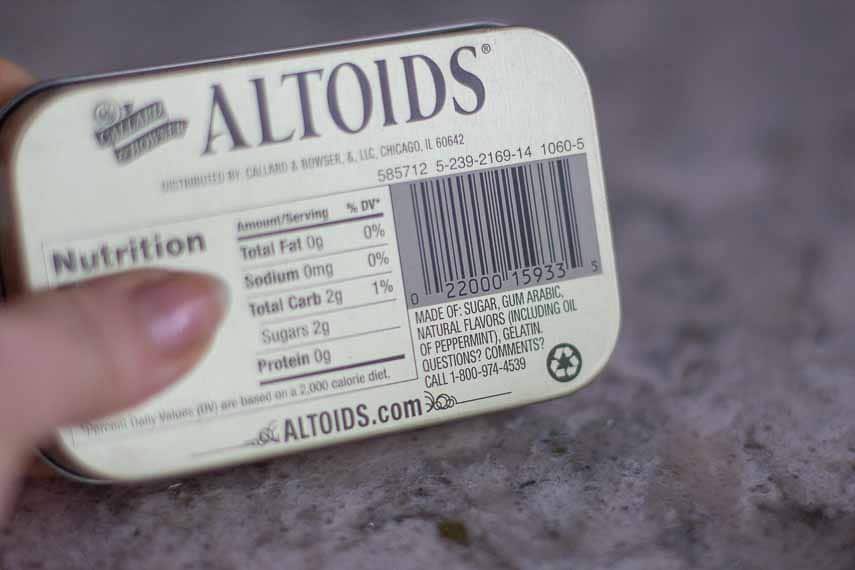
Take a look at the Altoids tin below. Every ingredient has low FODMAP amounts.
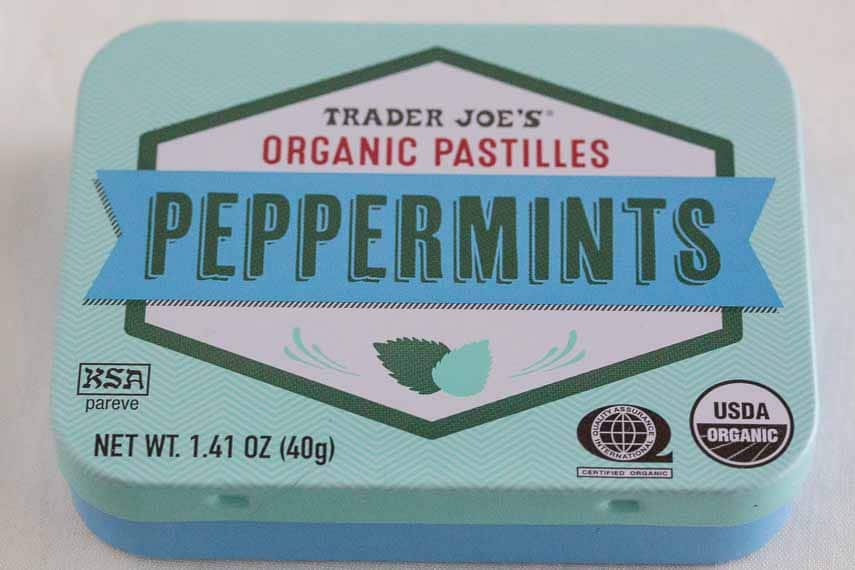
Or in the case of the Trader Joe’s mints, which contain maple syrup as well.
Learning to read labels for low FODMAP ingredients is a must when following the diet. Take a look at this article, too: How to Read Food Labels for the Low FODMAP Diet with Confidence.
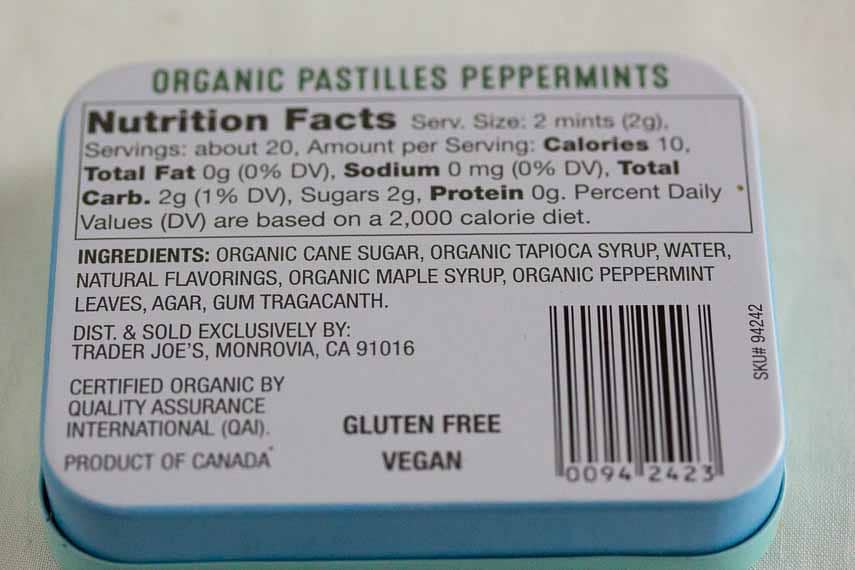
Note that the Altoids contain gelatin, which won’t work for vegans. The Life Savers have a simple ingredient label. And you can see that, in the case of Trader Joe’s, they are even labeled as vegan and gluten-free. As with all untested food, try a small amount (1 mint) and see how you feel.
Where Can I Buy?
If you are stopping at a gas station or convenience store, you can usually find Altoids and Life Savers quite easily. Most of the others are available through Amazon and other online sellers.


Last update on 2026-10-23 / Affiliate links / Images from Amazon Product Advertising API

Last update on 2026-10-23 / Affiliate links / Images from Amazon Product Advertising API

Last update on 2026-10-23 / Affiliate links / Images from Amazon Product Advertising API

Last update on 2026-10-23 / Affiliate links / Images from Amazon Product Advertising API

Last update on 2026-10-23 / Affiliate links / Images from Amazon Product Advertising API
Last update on 2026-10-23 / Affiliate links / Images from Amazon Product Advertising API

Last update on 2026-10-23 / Affiliate links / Images from Amazon Product Advertising API

Last update on 2026-10-23 / Affiliate links / Images from Amazon Product Advertising API

Last update on 2026-10-23 / Affiliate links / Images from Amazon Product Advertising API

Last update on 2026-10-23 / Affiliate links / Images from Amazon Product Advertising API
If you have a favorite low FODMAP mint, let us know what it is!