

If you’re over 65, the number you’ve spent decades worrying about on the bathroom scale may not be the number that matters most.
New research involving nearly 7,000 older Americans suggests that waist size may reveal health risks that BMI can miss—and being a little heavier wasn’t necessarily associated with a shorter life.
The findings are striking. Older men classified as overweight had a 46% lower risk of death during the study period than men in the normal-BMI category, while men with class I or II obesity had a 51% lower risk. At the same time, having a high waist circumference was associated with a 24% higher mortality risk in both men and women.
BMI doesn’t tell the whole story
That doesn’t mean older adults should try to gain weight—or that obesity is harmless. But it does challenge a familiar assumption: that getting your BMI into the “normal” range is always the healthiest goal as you age.
The study, published in the Journal of the American Geriatrics Society, followed 6,905 U.S. adults ages 65 and older using 14 years of nationally representative data.
What researchers found suggests that where you carry weight may tell us something BMI alone cannot.
A larger waist was associated with greater risk
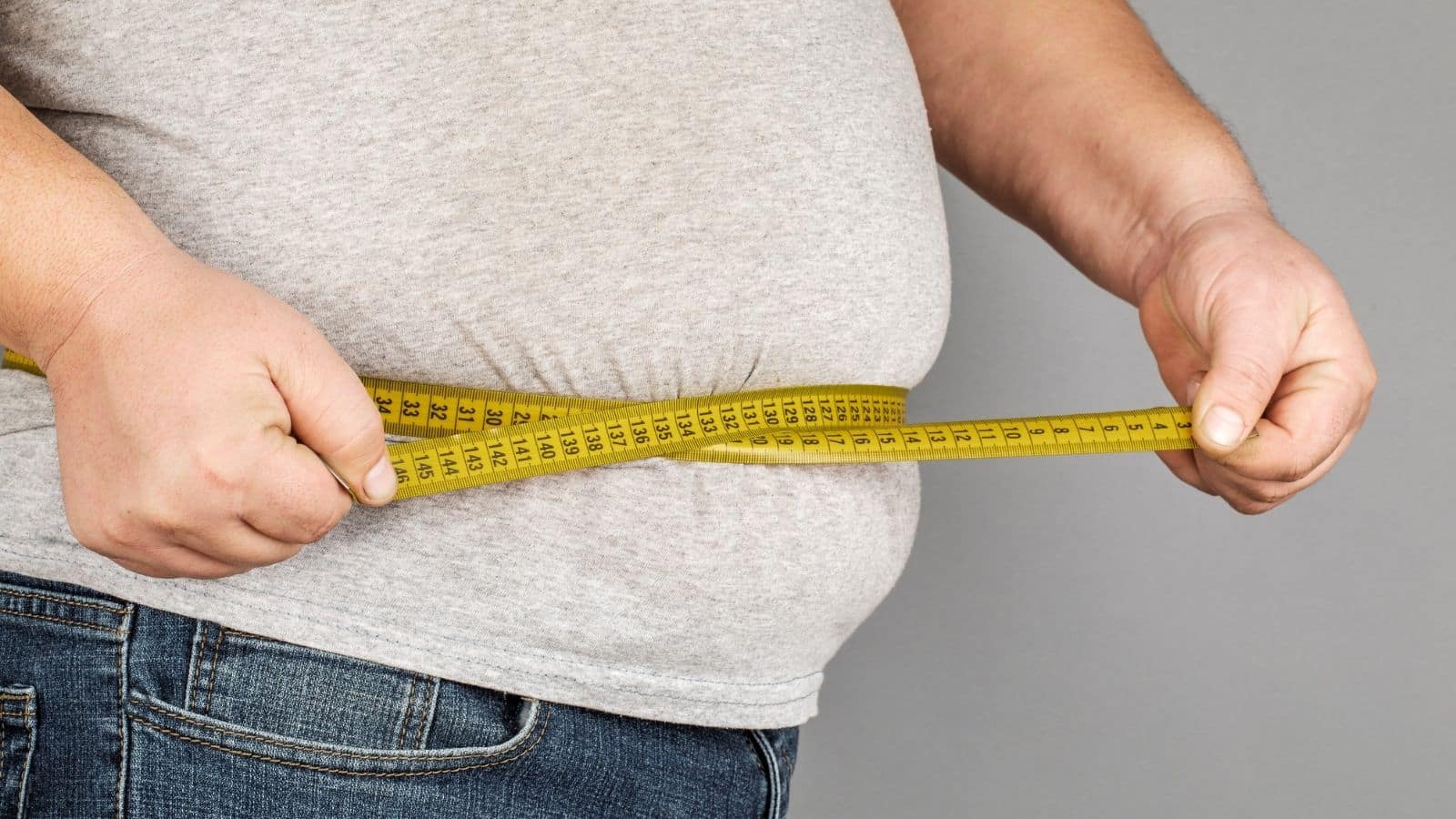
Having a high waist circumference was associated with a 24% higher risk of death from any cause in both men and women, independent of BMI.
Researchers defined a high waist circumference as at least 40 inches for men and 35 inches for women.
Perhaps even more surprising was what happened when researchers considered BMI and waist circumference together.
People with a normal BMI but a high waist circumference had a higher mortality risk in both sexes. In other words, landing in the supposedly reassuring “normal weight” category didn’t necessarily mean lower risk when excess weight was concentrated around the abdomen.
Meanwhile, being classified as overweight was associated with a lower mortality risk in both men and women compared with having a normal BMI. Among men, class I and II obesity was also associated with lower mortality risk.
The researchers describe this as a “BMI paradox” in older adults: a higher BMI can sometimes be associated with lower mortality, while a seemingly healthy BMI can conceal greater risk when accompanied by a larger waist.
That emphatically does not mean gaining weight will make you live longer. This was an observational study, so it cannot establish that additional weight caused people to live longer.
Instead, the findings illustrate why BMI alone can give an incomplete picture of health in older adults.
Why belly fat may be different
Fat isn’t simply stored energy. Its location can affect how it behaves in the body.
Visceral fat—the fat stored deep in the abdomen around internal organs—is metabolically different from much of the fat stored directly under the skin.
Higher levels of abdominal fat have been associated with insulin resistance, cardiovascular disease and other metabolic problems.
This helps explain why two people of the same height and weight can have very different health profiles.
One might carry more weight around the hips and thighs. Another might carry a larger proportion around the abdomen. Their BMIs could be identical even though their body composition is quite different.
As Medical News Today reported in its coverage of the new study, experts say this is one reason BMI shouldn’t be viewed as a complete assessment of someone’s health.
Being thinner wasn’t automatically better
Another important finding deserves attention, particularly among older adults.
Being underweight was associated with higher mortality risk in both men and women, regardless of waist circumference.
Save this article
That makes sense in the broader context of aging.
Unintentional weight loss can sometimes reflect illness, frailty, inadequate nutrition or loss of muscle mass. Maintaining muscle becomes increasingly important with age because it supports mobility, balance, bone health and independence.
So the takeaway from this research isn’t simply “lose belly fat.”
It’s that healthy aging is more complicated than achieving a particular number on the scale.
Your waistline can change even when your weight doesn’t
This is one reason someone can weigh roughly the same at 65 as they did at 50 and still have a very different body composition.
Muscle can decline while abdominal fat increases.
The scale may barely move.
That’s also why strength training, physical activity, adequate protein intake and other habits that help preserve muscle can become increasingly important as we get older.
Another recent 14-year study of older U.S. adults found that large changes in several body measurements—including both gains and losses—were associated with higher mortality risk.
Researchers cautioned that these changes may sometimes be markers of underlying illness rather than causes of increased risk.
Don’t throw away the scale
BMI and body weight aren’t useless.
They can still provide valuable information, particularly when tracked over time and considered alongside blood pressure, cholesterol, blood sugar, physical fitness, muscle strength and medical history.
But no single measurement can tell you whether you’re healthy.
Waist circumference may simply provide an additional piece of information that BMI misses.
And for adults over 65, that additional information may be especially useful.
You may want to read: Is BMI misleading? What this common health measure misses
Final word
For years, we’ve been conditioned to believe that maintaining a “normal” weight is one of the clearest signs that we’re doing something right.
This research offers a useful reminder that health isn’t quite that simple—especially as we get older.
A normal BMI doesn’t automatically mean low risk, and a BMI that technically falls into the overweight category doesn’t automatically mean poor health.
Your waist measurement, muscle mass, strength, activity level and overall metabolic health may tell a much richer story.
The scale still has something to say. It just shouldn’t get the final word.





