Your body isn’t just a quiet, clean machine; it’s a wild, slightly creepy biological circus that constantly regenerates, hosts microscopic life, and defies everyday common sense.
Have you ever stopped to think about what’s actually happening beneath your skin right now? Trends in health tracking and microbiome research show people are obsessing over their personal biology like never before.
Yet, the coolest stuff rarely makes it into glossy wellness magazines. When you look closer, human anatomy feels less like a sterile textbook and more like a bizarre sci-fi film.
Here’s a deep dive into the weirdest bodily quirks backed by real clinical data, so grab a seat and let’s explore your inner weirdness.
Uninvited Roommates That Party on Your Face
Right at this moment, microscopic eight-legged arachnids are living, crawling, and reproducing inside the pores of your face.
It sounds like a horror movie premise, but it’s pure biological reality. Tiny critters known as Demodex mites reside inside your eyelash follicles and oil glands. According to Dr. Jennifer Yu, an ophthalmologist at the UW School of Medicine, “Demodex mites are tiny parasites that can be found in eyelashes and eyebrows and can only be seen with a microscope.” Dr. Yu explains that they are mostly harmless roommates that spend their days munching on dead skin cells.
Here’s the kicker: these mites don’t have an excretory opening. They hold their digestive waste their entire lives until they die and burst directly inside your pores. If that isn’t wild enough, your entire body is essentially a bustling wildlife preserve. Your gut houses roughly 38 trillion bacterial cells that help manage digestion and immunity.
Even your belly button is a thriving urban hub, home to at least 67 different species of bacteria. On average, every single square inch of your skin hosts 32 million to 50 million microbes.
Your Body Is Silently Shedding and Rebuilding Itself
You are constantly dissolving, shedding, and rebuilding your physical frame without ever noticing the construction work.
Think about the dust in your home for a second. A huge chunk of it is actually you. Humans slough off about 600,000 microscopic skin particles every single hour. That adds up to roughly 1.5 pounds of dead skin each year, or around 105 pounds by the time you turn 70.
In fact, your skin replaces its entire outer layer every 30 days, giving you around 1,000 brand-new skins over a lifetime. Meanwhile, inside your gut, an even more dramatic survival routine plays out. Your gastric juices are acidic enough to dissolve metal, which means your stomach would quickly digest itself if left unprotected.
To prevent self-destruction, your stomach completely replaces its cellular lining every three to four days. Even your bones aren’t permanent fixtures. Specialized cells break down old bone tissue and lay down fresh mineral matrix, replacing your entire skeleton roughly every 10 years.
Related: 10 Unconventional Uses of the Human Body: Surprising and Bizarre Practices
A Jaw That Crushes and Blood Vessels That Circle the Earth
Human anatomy packs industrial-grade mechanical strength and thousands of miles of plumbing into an ordinary frame.
Save this article
You might assume your biceps or thighs hold the trophy for raw power, but think again. The masseter muscle in your jaw actually takes the crown for sheer compressive bite force. It even holds the Guinness World Record for the strongest muscle in the human body based on force exertion relative to its weight. Brian Krabak, a sports medicine specialist at the University of Washington, points out that the masseter “is so strong it can produce a force greater than 200 pounds on your molars.” That’s enough crushing pressure to crack tough nutshells and grind down dense food without breaking a sweat.
Now look at your cardiovascular system. Dr. Kris Patton, a cardiologist at the UW Medicine Heart Institute, says the human body has about 60,000 miles of blood vessels. “That’s the equivalent of going around the world over two times,” notes Dr. Patton.
Your heart diligently pumps 2,000 gallons of blood through that winding network every single day. By age 70, that tireless muscle clocks around 2.5 billion beats.
Gushing Spit, Hidden Mucus, and Inverted Vision
Every day, your sensory systems and internal glands process staggering quantities of fluids and visual data on pure autopilot.
Let’s talk saliva, because you produce an ocean of it. Over an average lifespan, your salivary glands pump out between 25,000 quarts and 40,000 liters of spit. That’s enough fluid to fill 500 bathtubs or two full-size swimming pools.
Your airways are just as busy. The respiratory system secretes about one full liter of mucus every single day. You swallow almost all of it subconsciously, where stomach acid safely breaks it down.
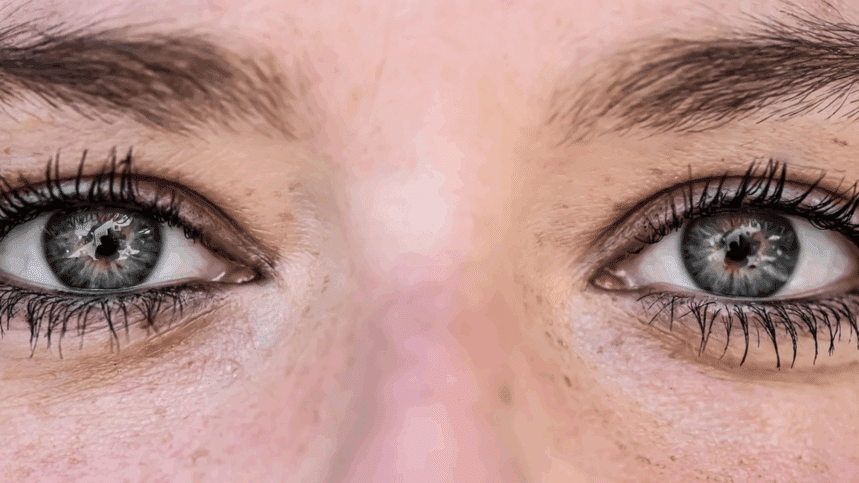
Your eyes pull off an equally spooky trick. Because incoming light rays cross as they enter your cornea and lens, images project onto your retina upside down. Your brain works overtime behind the scenes, continually flipping the world right-side up so you don’t stumble around.
Even your height shifts while you go about your business. Daytime gravity compresses the cartilage between your spinal vertebrae, making you roughly one centimeter shorter by bedtime than when you first wake up. Astronauts experience an exaggerated version of this effect in microgravity; without Earth’s gravity squeezing their spinal discs, their spines decompress enough to make them up to 2 inches taller in space.
Speaking of your nails, Dr. April Schachtel, a dermatologist at UW Medical Center, points out that fingernails take roughly six months to fully regrow, while big toenails take up to 18 months. Researchers have also observed that our nails grow nearly 25% faster than they did 70 years ago, mostly thanks to nutrient-rich modern diets.
The Bottom Line on Our Bizarre Biology
Our bodies are dynamic, self-healing superorganisms built to handle incredible physical stresses and survive an unforgiving world.
Learning about face mites, dissolving stomach linings, and gallons of spit might make you squirm at first glance. Yet each of these creepy traits is an evolutionary masterpiece designed to keep you thriving.
You aren’t just walking through life; you’re piloting an intricate, 60,000-mile vascular superhighway powered by trillions of microscopic partners.
Which of these strange bodily quirks surprised you the most, and how does knowing it change how you see your own body?