

France’s best-preserved medieval towns survive because they combine architectural history, dramatic landscapes, and living cultural traditions in one experience.
France holds one of the richest collections of medieval architecture in Europe, shaped by centuries of monarchy, religion, and conflict. The French Ministry of Culture estimates that more than 45,000 protected historic monuments exist across the country, many of them dating back to the Middle Ages. Stone walls, fortified towns, and soaring cathedrals still define the landscape, preserving a period when cities rose around castles and faith guided design.
These medieval sites reveal the enduring beauty of France through places that feel remarkably intact. Cobblestone streets, watchtowers, abbeys, and walled villages offer more than photo opportunities. They create a sense of time travel that modern attractions rarely match. The most beautiful medieval destinations in France combine history and setting, inviting visitors to walk through living chapters of the past rather than simply observe them.
Mont-Saint-Michel, Normandy
Mont-Saint-Michel rises from the bay like an illusion, a Gothic abbey balanced on a tidal island where land appears and disappears twice a day. Founded as a sanctuary in the eighth century and formalized as a Benedictine abbey in 966, it grew over the centuries, its spire reaching roughly 80 meters above the sand and sea. For more than 1,300 years, pilgrims crossed dangerous tidal flats to reach what medieval writers described as a stairway between earth and heaven.
Today, the French Centre des Monuments Nationaux lists Mont-Saint-Michel among the most visited heritage sites in the country, welcoming roughly 2.5 to 3 million visitors each year. Its crowd-drawing power comes from the same source as its medieval fame: the shock of seeing a fortress that seems to float at high tide, half real, half imagined.
Cité de Carcassonne, Occitanie
Carcassonne looks like a castle invented by a child and refined by history. Its double ring of walls stretches nearly three kilometers and is punctuated by 52 towers, making it one of the largest and most complete fortified medieval towns in Europe. Archaeological records trace occupation back more than 2,000 years, through Roman, Visigothic, and Crusader control.
The citadel’s survival owes much to a nineteenth-century restoration led by Eugène Viollet-le-Duc, whose work remains controversial but undeniably iconic. UNESCO added the Cité to its World Heritage list in 1997, and French tourism authorities estimate more than 4 million visitors arrive annually. Unlike many fortresses, Carcassonne is not frozen in time. People still live, shop, and sleep behind its walls.
Provins, Île-de-France
Provins sits quietly southeast of Paris, its stone ramparts encircling a town that once thrummed with international trade. During the Middle Ages, it was a major hub of the Champagne fairs, a role preserved in its layout of walls, tithe barns, and the looming Caesar Tower. UNESCO recognized Provins as a World Heritage Site for this unusually intact trading-town structure.
Each June, history becomes spectacle. According to the town’s cultural office, Provins hosts what it describes as France’s largest medieval festival, complete with jousting tournaments, costumed parades, and craft markets staged against authentic medieval walls. It is a rare day trip from Paris where the past feels theatrical without feeling artificial.
Avignon and the Palais des Papes, Provence
In the fourteenth century, Avignon became the center of Western Christianity. The Palais des Papes remains one of the largest Gothic palaces in Europe, a vast stone complex that functioned as both fortress and papal residence during the Avignon Papacy. Its scale reflects a moment when religious authority needed walls as much as words.
UNESCO’s World Heritage listing includes the palace, the historic city center, and the Pont d’Avignon, citing Avignon’s political and spiritual influence on medieval Europe. Today, that gravity coexists with performance. The Festival d’Avignon, documented by France’s Ministry of Culture as one of the world’s major theater events, transforms courtyards and cloisters into stages, layering art onto power.
Beynac-et-Cazenac, Dordogne
Beynac-et-Cazenac clings to a limestone cliff above the Dordogne River, its houses stacked like steps leading to the Château de Beynac. Built in the twelfth century, the fortress controlled river traffic and served as a French stronghold during the Hundred Years’ War, staring down English-held castles across the water.
The château remains remarkably intact, its ramparts and keep offering sweeping views of the valley. French tourism boards routinely place Beynac among the country’s most beautiful villages, and filmmakers return often, drawn by a setting where medieval stone drops almost vertically into postcard-perfect scenery.
Sarlat-la-Canéda, Dordogne
Sarlat is less a village than a compressed city of history. Its historic center contains one of the densest collections of medieval and Renaissance buildings in France, constructed from warm, golden limestone. The French Ministry of Culture designated the area as a protected sector in the mid-twentieth century, preserving its urban fabric with unusual rigor.
Sarlat’s appeal deepens at ground level. The town’s markets, famous for truffles, duck confit, and walnuts, link medieval streets to regional gastronomy. Travel analyses from Atout France often cite Sarlat as an example of how heritage preservation and food culture reinforce each other, turning history into something you can taste.
Conques, Occitanie
Conques rests in a green valley, reached by narrow roads and older paths. Its Abbey Church of Sainte-Foy is a Romanesque masterpiece, famous for its sculpted Last Judgment tympanum that once warned pilgrims of eternal consequences. The village’s half-timbered houses and cobbled streets preserve a scale that feels human and hushed.
Conques lies on the Camino de Santiago, and pilgrimage remains active. The French Compostela associations document a steady stream of modern walkers who still pass through its gates each year. Few places make the continuity of medieval travel feel so tangible, where boots meet stones worn smooth by centuries of belief.
Vézelay, Burgundy
Save this article
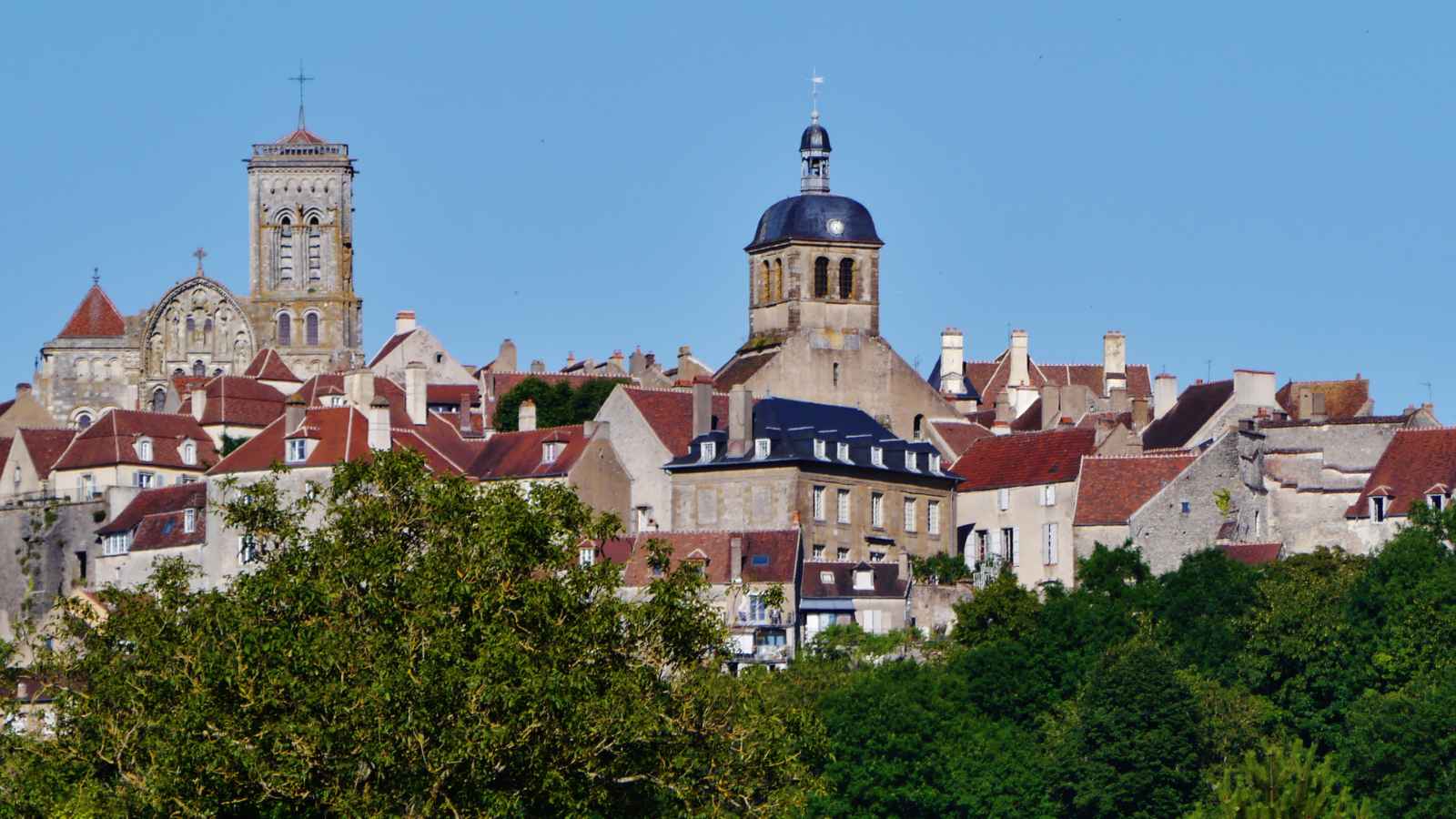
Vézelay rises like a beacon over Burgundy’s countryside, crowned by the Basilica of Sainte-Madeleine. The Romanesque church served as a major pilgrimage site and a departure point for medieval routes to Santiago de Compostela. UNESCO recognized the village and basilica for both architectural significance and spiritual history.
The climb through Vézelay’s steep streets unfolds slowly, revealing vineyards and rolling hills below. Art historians writing for the Centre des Monuments Nationaux often note how the basilica’s light-filled nave mirrors the openness of its setting, reinforcing Vézelay’s reputation as a place where landscape and faith align.
Les Baux-de-Provence, Provence
Les Baux-de-Provence perches on a rocky plateau, its ruins scattered across wind-carved stone. Once the seat of the powerful Lords of Baux, the village retains fragments of ramparts, chapels, and narrow lanes that cling directly to the rock itself.
Today, medieval drama shares space with contemporary art. Just below the village, the Carrières de Lumières hosts immersive exhibitions inside former quarries, drawing hundreds of thousands of visitors annually, according to site operators. Les Baux thrives on contrast, pairing ruin and innovation without apology.
Pérouges and Eguisheim, the fairytale tie
Pérouges, near Lyon, is a walled hilltop village of cobblestones and stone houses, frequently used as a film set and highlighted by French heritage organizations for its preservation. Eguisheim, in Alsace, forms a near-perfect circle of half-timbered houses around a central square, wrapped in vineyards and color.
Both villages belong to the “Les Plus Beaux Villages de France” network and depend heavily on tourism for economic survival. Local population data show tiny resident counts that swell dramatically in peak season, proof that medieval charm remains one of France’s most reliable exports.
Key Takeaway
France’s medieval villages are not interchangeable relics. The most compelling ones combine historical weight with visual magic, places where architecture, landscape, and memory reinforce each other.
From tidal abbeys to cliffside fortresses and pilgrimage towns, these ten sites show how medieval history survives not as nostalgia, but as a lived, visited, and deeply felt space.
More articles:
- 12 cruise dress code rules that spark debate every time
- 16 things you should never leave in your cruise cabin on port days
- 13 Hidden Cruise Risks Most Travelers Don’t Realize Until It’s Too Late
Disclosure: This article was developed with the assistance of AI and was subsequently reviewed, revised, and approved by our editorial team.
Like our content? Be sure to follow us on Newsbreak.
10 Insanely Fast Trains That Make Air Travel Look Slow

Rail travel has come a long way from the slow chugging of steam engines. Today, the race for the fastest train has become a high-speed pursuit of groundbreaking technology, pushing the boundaries of what’s possible on rails. From maglev marvels to sleek bullet trains, these trains don’t just break records; they redefine them. Here’s a look at the 10 fastest trains on Earth, each moving faster than most airplanes. Learn more.
8 financial mistakes travelers should avoid in Mexico

Traveling through Mexico can feel effortless, from booking boutique hotels to paying for street tacos on the go. Yet money mistakes can quietly turn a dream trip into an expensive lesson. Many travelers focus on flights and itineraries but overlook everyday financial decisions that shape their budget once they arrive. Exchange rates, payment methods, and local banking norms differ from those at home, and misunderstandings can drain funds faster than expected.
The stakes are higher than most people realize. According to data from the Consumer Financial Protection Bureau, international travelers can lose money on each transaction. Losses typically range from 3 to 10 percent when foreign transaction fees, poor exchange rates, and ATM charges are combined. Learn more.
10 travel scams targeting tourists

Vacations are supposed to be carefree, but a single clever scam can empty your wallet faster than any overpriced souvenir.
Planning a vacation is usually the highlight of the year, but falling for a scheme can ruin the fun before it even starts. Scammers are getting smarter and using advanced technology to trick even the most experienced globetrotters into handing over their hard-earned cash. You need to stay alert because these criminals often target distracted visitors who are just trying to relax. Learn more.





