

In 1941, Doris Miller was good enough to die for the United States Navy. He was not good enough to fire one of its guns.
Miller was Black, 22, and serving aboard the battleship USS West Virginia as a mess attendant, one of the few jobs the segregated Navy opened to Black sailors. Men like him were not trained on the anti-aircraft guns. When Japanese bombs tore into the fleet on December 7 and destroyed the magazine that was his battle station, Miller went where he was needed. He pulled wounded sailors from the fire, helped carry the ship’s dying captain to safety, then found an unattended .50-caliber gun and, untrained, opened fire on the Japanese planes.
Asked later how he managed it, Miller gave an answer far smaller than the act. “I just pulled the trigger and she worked fine.”
The Navy had spent years telling Doris Miller where his place was. Pearl Harbor gave him about fifteen minutes to answer. Eighty-five years later, the Navy is building one of the most powerful warships on earth, meant to carry his name. It may get Donald Trump’s instead.
The Ship That Was Supposed to Be His
The Navy announced in January 2020 that CVN-81, a Gerald R. Ford-class nuclear carrier, would be the USS Doris Miller. Carriers take the names of presidents, admirals, and decisive battles, and Miller would be the first Black American and first enlisted sailor to have one. His family unveiled the plaque at Pearl Harbor themselves.
Six years later, CNN reports the Navy is working to rename the ship, with two sources saying one option under discussion is naming it for President Trump. No decision has been announced, but something has changed. Officials have largely stopped calling it the Doris Miller and now use CVN-81. A White House shipbuilding memorandum Trump signed this month did the same. A strangely familiar place for Doris Miller to end up.
The First Time the Navy Left Him Nameless
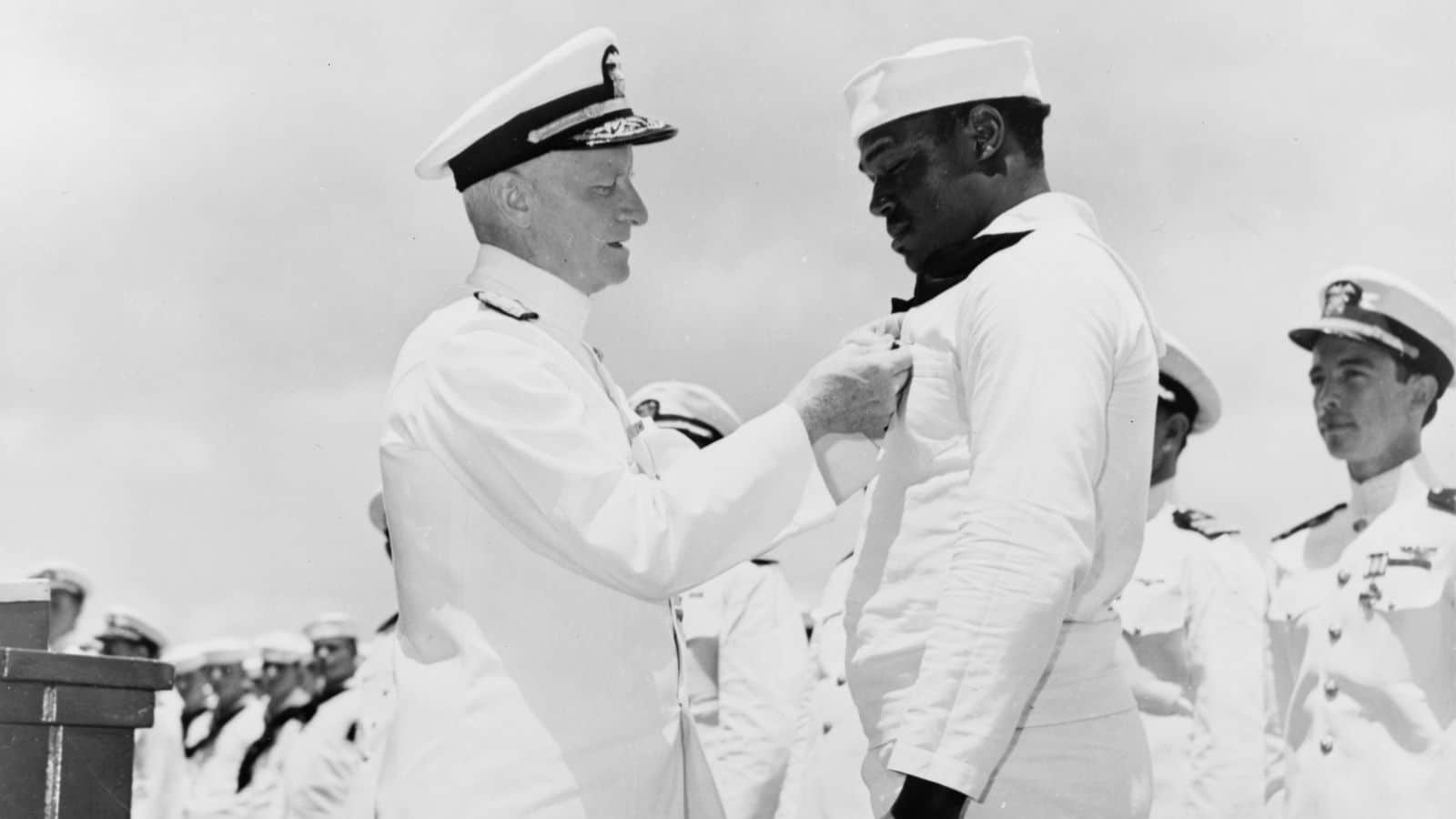
When America first heard what happened aboard the West Virginia, Miller had no name then either. For roughly three months, the man who manned that gun appeared in reports only as an “unnamed Negro messman,” and the Navy’s own commendation list that December identified him no further. It took Lawrence Reddick of the New York Public Library’s Schomburg Collection and the Pittsburgh Courier, a leading Black newspaper, to dig out who he was and put his name in print in March 1942.
He was Doris Miller of Waco, Texas. In May 1942, Admiral Chester Nimitz pinned the Navy Cross on him, the first awarded to a Black sailor, and the Navy put his face on a recruitment poster. That year it began opening other ratings to new Black recruits, but men already serving as mess attendants were barred from transferring into them. The Navy could use Miller’s face to recruit Black men into opportunities he himself could not reach. He kept serving until November 1943, when the escort carrier USS Liscome Bay was torpedoed near the Gilbert Islands and sank with him aboard. He was 24. He had been famous for 20 months.
The Man Whose Name Would Replace His
Save this article
The renaming effort has run since earlier this year, part of a wider Pentagon push under Defense Secretary Pete Hegseth to strip names tied to diversity, equity, and inclusion. A carrier named for Trump while he is in office would be unprecedented.
The name reportedly under discussion belongs to a man who never served. Trump received five Vietnam-era draft deferments, per The New York Times, four for education and one in 1968 for bone spurs. In August 2024, he called the Presidential Medal of Freedom “much better” than the Medal of Honor, because its recipients are often badly wounded or dead. His own former chief of staff, retired Marine General John Kelly, told CNN the comparison was “not even close.”
The Signature
The Navy is reportedly looking to name another warship for Miller and to recommend him for the Medal of Honor, which his family has chased for years. His great-nephew, Thomas Bledsoe, told CNN the family learned of the renaming from a news outlet, calling it a shock.
Because the ordinary deadline for the award has long passed, Miller’s case would require Congress to waive the time limit before a president could grant it. So the same signature that could finally give Doris Miller the nation’s highest military honor belongs to the man whose name may take his carrier, a man who called that very medal the lesser one.
The Navy would not train Doris Miller to fire the gun he used to defend it. It confined him to the kitchen and commended his heroism without telling the country his name. By any accounting the Navy offered him, there was almost nothing in it for Doris Miller.
He climbed behind the gun anyway.
Nearly eighty years later, the Navy put his name where no one could miss it, on the hull of a nuclear carrier. No change has been announced. But inside the service, CNN reports, the name has quietly given way to a hull number. For now, Doris Miller is CVN-81.





