

Ever think you had the Ten Commandments all figured out, only to find out you might have been duped by a Charlton Heston movie? Yeah, me too. A lot of what we “know” about these ancient rules is more Hollywood than holy text.
According to a 2018 survey conducted by Deseret News and YouGov, over 90% of Americans stated that the commandments against murder, theft, and bearing false witness remain essential today. However, support dropped for more religiously framed commandments—only 49% said that keeping the sabbath holy remains relevant, while honoring one’s parents continued to receive strong majority support.
Let’s bust some of the most common myths together, shall we? You might be surprised at what’s fact and what’s just excellent fiction.
They weren’t called the “ten commandments” originally
Surprise! The original Hebrew text doesn’t actually use the phrase “Ten Commandments.” Instead, it refers to them as the “aseret ha-devarim,” which translates to “the ten words” or “the ten statements.”
This might seem like a small detail, but it changes the vibe. It frames them less as strict orders from on high and more as divine declarations or principles for living. Thinking of them as “ten sayings” definitely feels a bit more approachable than a list of unbreakable rules, in my opinion.
There’s more than one version

If you thought there was only one “official” list, you’d be mistaken. Different religious traditions—such as Judaism, Catholicism, and Protestantism—number and categorize the commandments differently.
For example, some versions combine the prohibitions against coveting a neighbor’s wife and property into one, while others split them. The most famous list is the one in Exodus 20, but there’s another version in Deuteronomy 5. So, which one is the “real” one? Depends on who you ask.
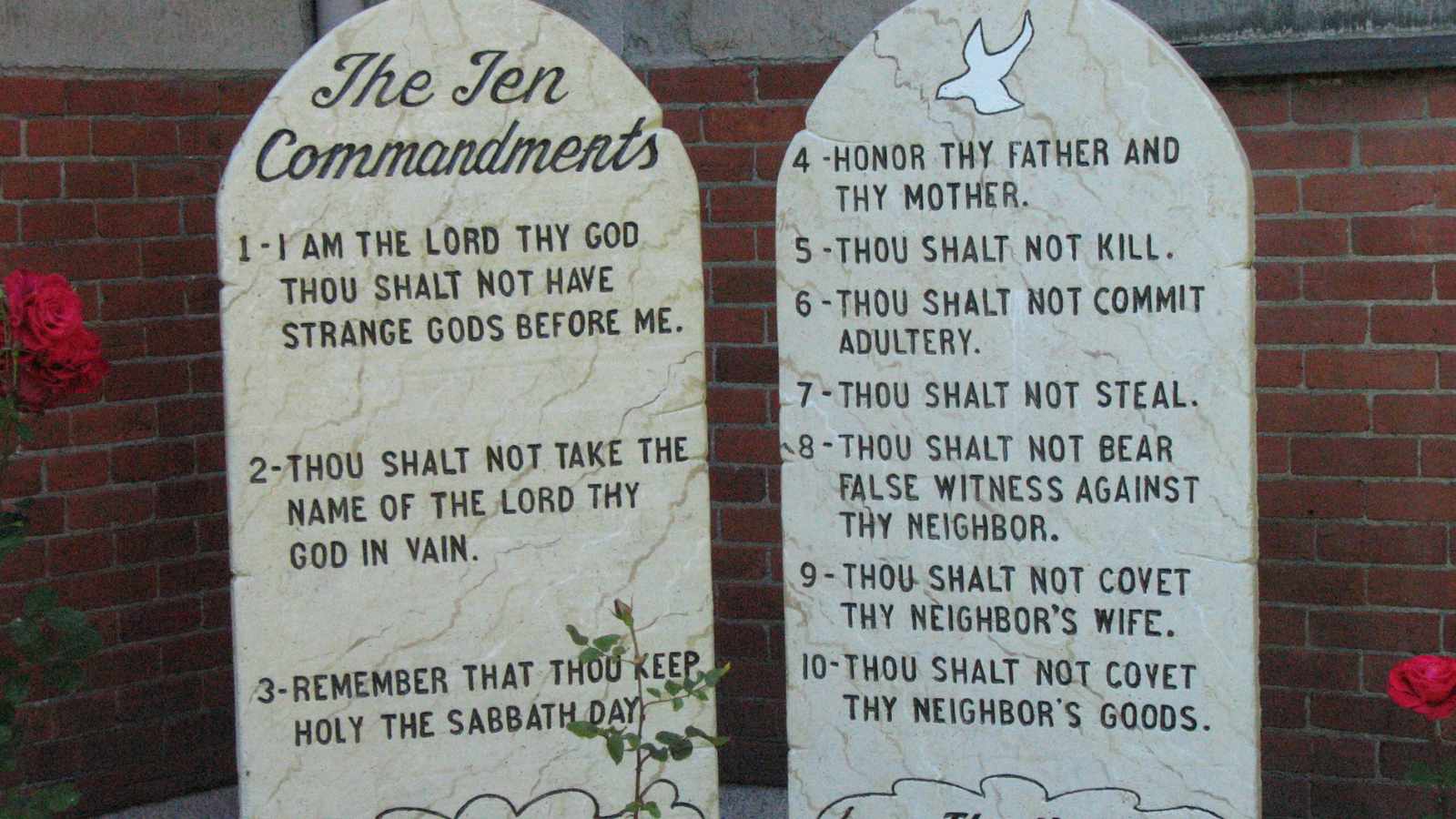
They weren’t written on two matching tablets

Picture this: Moses coming down the mountain holding two perfectly matched, arch-topped stone tablets. That’s the classic image, right? That’s probably not how it happened.
The text suggests that the two tablets were more like duplicate copies of a contract, with one for each party (God and Israel), rather than a neat division of commandments 1-5 and 6-10. Ancient treaties were often written in this manner, making historical sense. Sorry to ruin your movie-inspired mental image. :/
“Thou shalt not kill” is a mistranslation

This one’s a biggie. The sixth commandment, famously known as “thou shalt not kill,” is more accurately translated from Hebrew as “you shall not murder.” This distinction is crucial, as Hebrew has different words for killing in general versus unlawful killing.
This nuance allows for things like self-defense or state-sanctioned justice, which wouldn’t be permissible under a blanket “do not kill” rule. It’s a classic case of something getting lost in translation, but the difference in meaning is huge.
The original tablets were smashed

Save this article
Remember those first-edition stone tablets? Yeah, they didn’t last long. When Moses came down from Mount Sinai and saw the Israelites worshiping a golden calf, he was so incensed that he smashed the tablets on the ground.
It’s a pretty dramatic moment in the story that often gets glossed over. God later had him create a replacement set, but that initial act of pure rage shows just how seriously the whole “no other gods” thing was taken.
Coveting isn’t just about jealousy

When we hear the word “covet,” we usually think of simple jealousy, such as wanting your neighbor’s shiny new car. But the original meaning is much more intense. In the biblical context, to covet means to scheme or plot to take something that isn’t yours, not just passively wanting it.
It’s about the active desire that leads to action. So, it’s not just about envy; it’s about the kind of consuming obsession that could lead you to break other commandments, like stealing or worse.
They don’t all apply to Christians anymore (according to some)

Here’s a twist you might not have seen coming. Many Christian theologians argue that with the arrival of Jesus and the establishment of the New Covenant, the specific laws of the Old Testament, including parts of the Ten Commandments, were either fulfilled or superseded.
The moral principles underlying them (don’t murder, don’t steal) remain central to Christian ethics. Still, the idea that they are a binding contract for salvation is not a universal belief. It’s a complex theological debate, but it’s far from a settled issue that all ten are a strict requirement for modern Christians.
Disclaimer – This list is solely the author’s opinion based on research and publicly available information. It is not intended to be professional advice.
16 Grocery Staples to Stock Up On Before Prices Spike Again

16 Grocery Staples to Stock Up On Before Prices Spike Again
I was in the grocery store the other day, and it hit me—I’m buying the exact same things I always do, but my bill just keeps getting higher. Like, I swear I just blinked, and suddenly eggs are a luxury item. What’s going on?
Inflation, supply-chain delays, and erratic weather conditions have modestly (or, let’s face it, dramatically) pushed the prices of staples ever higher. The USDA reports that food prices climbed an additional 2.9% year over year in May 2025—and that’s after the inflation storm of 2022–2023.
So, if you’ve got room in a pantry, freezer, or even a couple of extra shelves, now might be a good moment to stock up on these staple groceries—before the prices rise later.
6 Gas Station Chains With Food So Good It’s Worth Driving Out Of Your Way For

6 Gas Station Chains With Food So Good It’s Worth Driving Out Of Your Way For
We scoured the Internet to see what people had to say about gas station food. If you think the only things available are wrinkled hot dogs of indeterminate age and day-glow slushies, we’ve got great, tasty news for you. Whether it becomes part of a routine or your only resource on a long car trip, we have the food information you need.
Let’s look at 6 gas stations that folks can’t get enough of and see what they have for you to eat.