
You are following the low FODMAP diet, and you want to eat food and feel no ill effects. So, what are the right questions to ask?
If you ask, “Is this low FODMAP?” there are only two answers.
- We know for sure that the item in question is, or is not, low FODMAP, because it has been lab tested.
- Or, we know that it is low FODMAP because it is a pure fat or protein – and therefore naturally not a FODMAP.
But, I bet the question you really want to ask is, “Can I eat this without triggering my IBS?“
That question does not have a simple answer. Let us take you through this step-by-step.
In The Beginning: Elimination
When you start the low FODMAP diet, the idea is to greatly minimize foods with FODMAP content in your diet. Referencing the Monash University and the FODMAP Friendly smartphone apps is the easiest, quickest, and most reliable way to gather that information.
That is because these two entities are the ones doing the lab testing. They are primary sources. We believe that you need these two apps in order to follow the diet.
Challenge To Learn
Once you progress to the Challenge Phase, you will begin to bring foods back into your diet, one at a time, in specific amounts. The end goal is to be able to eat as broadly as possible without triggering IBS symptoms.
During your Challenge Phase you will learn whether you can have 1 slice of wheat bread, 2 slices, or none at all. Or maybe it is even more nuanced than that and you find out you can have a sandwich on one day, but not two days in a row.
What you discover about your FODMAP tolerances is not only unique to you, but this information is also potentially time sensitive.
Maybe today and tomorrow you can’t have a sandwich, but 6-months down the line you can enjoy a sandwich two days in a row!
YOUR digestive tract is unique to you, and what you can tolerate today might be different from what you can tolerate a few months from now and is most assuredly different from what your best friend, your neighbor, your work colleague and your 100s of Facebook friends can tolerate.
This is one reason crowd-sourcing tolerance information makes little sense.
Ask The Right Questions & Use The Answers To Your Advantage
In the beginning – and perhaps throughout your navigation of the low FODMAP diet – it is helpful to know whether something is low FODMAP or not. Some foods have even been shown to not contain any FODMAPs at all in lab tests, and we have an article for you about those, including recipes.
- Read No FODMAP Foods, and Foods with a Trace of FODMAPs.
But ultimately, what you digest and tolerate well is what is important. And here are two points that are often overlooked:
- There are low FODMAP foods that can trigger digestive upset in some people.
- There are moderate and high FODMAP foods that might not trigger you at all.
This is why asking, “Is this low FODMAP?” doesn’t give you all the info you need.
Structured Elimination & Challenge Phases To The Rescue
The info you need will be discerned during a structured Elimination and Challenge Phase, and you will have the greatest chance of success if you work with a FODMAP trained Registered Dietitian (RD). A RD can also help you assess whether your digestive issues go beyond FODMAPs. It is very common for people to have additional digestive issues.
All FODMAPs Are Safe
And of course, always remember that high FODMAP foods are not “unsafe”. Read more in FODMAPs Are Not “Unsafe” to learn more.
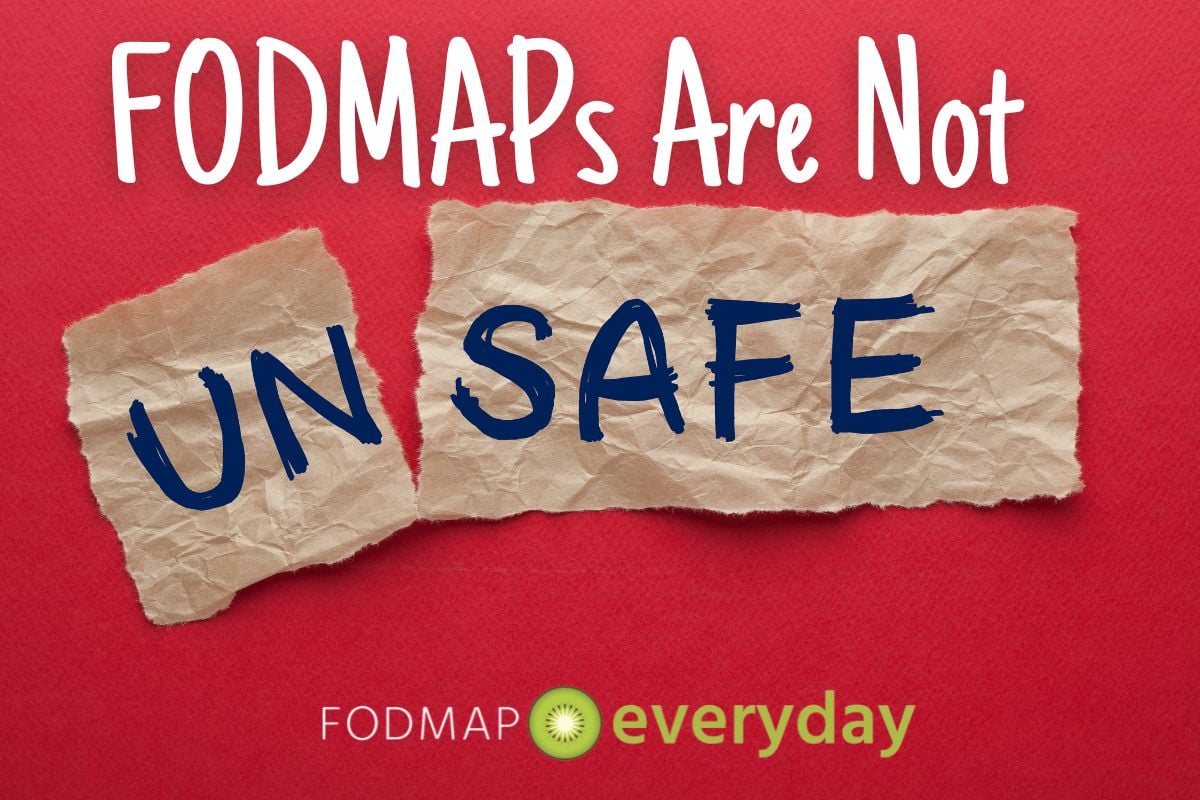
You might be thinking, “When I eat XYZ it triggers diarrhea, so it isn’t safe for me!” Think of it this way:
- You might digest it just fine next week, next month or six months from now.
- When someone else reads or hears you say, “that food is the devil,” that negative idea is implanted in their mind, and they might steer clear, when the food is perfectly fine for them.
- This word and perspective leads to overrestriction, which is a huge problem.
These foods are not “unsafe.” They are high FODMAP, moderate, low, or perhaps contain no FODMAPs at all. What they ARE, are foods that, at this moment in time, are triggering symtoms for you.
Unsafe foods are foods that contain Salmonella, E coli, Listeria, or have been recalled for a variety of actual safety reasons. Period. Language is very important when we discuss digestive issues, just as an allergy is not an intolerance, for example.
The Takeaway
So, there you have it. Maybe a new way to look at the low FODMAP diet and to understand what questions to ask, when – and what the answers mean.
Knowledge is power, and we are here to help you THRIVE on the low FODMAP diet!