
Tablespoons Vary in Volume Measurement Depending On Where You Live
Question: When is a Tablespoon Not a Tablespoon?
Answer: When it is considered to be equal to 20 ml, like in Australia, versus the 15 ml tablespoon that we use in the U.S. and virtually everywhere else.
Did we lose you?
Most of the primary sources for low FODMAP information come from Australia, so if Monash University says that “1 tablespoon” of something is low FODMAP, we have to look at the weight or volume equivalent of that item to know how it equates to our measuring implements here in the United States and elsewhere around the world.

Monash University Liquid Conversions
In addition, as of March 2026, Monash switched the presentation of liquids within their smartphone app to be represented in milliliters, “ml,” instead of grams or ounces (which had been the case since the app launched).
NOTE: In general, liquids should be measured in liquid measuring cups, and dry ingredients, such as flour or sugar, should be measured in dry measuring cups. The exception, in American home cooking, is if a liquid is a small amount, such as 1 teaspoon of vanilla extract, or 1 tablespoon of soy sauce, then a measuring spoon is used.
There is much more in our article, How To Measure by Volume for Low FODMAP Recipes.
While we applaud Monash’s update as a more appropriate way to present liquids, it does not appear that they returned to the lab to retest for FODMAP content in relation to volume. When the app entries were in grams and ounces (weight), the assumption was that the ingredient in question was indeed weighed. Monash researchers appear to have simply replaced the gram and ounce language with milliliters, keeping the weight/volume numbers the same (but weights do not always equal volume).
The Monash University and FODMAP Friendly app entries are meant to be used as guides, not absolutes.
Do Weight and Volume Discrepancies Matter?
Do weight and volume discrepancies matter?
Ultimately, not that much from a FODMAP perspective, because the Monash University and FODMAP Friendly app entries are meant to be used as guides, not absolutes.
But it could be a problem if you are baking or cooking, as some liquids, like oil, do not weigh the same as something like vinegar. There is approximately an 8% difference. And, since Monash went from weights to milliliters, I have no answers for you in this regard. As a professional recipe developer, this is maddening, but we are going to focus on FODMAPs.
In addition, hopefully you know that pure fats, such as olive oil, coconut oil, flaxseed oil, peanut oil, vegetable oil, etc., contain no FODMAPs at all, so for those app entries, the variance is of less consequence, from a low FODMAP diet perspective.
The Good News
The good news from a FODMAP perspective, if you are outside Australia, is that if you see a tablespoon as the recommended low FODMAP serving size in the Monash app, you can actually have 33% more, if measured by tablespoons.
A closer look at the math: 1 tablespoon of natural, regular-fat yogurt in Australia equals 20 grams and is given the Green Light by Monash as a low FODMAP serving size, while 1 tablespoon of this yogurt everywhere else equals 15 grams. So we non-Australians can actually have about a third more if measured by tablespoons.
For FODMAP Everyday®, however, we approach things conservatively and if Monash University states that “1 tablespoon” of something is suggested, we stick with that wording. This also means that recipes do not readily translate from Australia to the U.S. (and beyond) and vice versa, so pay attention when using recipes from varied international sources.
Knowledge is power and attention to detail is important in the low FODMAP diet when it comes to amounts and serving sizes.
Recipes do not readily translate from Australia to the U.S. (and beyond) and vice versa, so pay attention when using recipes from varied international sources.
Speaking of Measuring Spoons
Let’s talk equipment quality. Decades ago Gourmet magazine did an article that stuck with me. They had everyone in the office bring in their own personal set of measuring spoons.
Then they took table salt, measured it in every one of the sets of spoons, and weighed the results. The results were staggering. They varied by as much as 100%! Some of the tablespoons of salt weighed around 16 grams, which is the correct weight, while some were as little as 7 or 8 grams and they found many variations in-between.
Shocking!
Invest in Quality Tools
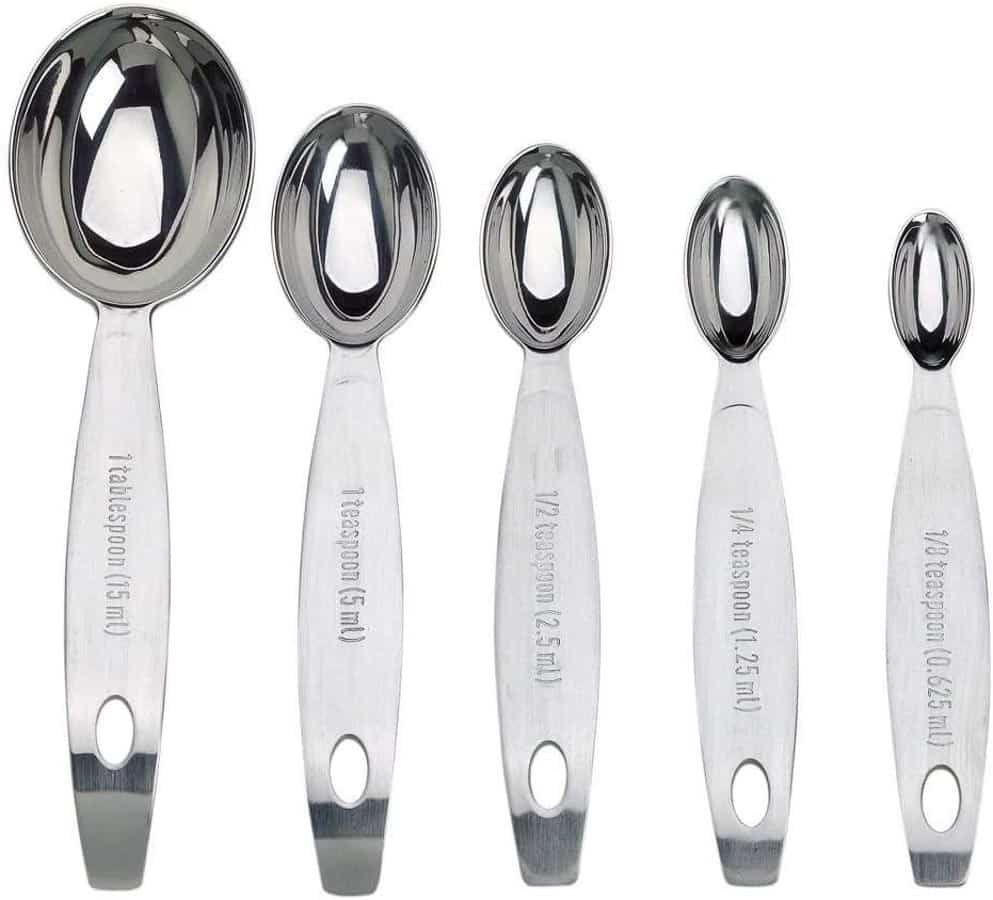
Why did this happen? It had to do with the quality of the measuring spoons. In the Test Kitchen we use measuring equipment from Williams Sonoma, Cuisipro (seen below) and The Baker’s Catalogue.
What Not To Buy
Cheap, poorly made measuring spoons are often improperly calibrated, and that will wreak havoc with any recipe. If you have dollar store versions, dented sets, old-flea market finds or decorative ones that look like hearts or flowers, toss them.
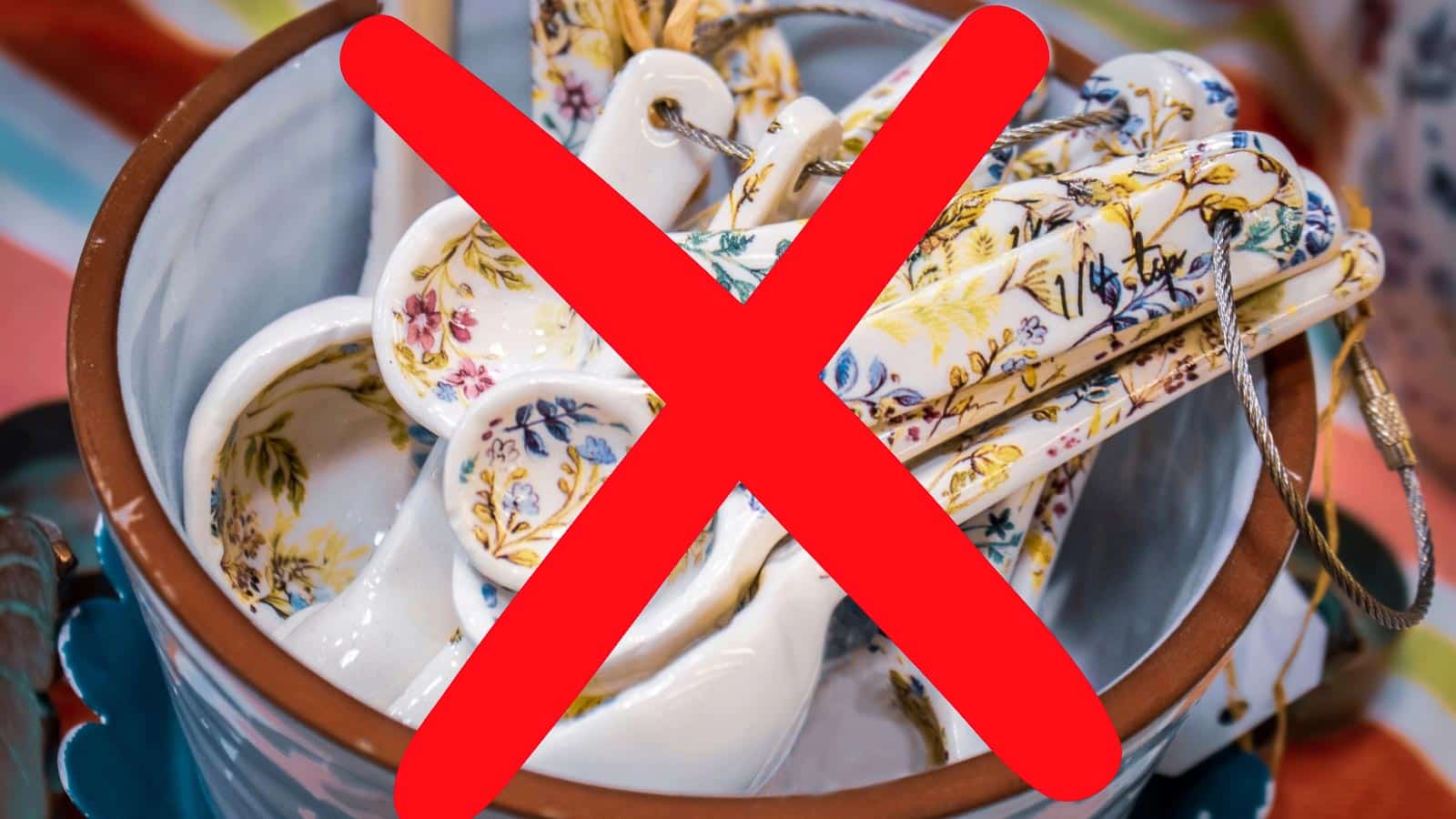
Invest in high-quality equipment, such as from the brands mentioned; they will last forever.
Do It!
You might be thinking, hey, I’ve used this one set of spoons for years with no problem! Really? How about those baked goods that didn’t come out as great as you had expected?
Think about it.

If a recipe calls for 1 tablespoon of baking powder and you are really measuring out a different amount, the recipe will not be at its best and possibly will fail. Being precise when baking, especially, is vital to success.
Having high quality measuring spoons will help you not only get the best results from recipes, but in the instance of translating Australian to other cuisines, you will be able to measure out and eat more of the delicious low FODMAP foods that you crave.
Some of our Favorite Kitchen Utensils can be found in our SHOP.






Thanks quite astounding info!
Oh, Thank you! It is so important and yet no one talks about it…WE DO! 🙂
I never thought about a large difference in Australian measures and US. This is very helpful. Makes me want to invest in an Australian set of measuring spoons…but better, if my math is correct, simply add a teaspoon to a USA tablespoon in order to have the correct measure. But then, the 1/2 Tablespoon will also be off. How about the other measures? Any important differences?
We are based in the US and all of our recipes use US tablespoons. If you plan on using a lot of Australian recipes that would be the only time it would really be an issue when cooking