
The low FODMAP diet is designed to give you confidence around food but, if followed too rigidly, your strict approach will chip away at your nutrition, microbiome, and peace of mind.
Every day, we hear people say that they are following the low FODMAP diet “strictly.” There is a common misconception that stricter is better. It isn’t. In fact, being overly strict may do more harm than good.
Overview of Why Strict Isn’t Necessarily Better

The low FODMAP diet was always meant to be undertaken along with a FODMAP-trained Registered Dietitian (RD). The diet developed by Monash University is a structured framework intended to be tailored to the individual. A FODMAP-trained RD determines how you should follow the diet based on your symptoms, medical history, lifestyle, and nutritional needs. What is right for you will be different from your relative or best friend who also has irritable bowel syndrome (IBS), as well as the person with IBS with whom you are chatting online. This specificity is not something most of us can accurately or safely accomplish on our own.
There is a common misconception that following the low FODMAP diet strictly is the best approach. It isn’t. In fact, being overly strict may do more harm than good.
Strict might the perfectly wrong approach for you.
Yet many people do the opposite: they self-diagnose; they think that one-page sheet from the doctor sufficiently explains the diet; they stay in the Elimination Phase too long; and/or they become far stricter than the diet requires.
The Specific Reasons Why Strict Might Be Contraindicated
Here are the reasons why being “strict” might be contraindicated for you:
- The initial Elimination Phase is not a long-term diet: The Elimination Phase is designed as a short diagnostic tool, not a permanent way of eating. Staying within this first Phase indefinitely can create unintended health consequences, both physical and psychological.
- Risk to the microbiome: Broad restriction of fermentable carbohydrates (FODMAPs) can reduce microbial diversity and beneficial bacteria if maintained too long.
- Nutritional adequacy concerns: Strict Elimination may lower intake of fiber, calcium, and other key nutrients if not carefully managed.
- History of disordered eating: For individuals with past or current eating disorders or restrictive tendencies, a highly rule-driven diet can trigger relapse or intensify food fears. Note that disordered eating patterns should be taken seriously; read our article, The Intersection of Gut Issues and Eating Disorders.
- Children and adolescents: Growing bodies have higher nutritional needs, and strict Elimination without close supervision may compromise adequate intake. See our article, Low‑FODMAP Gentle Diet for Kids: A Simpler Guide for Childhood IBS.
- Pregnancy and breastfeeding: Increased nutrient demands during these life stages require careful planning; unnecessary restriction may not be appropriate. We have a series that addresses IBS and maternal health. Start with Pregnancy, GI Discomforts & FODMAPs.
- Underweight or medically fragile individuals: Those already struggling to maintain weight or with complex medical conditions may not tolerate further restriction.
- High stress or limited bandwidth: The Elimination Phase requires planning, label reading, and food preparation. For some, the stress burden may outweigh the benefit.
- Limited access to food variety: People with restricted food access, tight budgets, or limited cooking ability may find strict adherence unrealistic or nutritionally risky. Check out How To Follow The Low FODMAP Diet On A Budget.
- Unclear diagnosis: If IBS has not been properly evaluated, strict Elimination may mask other gastrointestinal conditions that require different treatment. Read How Is IBS Diagnosed?
- Medication interactions or other GI conditions: Conditions like IBD, celiac disease, SIBO, or pelvic floor dysfunction require individualized management; strict low FODMAP is not universally appropriate. IBS and IBD—What’s The Difference?
- Symptom pattern does not suggest FODMAP sensitivity: Not all digestive symptoms are driven by FODMAPs. For some individuals, other triggers such as hormones, stress, fat intake, caffeine, or meal timing may be more relevant. Why Your IBS Might Not Be About Food at All.
- Psychological impact: Highly restrictive phases can increase anxiety around food, social isolation, and fear of reintroduction, particularly if someone feels dramatically better during Elimination and becomes reluctant to move forward.
So, Why Do So Many People Think Strict is Better?
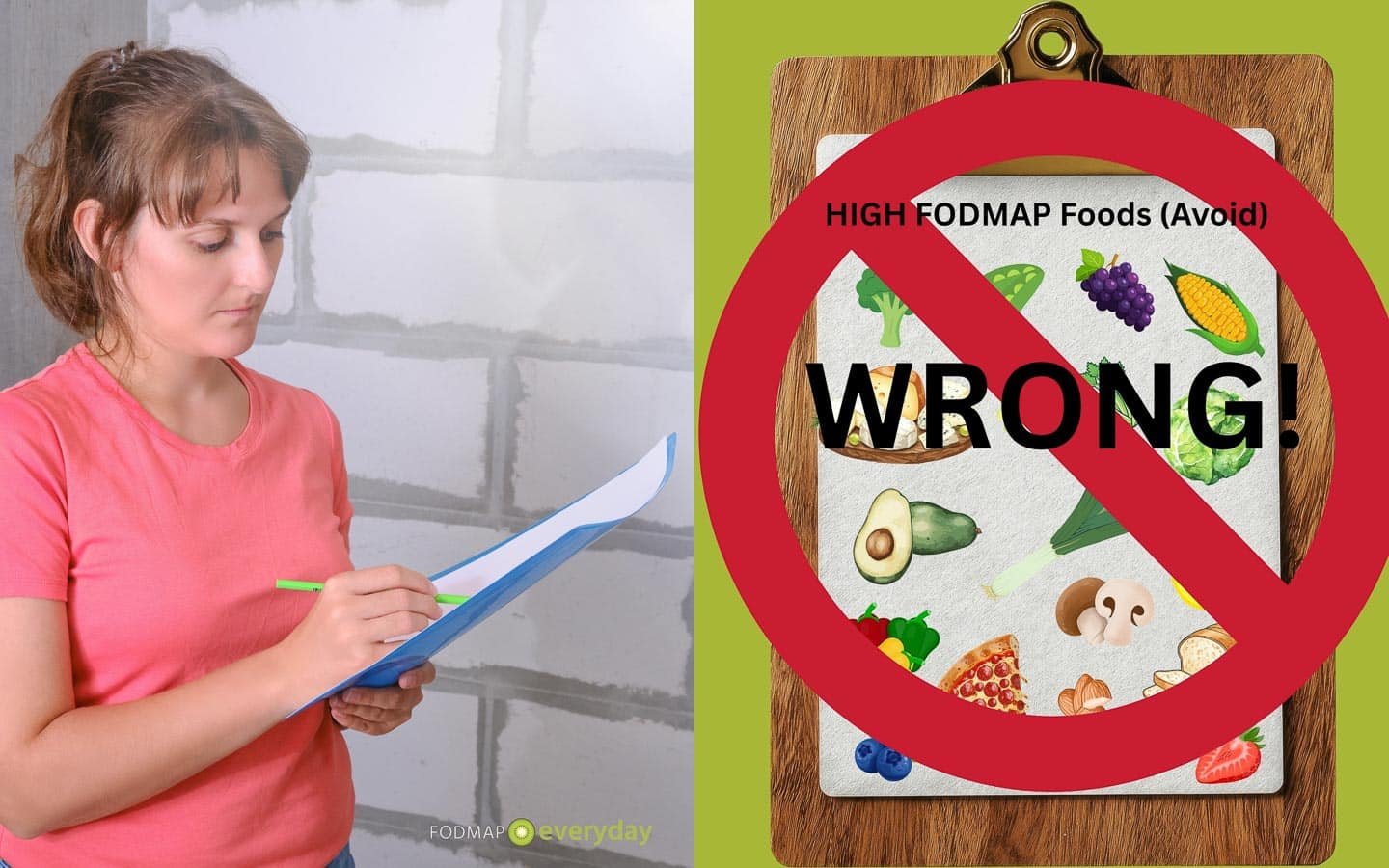
The concept of being strict in life often means that whatever we are applying ourselves to will yield better results, so it is a default position. Another reason is because people are misguided by their medical doctors who give them a sheet of paper with a list of “good” foods to eat, and “bad” foods to avoid, or they tell the patient to “go try the diet.” These scenarios are all too common and lead to over restriction.
Many popular lists make is seem as though entire foods and food groups are to be avoided, when that is not the case.
The Low FODMAP diet is:
- NOT gluten-free
- NOT wheat-free
- NOT bread-free
- NOT dairy-free
- NOT cheese-free
- NOT sugar-free
- NOT fat, protein, or soy free
- NOT FODMAP free; it is reduced in FODMAPs, even during Elimination, and this is a very important nuance.
On the Low FODMAP Diet, you:
- CAN eat many vegetables
- CAN eat many fruits
- CAN eat all kinds of whole grains and grain products
- CAN have a slice of wheat bread
- CAN have wheat pasta
- CAN have many dairy products
- CAN have beans
- Can have sugar in your coffee
- Can have all sorts of condiments
- CAN have alcohol
- CAN have snacks of all kinds
The Elimination Phase is meant to calm your gut. There are many low FODMAP fruits, vegetables, grains, and dairy options that belong on your plate, even during Elimination.
Following the diet in a structured manner—not more strictly—helps you get the information you need while still supporting nutrition, gut health, and quality of life. The goal is to progress toward a diet that is as varied, nourishing, and enjoyable as possible while keeping symptoms under control.
Structured, Not Strict

There is a difference between strict and structured. Hopefully you now see why strict might actually be the wrong approach for you. A FODMAP-trained Registered Dietitian can determine what is the best approach for your unique medical presentation. Doctors are not trained to do this; please work with a RD.
Structured, however, is the goal. A structured approach will help you navigate the Elimination Phase properly, which means many foods will be minimized, but no foods will be completely off-limits. And then, during the Challenge Phase, a structured approach will help you home in on the specifics of your unique FODMAP tolerances and intolerances. A Registered Dietitian will also help you understand your non-food triggers, which are often greatly overlooked.
Following the low FODMAP diet, throughout its three phases, should not involve additional stress, frustration, pain, or lack of answers. Following the three phases of the low FODMAP diet should provide you with a long-term solution to symptom management. Remember, the third Integration Phase will evolve overtime, and you will be able to eat broadly, which will provide adequate nutrition as well as a positive relationship with food.
Resources For You
- FODMAP Everyday® Global Registered Dietitian Directory
- The Role Of The Dietitian vs. The Gastroenterologist
- Have IBS? Top Reasons To Work With A Dietitian
- How To Choose A Dietitian
- Dietitians & Nutritionists: What’s The Difference?
- Patient Dos And Don’ts For A Great Telehealth Appointment
- Ins & Outs of the Low FODMAP “Gentle” Diet
- The Low FODMAP Diet Elimination Phase: Short & Sweet for Your Health!
- The “Low FODMAP Diet” is NOT Just About The Elimination Phase
- Your Guide To The Low FODMAP Diet Challenge Phase
- The Low FODMAP Diet Integration Phase