Is maple syrup low FODMAP? Yes!
Both Monash University and FODMAP Friendly have lab-tested maple syrup. Unfortunately, both of their app entries leave out a lot of information, and, various batches of lab testing have shown different results—and even different FODMAPs.
This article was updated in June 2026 after a major Monash app update. You will find everything you need to know about maple syrup in regard to the low FODMAP diet below, as well as general information about this fantastic natural sweetener.
- Maple Syrup FODMAP Content as Listed in the Apps
- Variable FODMAP Content of Maple Syrup
- Australian Healthy Eating Guidelines
- Let's Talk Maple Syrup
- Maple Syrup vs. Pancake Syrup
- Maple Grades & Colors
- Maple Sugar
- “Flavored” Maple Syrup
- How to Buy and Store
- FODMAP Everyday® Recipes Featuring Maple Syrup: Sweet & Savory
- Celebrate Maple Syrup
Maple Syrup FODMAP Content as Listed in the Apps
For almost a decade, the Maple Syrup entry in the Monash University app showed that it contained no FODMAPs. The low FODMAP serving size was listed as 50 g (50 ml) or 2 Australian tablespoons. No additional information was given.
During the June 2026 update, the listing changed dramatically. This batch of lab testing showed fructan FODMAP content. The Monash app now shows a low FODMAP serving of maple syrup to be 1 tablespoon (20 ml), becoming Moderate for FODMAPs at 2 tablespoons (40 ml), and High FODMAP at 2 ½ tablespoons (51 ml), with fructans as the detected FODMAP.
FODMAP Friendly has lab-tested maple syrup, and they state that a 50 ml serving is low FODMAP, which they peg at 2.5 tablespoons. They put a max serve at 1000 ml, or 50 tablespoons. No fructans were detected; fructose was present at very low levels.
At first glance, the results seem contradictory. How can one laboratory analysis find no detectable FODMAPs while another identifies fructans in the same ingredient? The answer involves the realities of food testing, natural variation in maple syrup, and the way low FODMAP serving sizes are determined.
Please review our articles, When Low FODMAP Lab Tests Differ and What Is a Low FODMAP Serving Size? as primers for the rest of this article.
Variable FODMAP Content of Maple Syrup
Many of us were surprised when recent laboratory testing identified fructans in maple syrup. Earlier analyses had reported no detectable FODMAPs. So what happened?
The short answer is that maple syrup is a natural agricultural product, and natural products are not identical from one batch to the next.
To better understand why test results of maple syrup can vary, we spoke with Mark Isselhardt, University of Vermont Extension Maple Specialist.
Maple Syrup Is Not a Uniform Product
Unlike highly standardized manufactured foods, maple syrup begins as tree sap and is influenced by many variables before it reaches your table.
The exact composition of a particular syrup can vary based on:
- Weather conditions during the sugaring season
- Tree species and genetics
- Geographic location
- Soil conditions
- Early-season versus late-season sap collection
- Storage and processing conditions
Researchers have long known that maple sap changes throughout the season. Syrup produced from different sap runs may not have exactly the same chemical composition.
Maple Sap Is a Living Biological Material
One factor many consumers never consider is the lack of sterility in maple sap.
As Isselhardt explained, “Maple sap is not sterile. Environmental and microbial contamination can occur from the tree itself, collection systems, and processing.”
Those naturally occurring microorganisms can influence the chemistry of the sap and, ultimately, the syrup produced from it. Researchers have documented changes in carbohydrate composition as sap ages and undergoes natural biological activity.
Isselhardt noted that “heat, fermentation, and microbial activity can change the carbohydrate profile of maple syrup.”
Cooler versus warmer seasons affect sap quality, too. Isselhardt explained that warmer seasons generally yield lower-quality and more fermentation due to exposure to bacteria, yeasts, and mold.
While these changes are most often discussed in relation to flavor development and syrup quality, they demonstrate that maple syrup is not a chemically static product. Any of these could explain the difference in FODMAP content.
Blending Adds Another Layer of Complexity
According to Isselhardt, about 90% of the syrup that reaches the mass market is a blend. What is in that bottle did not come from a single producer, location, or harvest period.
“Syrup producers often blend syrup to achieve a consistent color and flavor profile from year to year. They might even blend a four-year-old harvest with a more current one… The syrup ultimately purchased by consumers may represent a blend of multiple harvests, producers, and production conditions,” explains Isselhardt.
We know that Monash buys multiples of a product for testing. Let’s say they bought six bottles of syrup. If each of those bottles represents blends from multiple sources, then they are really testing syrup from an unknown number of sources, any one of which could have been a fermented or contaminated product (we are focusing on the FODMAP perspective here), thereby skewing the combined test batch.
And keep in mind, the bottle you purchase literally cannot be the same as what was tested.
From Isselhardt: “In the US, we have packers, who draw from hundreds, even thousands of maple syrup producers, and they blend product on demand. Could you have a batch of syrup that had experienced fermentation, which was blended with others? Sure, it is possible.”
What Does This Mean for Low FODMAP Diets?
The appearance of fructans in a newer laboratory analysis does not necessarily mean that maple syrup has fundamentally changed. Rather, it highlights an important reality of food composition research: laboratory results reflect the specific sample that was tested.
As Isselhardt summarized, “Maple syrup is not a uniform product; it is a wild food. Factors such as seasonality, microbial activity, storage, fermentation, and blending can all contribute to natural variation between samples.”
The Bottom Line
Differences in maple syrup test results do not necessarily mean that one laboratory analysis is right and another is wrong. Food composition can vary naturally, and laboratory testing reflects the specific sample analyzed at a particular point in time.
For people following the low FODMAP diet, there are four important takeaways:
- Laboratory testing of natural foods is expected to show some variation.
- Serving sizes provided by laboratory testing are guides, not absolutes. They are a starting point for understanding your own tolerance levels.
- Newer test results are not necessarily “better” than older ones. They simply reflect the particular sample that was analyzed.
- And guess what? If you have been enjoying maple syrup without any digestive upset, there is no reason to change your approach!
And Isselhardt’s parting statement in regard to the June 2026 Monash update: “The sample size is not comprehensive enough to hang your hat on.”
For this reason, FODMAP Everyday® follows the most current laboratory data available while recognizing that natural foods, including maple syrup, are not always identical from one batch to the next.
Australian Healthy Eating Guidelines
Now let’s take a look at the serving sizes. One thing that is rarely discussed, but is vitally important to understand when using the Monash University and FODMAP Friendly smartphone apps, is that the serving sizes shown are not only presenting FODMAP information, but they are also dictated by Australian Healthy Eating Guidelines. White sugar contains no FODMAPs, but the researchers are not going to tell you to eat unlimited sugar. The serving size of white sugar in the app is based on the government’s healthy eating guidelines. Same goes for maple syrup.
Since FODMAP Friendly’s test shows no FODMAPs detected, their small serving size is due to the government’s suggested serving sizes, but they also include the max serve suggestions, which we appreciate.
Let’s Talk Maple Syrup
The FODMAP Everyday® offices and Test Kitchen are smack dab in the midst of New England in Massachusetts and this is maple syrup country!
Save this article
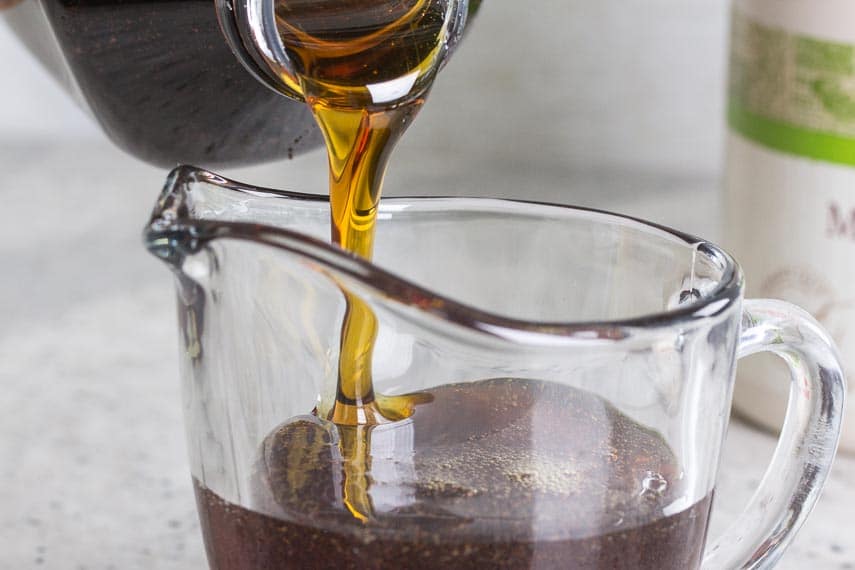
Thankfully, maple syrup is low FODMAP and we take advantage in both sweet as well as savory baking and cooking.
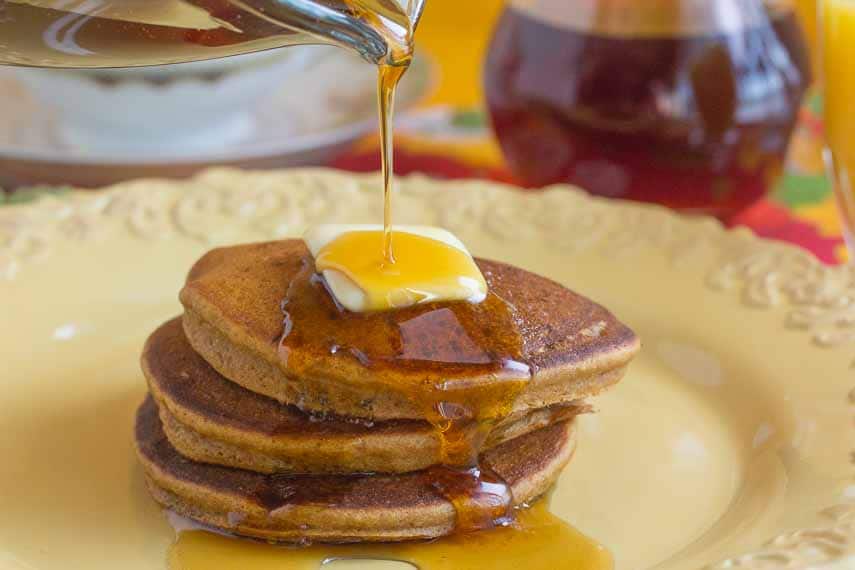
Sugaring Season
Maple syrup comes from maple trees, which are plentiful around here. Vermont and areas of Canada are also huge maple syrup producers. In late winter and early spring when the nighttime temperatures dip down to the 20s and the daytime temperatures are in the 40s (Fahrenheit), the maple trees will be tapped.
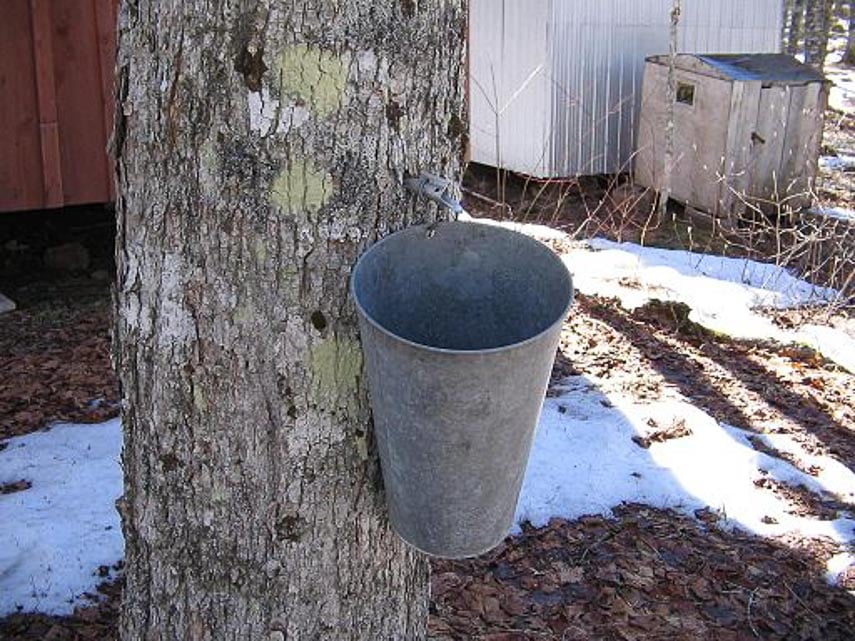
Some folks even tap the trees in their own backyards. The simplest way is to tap the tree and set a bucket underneath to collect the sap, as seen above. More sophisticated systems will use taps and hoses which flow to one main hose that connects several trees, such as in the image below.
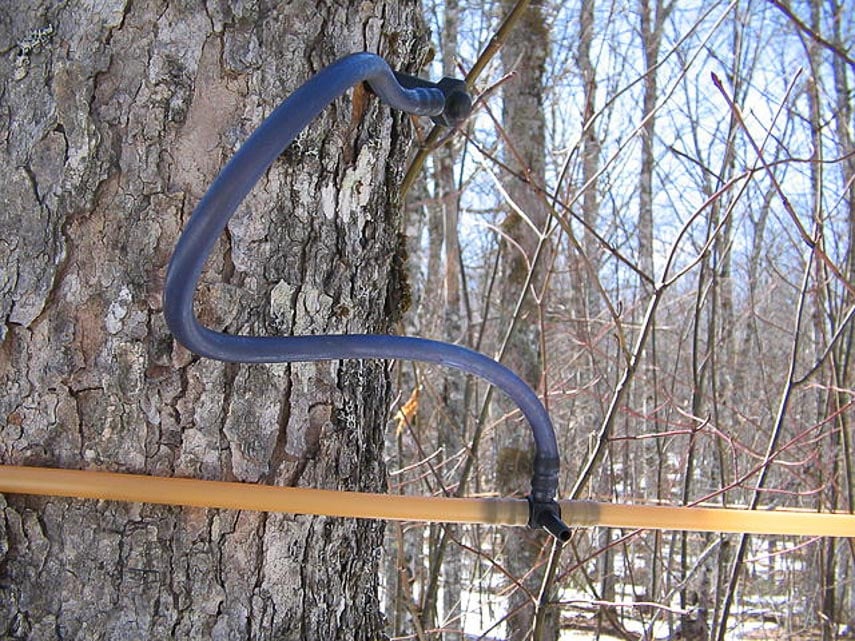
And yet another way is a hybrid of these two with each tree tapped with its own hose that empties into a bucket or even a bag hanging from the bark to collect the sap. The sap flow also reacts to atmospheric pressure in addition to temperature. When the pressure inside the trees is greater than externally, the sap will flow well.

Once the sap is collected it has to be boiled down and it takes 40 quarts of sap to make just 1 quart of maple syrup, which is why it can be pricey.
Maple Syrup vs. Pancake Syrup
It should go without saying that we are talking about pure maple syrup here. There is no other ingredient other than “maple syrup.” There are many syrups that kind of look the same called “pancake syrup,” and these are loaded with other sugars, often high FODMAP high fructose corn syrup (HFCS), so not only are these not nearly as delectable and maple-y, but they would also be high in FODMAPS. Steer clear. They are not worth the calories, as far as we’re concerned.
Maple Grades & Colors
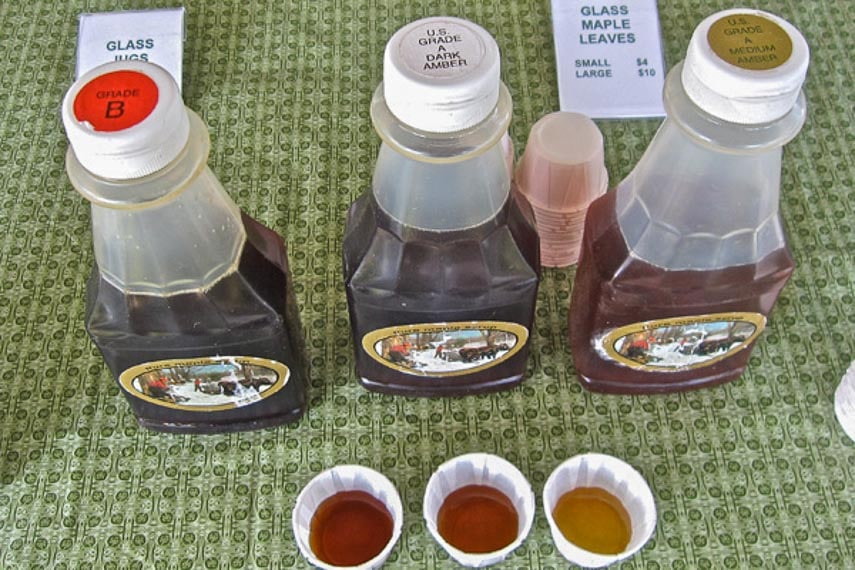
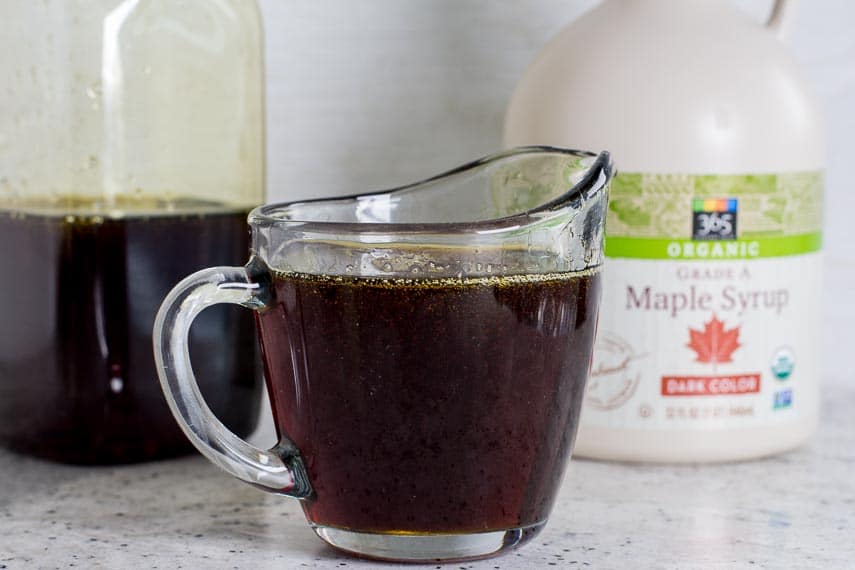
Maple syrup comes in different grades and colors and they each have their own flavor profile. In general the darker it is, the more robust the flavor. Some are very pale, light golden liquid and some is as dark as molasses.
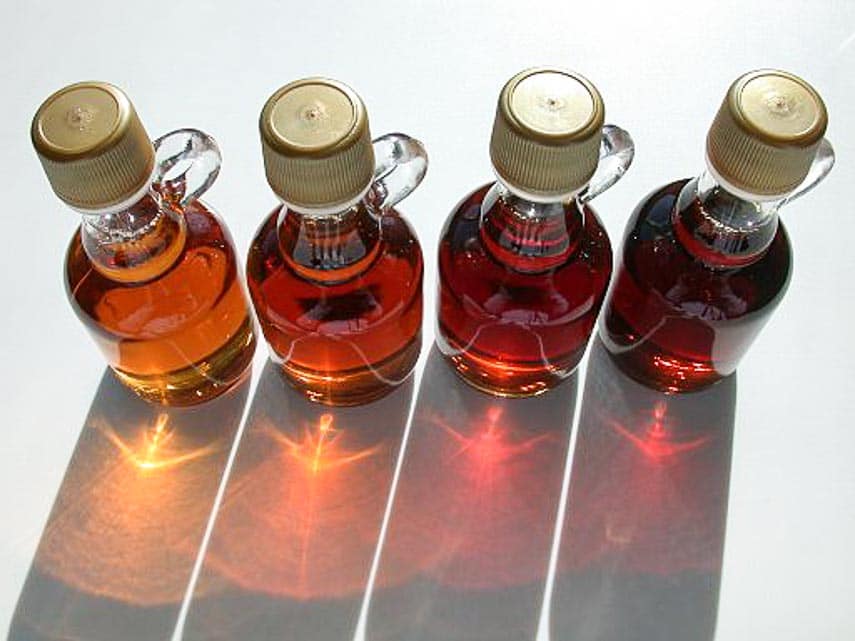
Canada produces quite a lot and until fairly recently the U.S. and Canada used different grading systems, which was not helpful to the consumer. In 2014 a transition took place to create a universal system. You can see in the image below what the old labeling was on the right, and what the new labeling and language is on the left.
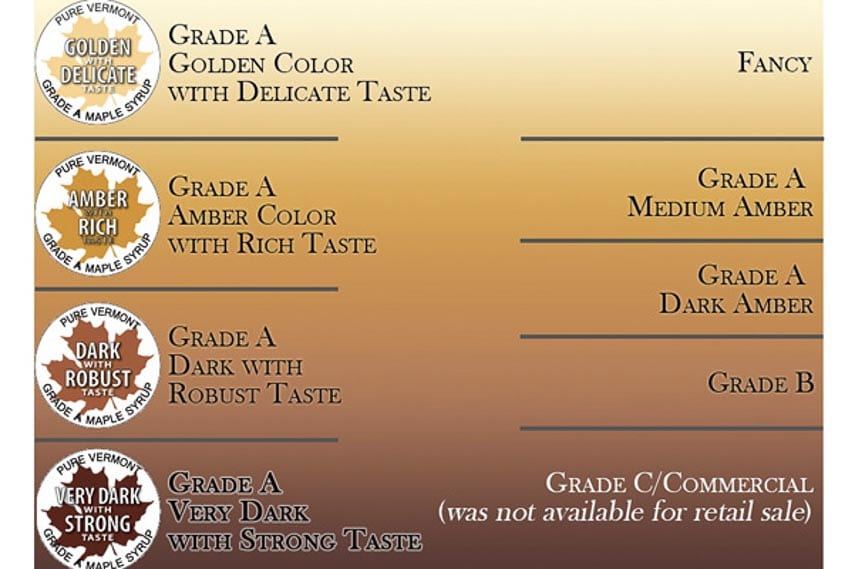
The issue was that “Grade B” sounded like it was subpar, when that was not the case. I actually like the darker colored and flavored maple syrups for baking for their more pronounced maple flavor. But they are all delicious and can be enjoyed in moderation while on the low FODMAP diet.
Maple Sugar
FODMAP Friendly has lab-tested maple sugar. Low FODMAP servings are 20 g, which is about 4 teaspoons, with a max low FODMAP serve of 40 g. It contains fructans, and a small amount of GOS.
Maple sugar is made by further reducing maple sap. The sap is reduced by a factor of 40 to make maple syrup, and further reduced and stirred to encourage crystal formation, creating maple sugar. Nothing is added.
The fact that this processing of maple syrup into sugar shows fructan content might relate to what was most recently found in the Monash June 2026 update for syrup. But, without more information, this is just conjecture. And one thing we have learned over the years about the low FODMAP diet is not to extrapolate.
“Flavored” Maple Syrup
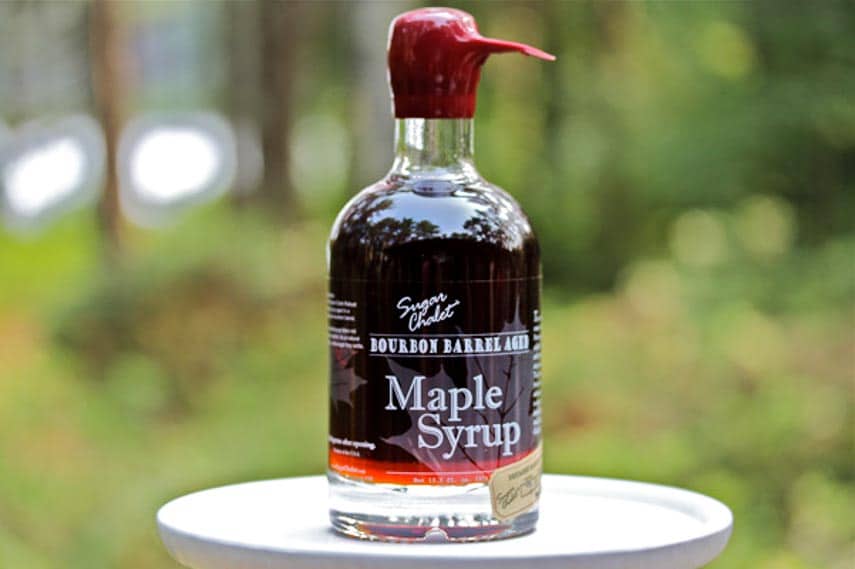
Several years ago at the Summer Fancy Food Show in NYC I came across a new treatment for maple syrup. Producers were getting experimental and aging the maple syrup in bourbon or whiskey casks. The ingredient is still just maple syrup and is non-alcoholic but the heady aromas in the wood of the casks becomes infused within the maple syrup. These are incredible flavor experiences that we heartily recommend.
Runamok Maple of northern Vermont not only offers both bourbon and whiskey barrel-aged maple syrups but also a smoked version, which is absolutely incredible in savory recipes and cocktails. Again, the ingredients are just pure maple syrup. They even have a rum barrel-aged version, and since rum is off limits for FODMAPers, we are intrigued since there is no rum proper in the syrup. Pure maple syrup, as seen below, can make a fantastic host gift.
How to Buy and Store
At the Test Kitchen we like to buy ours in bulk, as it is often the most economical and we recommend it if you have access. At the very least, always read the label. You should be buying pure maple syrup with no additional ingredients.
Store refrigerated in an airtight container, preferably glass or plastic, once opened. It will last a while – some say a year, others say indefinitely. Taste it. It should taste like pure maple with no fermented qualities, in which case it has gone bad, but this is very rare if it is uncontaminated.
FODMAP Everyday® Recipes Featuring Maple Syrup: Sweet & Savory
We think you will enjoy working with maple syrup as much as we do. Try our:
- Maple Glazed Carrots & Parsnips
- Sticky Maple Ginger Soy Glazed Chicken Wings
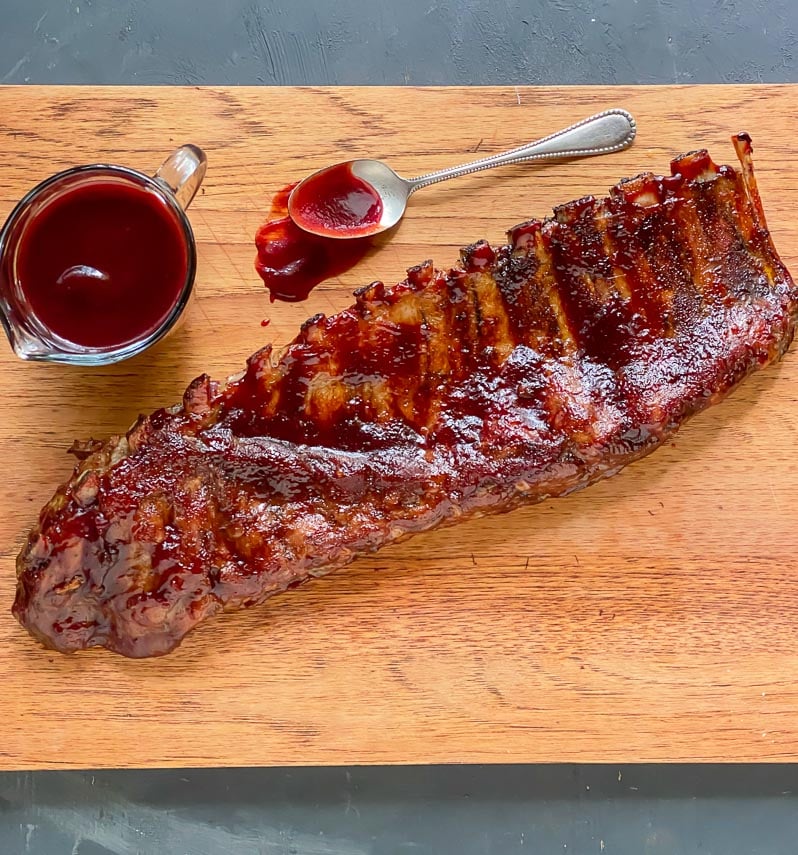
- Pork Loin with Maple Mustard Sauce
- One-Bowl All-Purpose Maple Mustard Sauce
- One-Pan Chicken, Carrots & Potatoes with Maple Mustard Sauce

- Maple Pumpkin Pie
- Maple Pumpkin Spice Granola
- Gluten-Free Browned Butter Maple Bars
- Maple Lime Low FODMAP Sports Drink
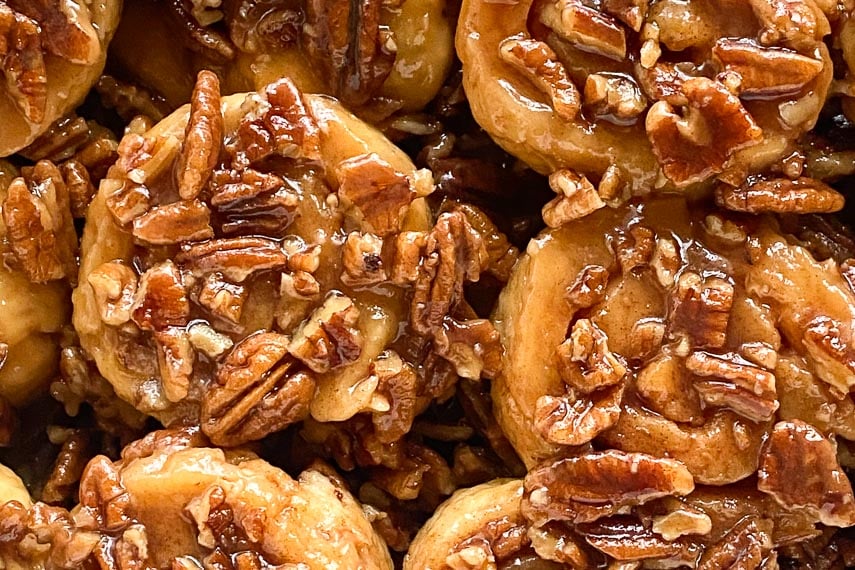
- Gluten-Free Caramel Pecan Sticky Buns
- Maple Balsamic Chicken with Roasted Blueberries
- Maple Mocha Cake
- Maple Blueberry Compote
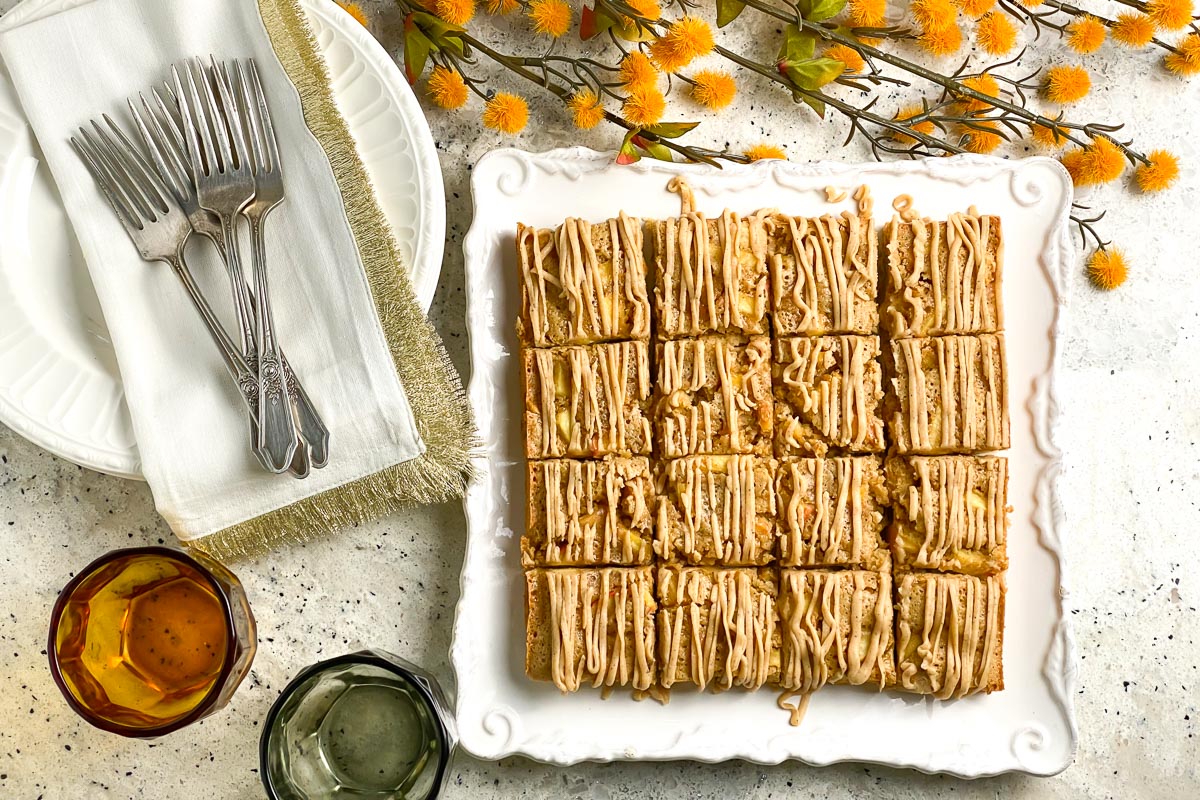
- Browned-Butter Apple Bars with Cinnamon Maple Frosting
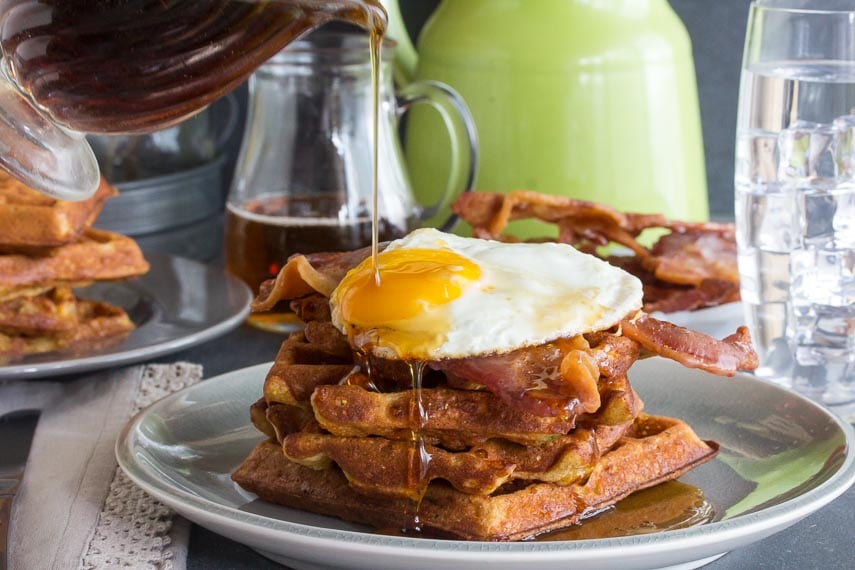
- Maple Pecan Scones, and of course, any of our luscious low FODMAP pancakes or waffles with a drizzle of pure maple syrup.
- Or check out this collection: 15 Best Low FODMAP Maple Syrup Recipes for Spring – Sweet & Savory Ideas.
Celebrate Maple Syrup
And if you are anywhere near northern Vermont, be sure to check the Vermont Maple Festival website for the dates of the annual festival, at the end of April. There are vendors and tastings, music, a craft and antique show, sugarhouse tours, a maple BBQ, children’s programming, talent show, cooking contest and more. You could be crowned that year’s maple ambassador!
If you want to read about other sweeteners and sugar, please check out our article Explore and Ingredient: Sugar & Sweeteners.

